Guide
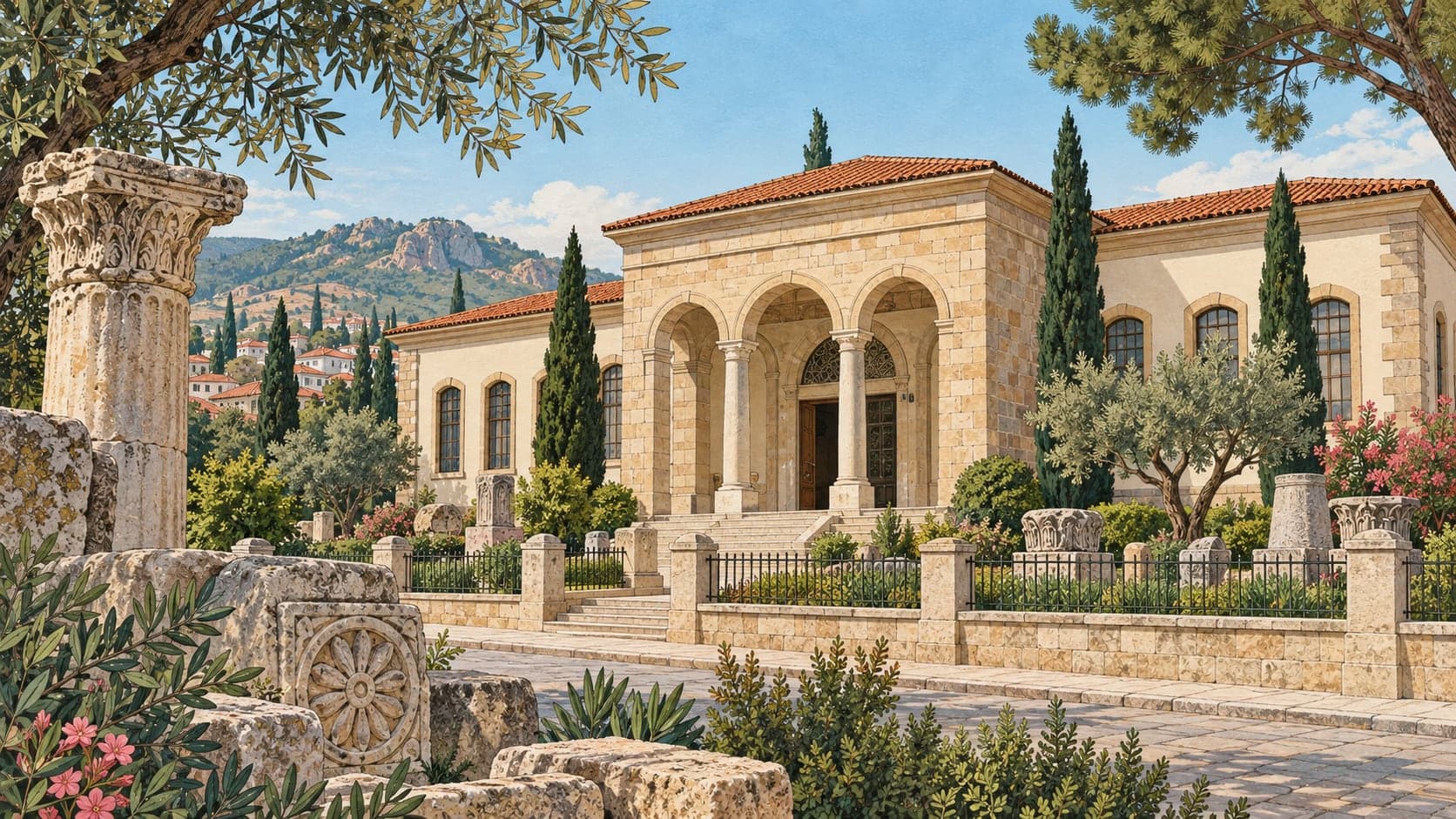
Akhisar Museum is an archaeological and ethnographic museum standing opposite the ruins of Thyatira, run under the Manisa Museum Directorate, and open to visitors since 18 May 2012. It has 650 square metres of enclosed gallery space and a further 1,250 square metres of open-air display in the garden, and is arranged in two main parts, archaeology and ethnography.
The archaeology section shows coins of Thyatira, gold objects of the Lydian period, Early Bronze Age pottery of the Yortan culture and the Gökçeler relief, alongside other Hellenistic, Roman and Byzantine material from Akhisar and its surroundings. The ethnography section shows embroidery, clothing, carpet-weaving objects and seals from the traditional life of the town, and within it a part called the Arasta is given to trades particular to the region — tobacco working, felt making, the driving of horse carriages, and saddlery — with the tools belonging to each. The pieces were assembled by donation, purchase and seizure, and by transfer from the Manisa Museum when this one was founded; 1,051 objects were on display in the opening year and 689 as of 2019.
The building has served the town in several roles. It was put up in 1932 by Ayşe Aloğlu as a two-storey hospital in memory of her son Ali Şefik, who had died young of illness, and named the Ali Şefik Hospital. At the request of the administration of the day, and with her permission, it was assigned to the Ministry of Education to be used as a school; it was the Ali Şefik Middle School until 1992 and then, after alterations, the Ali Şefik Teachers' House from 1994.
Its conversion to a museum was not a quiet process. Finds from excavations around Akhisar were being kept in storage because the Manisa Museum had run out of room, and with digs continuing the need for display and storage grew; Akhisar's position at the crossing of the İstanbul–İzmir and Bergama–Denizli tourist routes, and the presence of Thyatira, made the case for a museum in the town. Work began at the initiative of Kefayettin Öz, then head of the culture and tourism commission of the Manisa provincial assembly, and the site — at that point still the teachers' house — was assigned on 4 September 2006. When the closure of the teachers' house came up in 2005 it caused argument in Akhisar: the local branch of the union EĞİTİM SEN held that the closure was politically motivated and organised protests joined by townspeople, and although officials replied that the building would become a museum and that this would add to the town's cultural heritage, the dispute over the reasons did not end. Use as a teachers' house ceased in 2007.
The restoration then ran long. Tendering began in 2007 and a survey of the building was made that March; the Ministry of Culture and Tourism covered the shortfall in the budget, announced as 2.1 million lira in total. Because the building stands inside a protected site, design and permission took time. Once work started it became clear that the building as it stood did not match the project: when the plaster was stripped from the outer face, changes accumulated over the years showed that the existing plans could not be met, technical experts reported as much, and new projects had to be put to the conservation boards and approved. The changes, a fresh tender and the demolition of the second floor brought the work to a halt and stretched it further. A building meant to be finished by the end of 2007 was completed after six years at a cost of 1,537,897 lira, opened to the public on 18 May 2012, and formally opened on 6 August 2012 by the minister of culture and tourism, Ertuğrul Günay.
Visit status for this record: open to visitors.