Guide
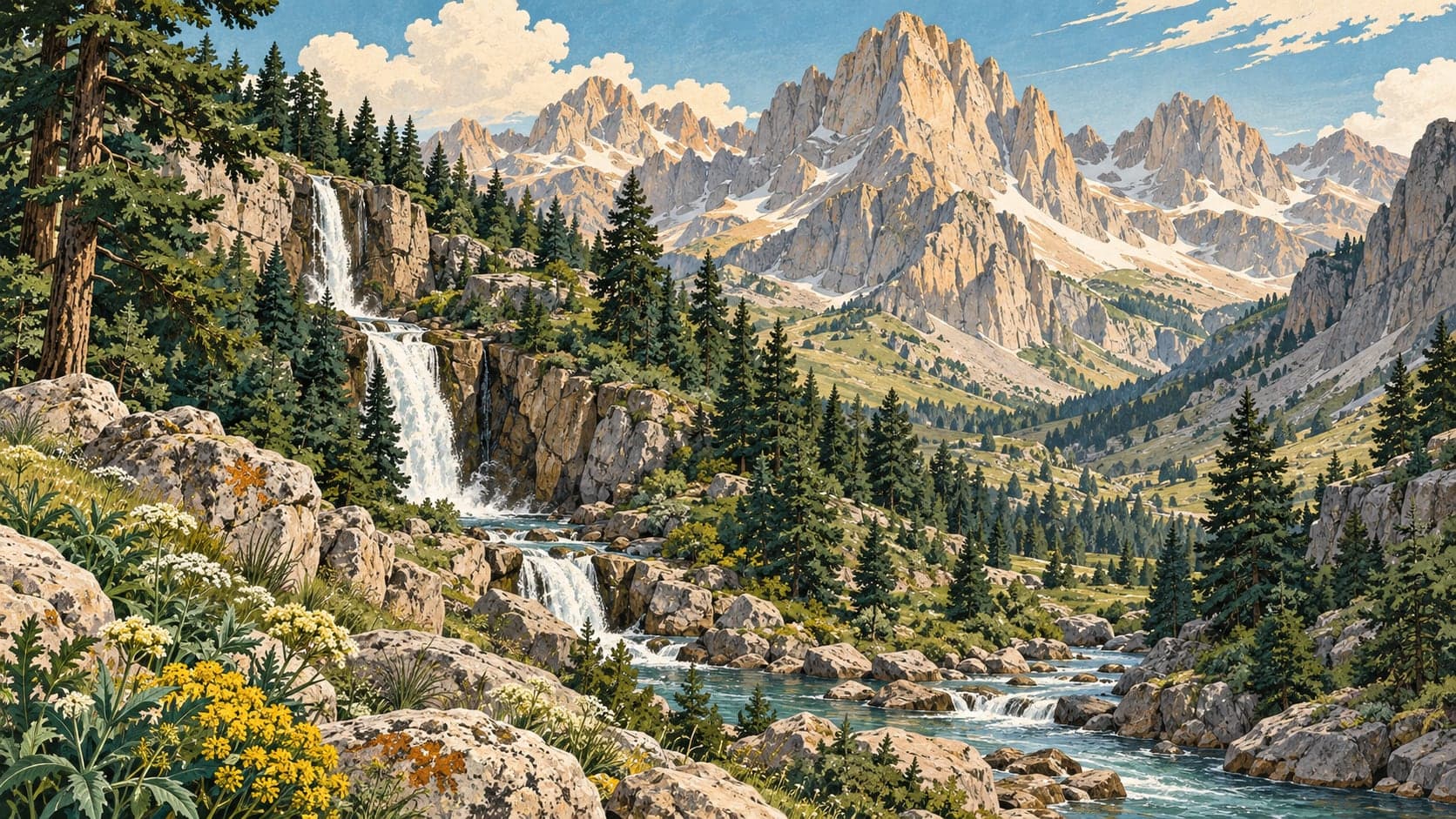
The Aladağlar are a mountain range lying between the provinces of Niğde, Kayseri and Adana, rich in plant and animal life. A stretch of 54,524 hectares was first protected as the Hacer Forest Nature Park, and in 1995 a slightly larger area of 55,065 hectares was declared a national park. The range holds the highest summits of the Taurus mountains and is among the most geologically interesting parts of the country; the glacial lakes and the Kapuzbaşı waterfalls are the sights most worth seeing.
Red pine grows in the lower parts of the park, with cedar, black pine and fir higher up, and above the tree line alpine meadows rooted among the rocks. Endemic plants are unusually numerous. The southern side has a Mediterranean climate and the northern a continental one, and the northern slopes carry the steppe species of the Irano-Turanian group, where human pressure is enlarging areas of anthropogenic steppe. Wild goat, wild boar, wolf, jackal, marten and souslik live here; among the birds are the golden and lesser spotted eagles, the bearded, griffon and Egyptian vultures, and the Caspian snowcock, which birdwatchers come particularly to see. Many lakes form from the melting snow in spring, and most evaporate in the dry summer; only the few fed also by groundwater remain.
The highest summit is Kızılkaya at 3,771 metres. Four peaks rise above 3,700 metres and more than fifty above 3,500, and the range is one of the most sought-after climbing grounds in Türkiye for climbers from the country and abroad, with high rock walls, deep valleys and glacial lakes. Professional climbing here goes back more than a century: the first recorded ascent was the geologist Franz Schaffer's climb of Alacabaşı in 1901, and in the summer of 1927 an expedition by the European climbers Georg Künne, Wilhelm Martin and Marianne Martin made the first ascents of Demirkazık, Kızılkaya, Eznevit, Kaldı and Alaca. Walking, birdwatching and camping are the other activities. Outside the park boundary — at Çukurbağ and Demirkazık to the north, Ulupınar and Kapuzbaşı to the south — there are tour operators, guides, guesthouses and bungalows.
This is also the range where Türkiye records the most mountaineering accidents, which the source attributes above all to the sheer number of training courses, climbs and walks held here compared with other mountains; falls and avalanches account for most fatal accidents in the country, and the first death recorded here was that of Engin Kongar in 1956. Climbers are asked to inform the gendarmerie of their climb so that contact can be made in an emergency. A circular issued after an accident on Uludağ requires written permission in advance for any climb undertaken in Türkiye for mountaineering purposes; this has been disputed, with many climbers holding that a permit runs against the spirit of the sport, and as of December 2022 its application was inconsistent. Anyone without experience should climb only with a guide.
When to go
Climbing is possible in any season, but the decision belongs to the climber's own knowledge, experience and fitness. Winter brings heavy snow, blizzards and wind, and temperatures stay below freezing for long spells. Spring, as temperatures rise, is when avalanches are most frequent, and anyone climbing between February and May should pay particular attention to avalanche conditions. Activity increases in June and July, when the weather warms, the snow thins, the days are longer and water sources are plentiful. August and September have the most stable weather and very little rain; they suit climbing too, but towards the end of summer the water sources dry up and climbers must carry their own water.
- Designated
- 21.04.1995
Entry fee
- Mediterranean group 2 · category 1 · Per person
- 65 ₺
- Marmara group 3 · category 1 · Per person
- 65 ₺
- Black Sea group 1 · category 1 · Per person
- 75 ₺