Guide
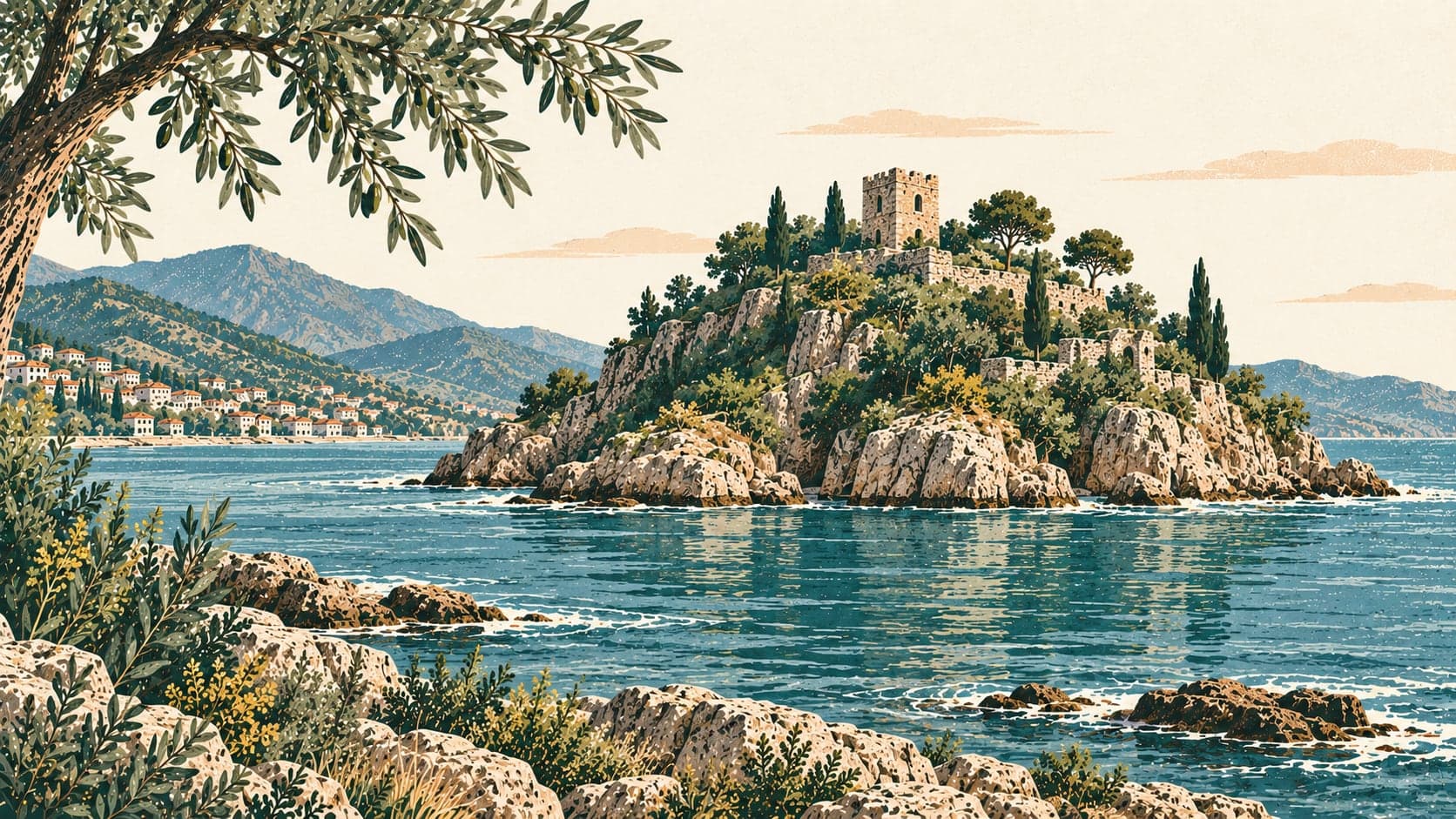
Giresun Island is one of only two islands belonging to Türkiye in the Black Sea, the other being Kefken. It lies 1.6 kilometres off the shore and covers 40,000 square metres. It is a second-degree conservation site, visited on day trips in summer for picnics, with boat tours running from Giresun harbour.
Seventy-one native herbaceous and woody plant species grow on it, Mediterranean bay and black locust above all, and ten further tree species have since been introduced. It is one of the places in the Black Sea where cormorants and gulls breed naturally, and migrating birds stop and rest here.
The remains on the island show it was ringed by walls; the masonry technique is the same as that of Giresun castle, and the walls are thought to date from the Pontic period. Among what survives are wall remains and a watchtower still standing, the ruins of a shrine and the site of a temple, and two great wine jars. Historical sources say that Amazon queens had a temple built here to Ares, the god of war, and that the island held the monastery of Phokas, bishop of Sinop; there are also the remains of walls, towers and a monastery serving as inner citadel built in the time of Alexios II, historic terracotta casks and the foundations of some buildings. The Genoese and the Venetians used the island for a long time as a shelter for ships.
At the eastern end stands the Hamza Stone, a standing stone from antiquity: a stone resting on three legs like a trivet, taken to represent the mother goddess Cybele and the culture of the hearth and the family. Held sacred and given a past of four thousand years, it is a wishing stone and, by religious belief, a source of hope and mystic power for the old. Each year on 20 May, during the International Aksu Festival, people pass through the trivet in the belief that it secures the continuation of the line, and complete the rite by walking round the island; the circuit begins and ends at the Hamza Stone.
The island is known in world mythology and history under several names: Aretias and Areionesos in antiquity, Nesos, Area, Areos, and Chalceritis, the name the Romans gave it. One tradition holds that it was formed when a piece broke away from Gedikkaya, the rock south-east of the city whose shape recalls an eagle's beak, and settled in the sea. The Roman scholar Pliny writes in his Historia Mundi of an open-air shrine on the island dedicated to Mars, the god of war: opposite Pharnacia, he says, lies Chalceritis, the Arias of the Greeks, consecrated to Mars, where the birds are said to fight strangers off by beating their wings.
The island appears in the Argonautica as the second-to-last stop on the outward voyage of the fifty heroes who sailed from the Greek mainland in the fifty-oared Argo for Colchis at the eastern end of the Black Sea to take the Golden Fleece. As the Argonauts were about to reach the small island of Ares opposite Giresun — Kerasos in antiquity — they were attacked by wild birds that dropped feathers as hard as iron each time they passed overhead. To guard against them they recalled the trick Herakles used against the Stymphalian birds in the sixth of his labours: half the crew rowed while the other half held their shields and spears above their heads to roof the deck, and then, as Herakles had done, they drove the birds off by making noise. Having escaped, the heroes spent the night in the hollows of the island's rocks and sailed on in the morning for Colchis. In 1984 a research team under the captain Tim Severin, seeking to reconstruct the voyage, had a replica of the Argo built without a single nail and rowed it to Giresun Island; the journey, which National Geographic also joined, was made into a documentary by a twelve-person BBC television team, and the island became known worldwide. The subject is treated in more detail in Pliny and in the Argonautica of Apollonius, who lived between 295 and 195 BC.
Two other stories are told of the island. In one, many noblemen wish to marry the young and beautiful daughter of King Mithridates, but she wants none of them, being in love with a shepherd who grazes his sheep below the castle; the king, angered, shuts her in the monastery on the island, has the shepherd seized and hanged from the cherry tree before it, and the next day she hangs herself from the monastery tower. In the other, the children of Israel make a golden statue of Joseph and, having left Egypt for Palestine, ask Moses to bring it; he brings it by a miracle, the Phoenicians take it to Cyprus, the Greeks take it from Cyprus to Mount Olympus, and when the Persian emperor Darius takes Anatolia and Greece he returns it to Egypt. It passes back to the Phoenicians, who bring it to the island of Aretias, and the Greeks are said to have attacked Giresun Island forty times to take it.