Guide
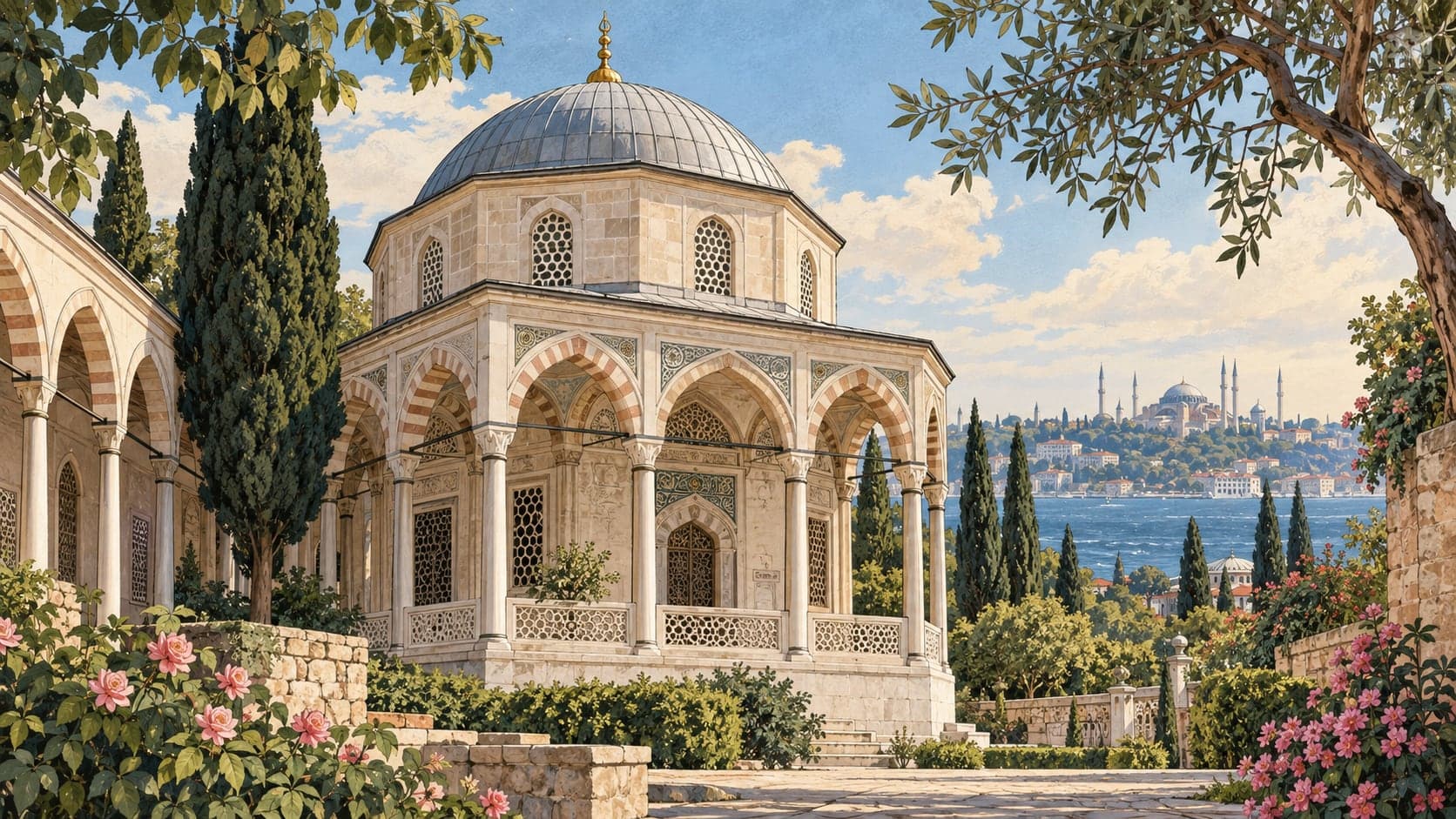
A white marble tomb with twelve oval faces, two rows of windows and a dome, and one of the clearest pieces of Ottoman baroque in Eyüp. Engaged columns and angular pilasters stand between the windows on each face; horizontal mouldings above and below the openings, with those columns and pilasters between them, divide the elevations into fields, and coloured stone is used to considerable effect. The window arches have an S profile with a stylised scallop on the keystone, the lower ones closed with cast-iron grilles and the upper ones with leaded glass.
The entrance is a three-part porch, domed in the middle and vaulted at the sides, its inner surfaces covered with painted decoration; the round arches rest on columns with cushions and imposts, and the one before the door is higher and wider than the rest. The door itself is of black and white marble with the same S-profiled, scallop-keyed arch, and above the Qur'anic inscription a crown of S and C curves is edged inside and out with acanthus and palmette. Two columns frame the doorway on each side, with a rectangular window to left and right.
Of the twelve faces one is the entrance, the two beside it are worked inside as cupboard niches, and nine carry windows in two rows, the upper ones glazed in colour. Twelve columns inside ease the transitions at the corners. The Qur'anic inscription in celî sülüs above the lower windows and the medallions above the upper ones — the names of God and of the Prophet, of the four caliphs and of Hasan, Hüseyin, Saîd, Sa'd, Zübeyr and Talha — are the work of the calligrapher Mahmud Celâleddin Efendi, and the painter was Mehmed Şevki. The inside of the dome is painted with wavy bands in yellow, white, red, green and blue that spring from a round medallion at the centre and divide into twelve arms, with baroque S and C scrollwork filling the spaces between them and running round the skirt.