Guide
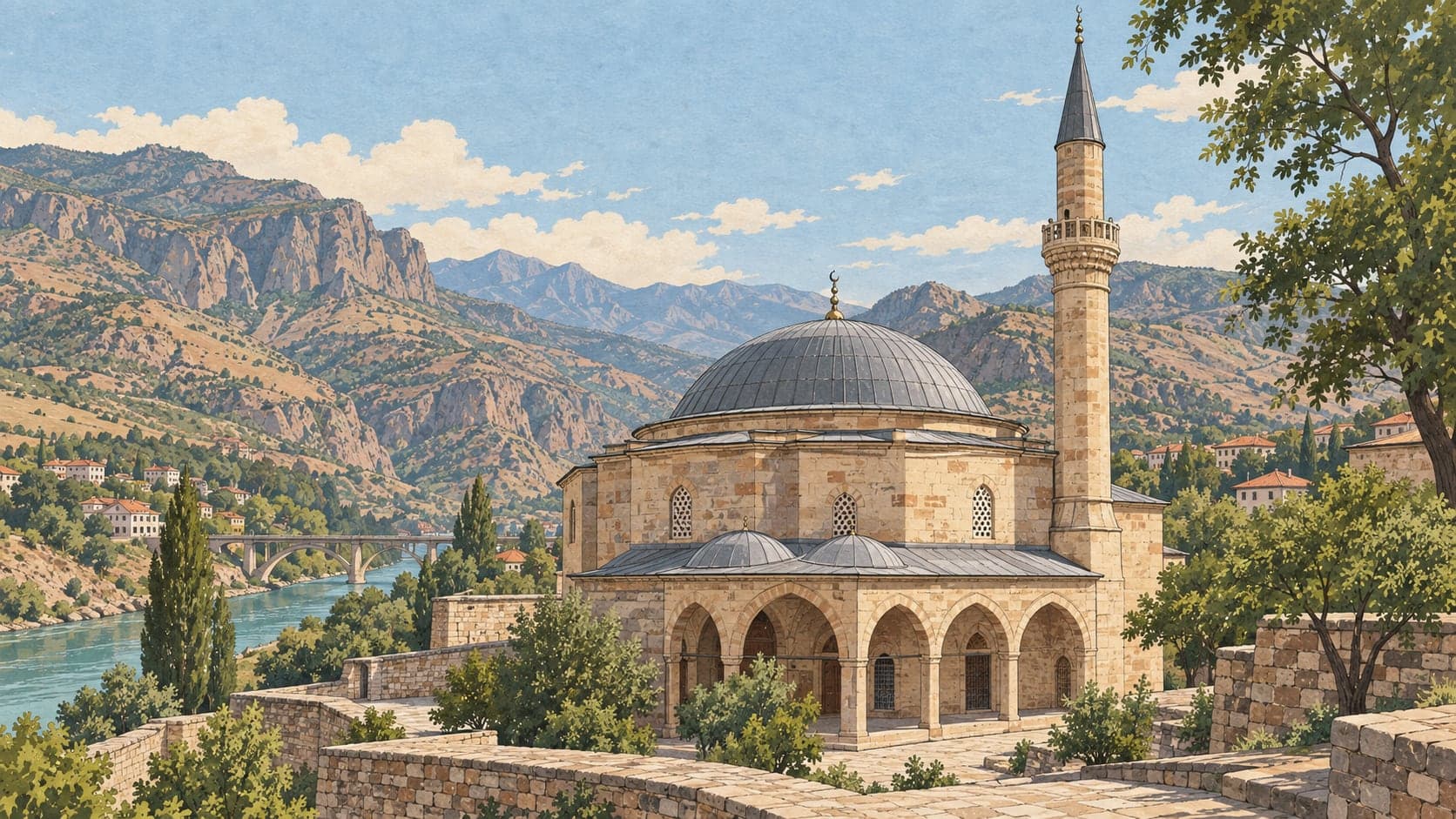
The Yelmaniye Mosque stands on a hill commanding the district town of Çemişgezek, in the Tepebaşı quarter that people still call Medrese. It was not built as a mosque. It is thought to have been founded as a medrese between 800 and 809 in the Hijri calendar, in the time of Timur, by the emir Taceddin Yelman bin Keykubat bin Halid el-Kurdi; the inscription itself gives 806, and records that the just ruler Taceddin Yelman ordered the building of this blessed medrese in the days of Timur Khan. Because it was later used for prayer it is also known as the Medrese Mosque.
The building has clearly been repaired and altered continually, and traces of other structures lie around it. Foundation remains extending to the south show it stood within a group of buildings: the main southern section was where teaching took place, while the northern part held the students' rooms and the kitchen. The mosque is cut stone on sloping ground, and the iwan-shaped portal on the west front is the only part that has kept its original form. It is monumental in scale, with careful stonework, framed by bands of geometric ornament. Look at the octagonal, geometrically carved columns on either side of the door: they turn on their own axes as the door opens. The mosque has a single dome and no minaret. The mihrab is set about with green tiles, and the combination of tile and stone makes it the striking feature of the interior; the minbar beside it is plain. The building sits between the Seljuk and Ottoman manners as a transitional work.