Guide
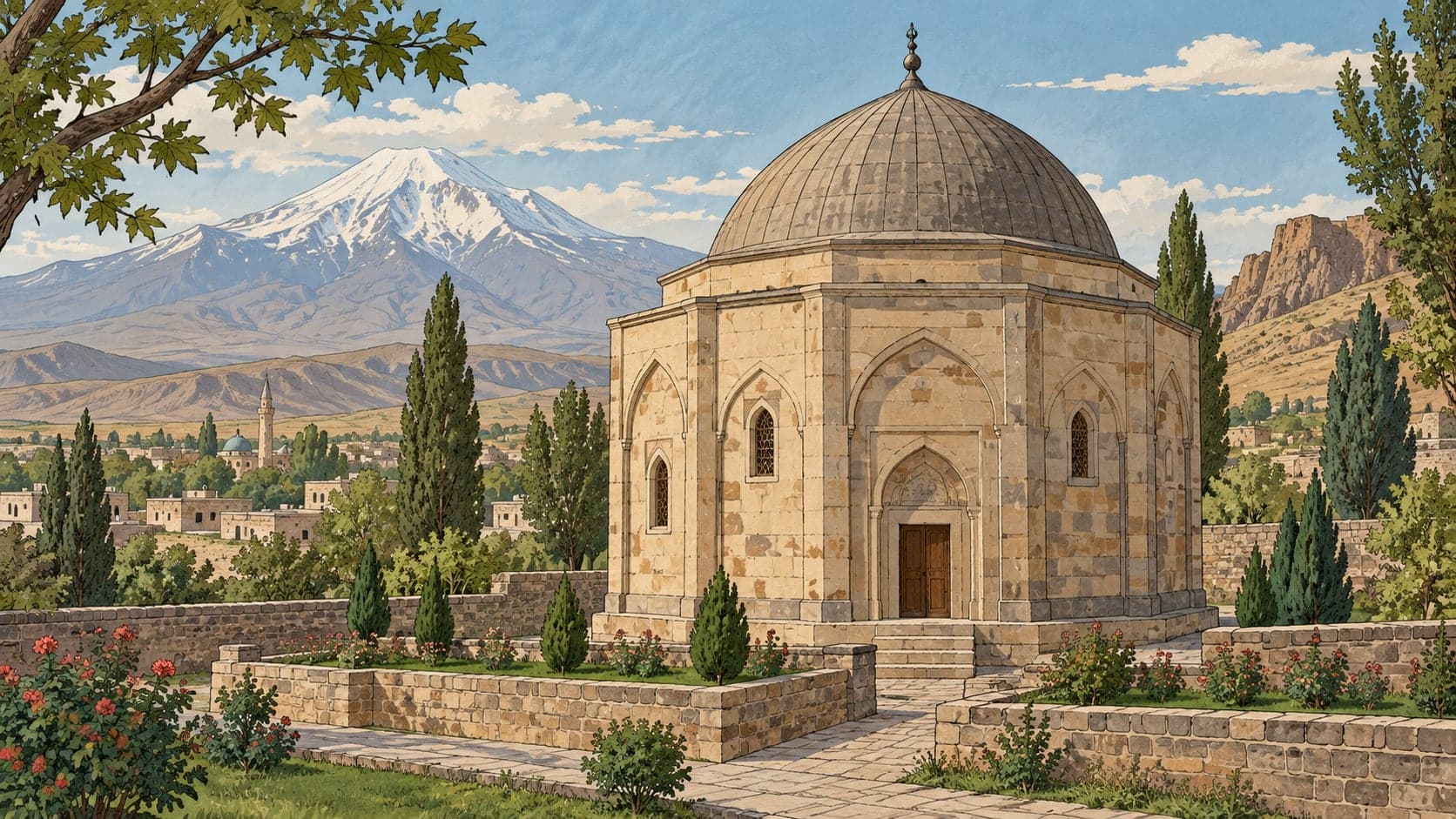
The tomb of Ahmed-i Hanı stands about eight kilometres from Doğubayazıt, close to the İshak Pasha Palace, and it is one of the most visited tombs in the region. It is thought to have been built in the eighteenth century, and there is a later mosque and a burial ground beside it.
The man buried here was one of the leading Islamic scholars of the seventeenth century, a mystic and a poet. Ahmed-i Hanı was born in 1651 at the village of Han near Hakkari, and his name is thought to come either from that village or from the Hanıyan family of the Hanı tribe who lived there. He travelled widely in eastern Anatolia studying Arabic, rhetoric and the religious sciences, and took an interest in astronomy as well. For a time he lived in Cizre, then a centre of learning in the region, and it was there that he wrote his best-known work. He spent his last years in Eski Bayezit, today's Doğubayazıt, and died in 1707. His writing deals with divine love, ethics and the problems of society, and the work he is remembered for is the mesnevi Mem u Zin, which tells a human love story in order to speak about divine love. Nubahara Bicukan, Akida Iman and Carkuse are his other works.