Guide
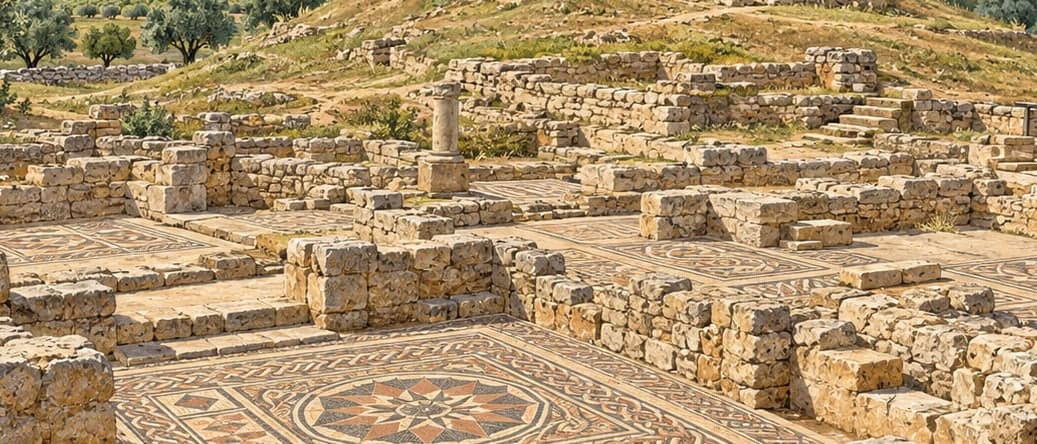
The basilica lies about 200 metres south-west of Oylum Höyük. Part of it was uncovered in 1999 and almost all of it in the excavations of 2004 and 2006, and it is known to belong to the early Christian period, dated to the sixth century AD.
The plan is a long rectangle, built of black basalt and limestone. The entrance is on the west, and two rows of columns divide the interior into three aisles. The excavations produced a great many Roman and medieval coins, column bases and other archaeological material.
The floor mosaic covers about 800 square metres and carries the features of the early Byzantine period: plant motifs worked in red, white, brown, grey and black stone, along with geometric patterns of intersecting circles, lozenges, squares and zigzags, and interlaced ornament arranged in the form of a Maltese cross.
The mosaics were found to be in good condition, and work to cover them over so they would not be damaged began in 2015 and was completed in 2017. The site protection and landscaping work was provisionally accepted on 16 August 2017.