Guide
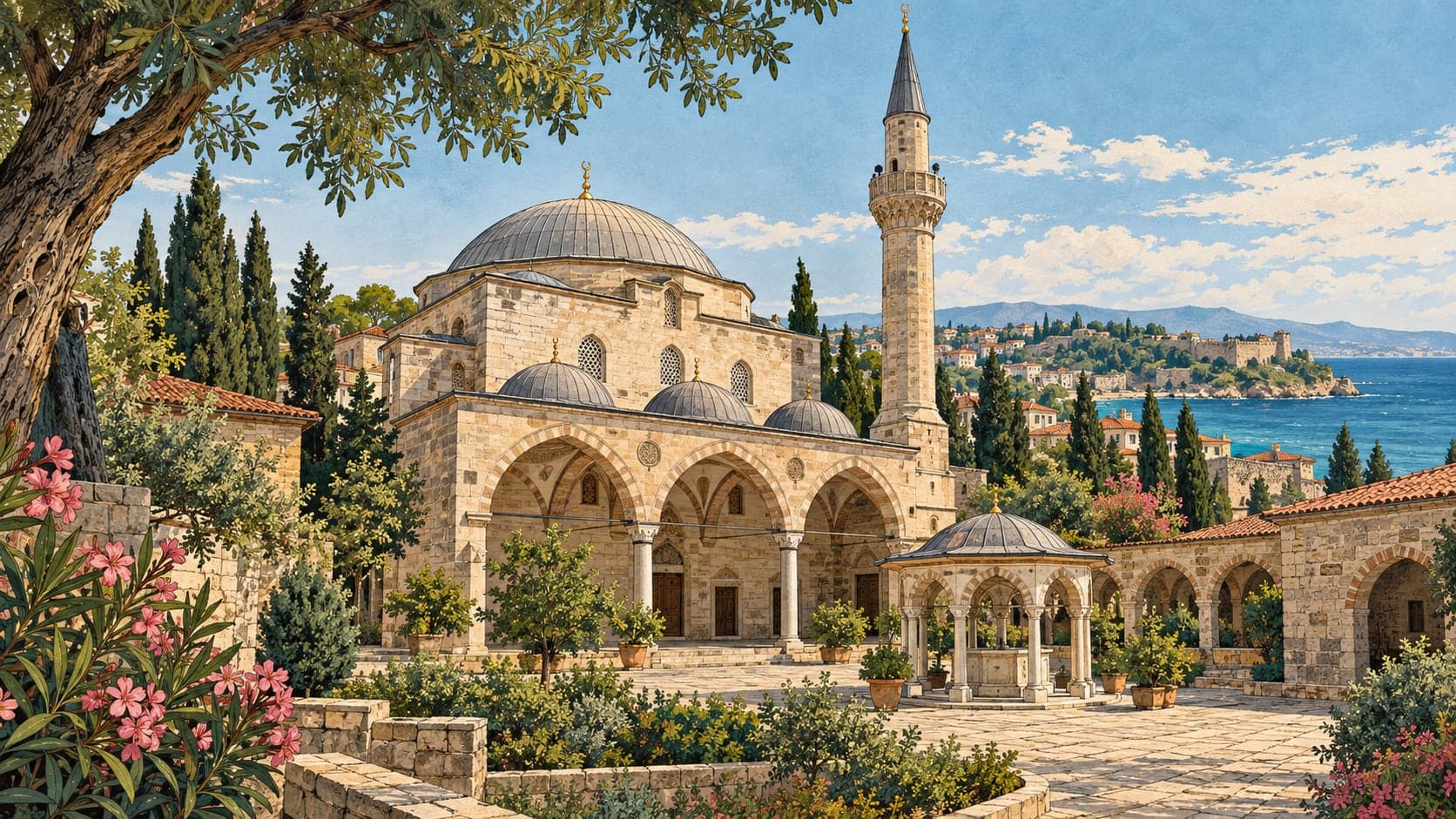
The Alaaddin Mosque is the great mosque of Sinop, in the middle of town. Foundation records attribute it to the Seljuk sultan Alaeddin Keykubad, and it is thought to have been built soon after the Seljuk conquest of Sinop in 1214. It is laid out transversely in two aisles, 66 by 22 metres, with a large courtyard on the north side measuring 66 by 44 metres and enclosed by walls twelve metres high. Three gates lead into the courtyard and five doors open from it into the mosque. Three fairly large domes stand over the centre, one of them on a higher drum, with a smaller dome each on the east and west; the rest is covered by cross vaults. The transverse plan and the wide courtyard put it close to the scheme of the early Islamic mosque.
The mihrab is marble, carved with the interlaced ornament of the Seljuk manner, with the chain motifs in relief on its borders that recur in other Candarid mihrabs, and the Ayat al-Kursi framing it on three sides. The minbar you see is not the original. The first one was densely carved with interlacing plant ornament, and Evliya Çelebi compared it to the minbar of the Great Mosque of Bursa, which he thought resembled it to a degree. It was smashed when the mosque's dome collapsed in 1853 and its pieces were taken to the Çinili Köşk in İstanbul; the present wooden minbar is nineteenth-century work. The mosque and its courtyard were last restored in 2008-2009. In the northeast corner of the courtyard stands the tomb of the Isfendiyarids, holding eleven cenotaphs.