Guide
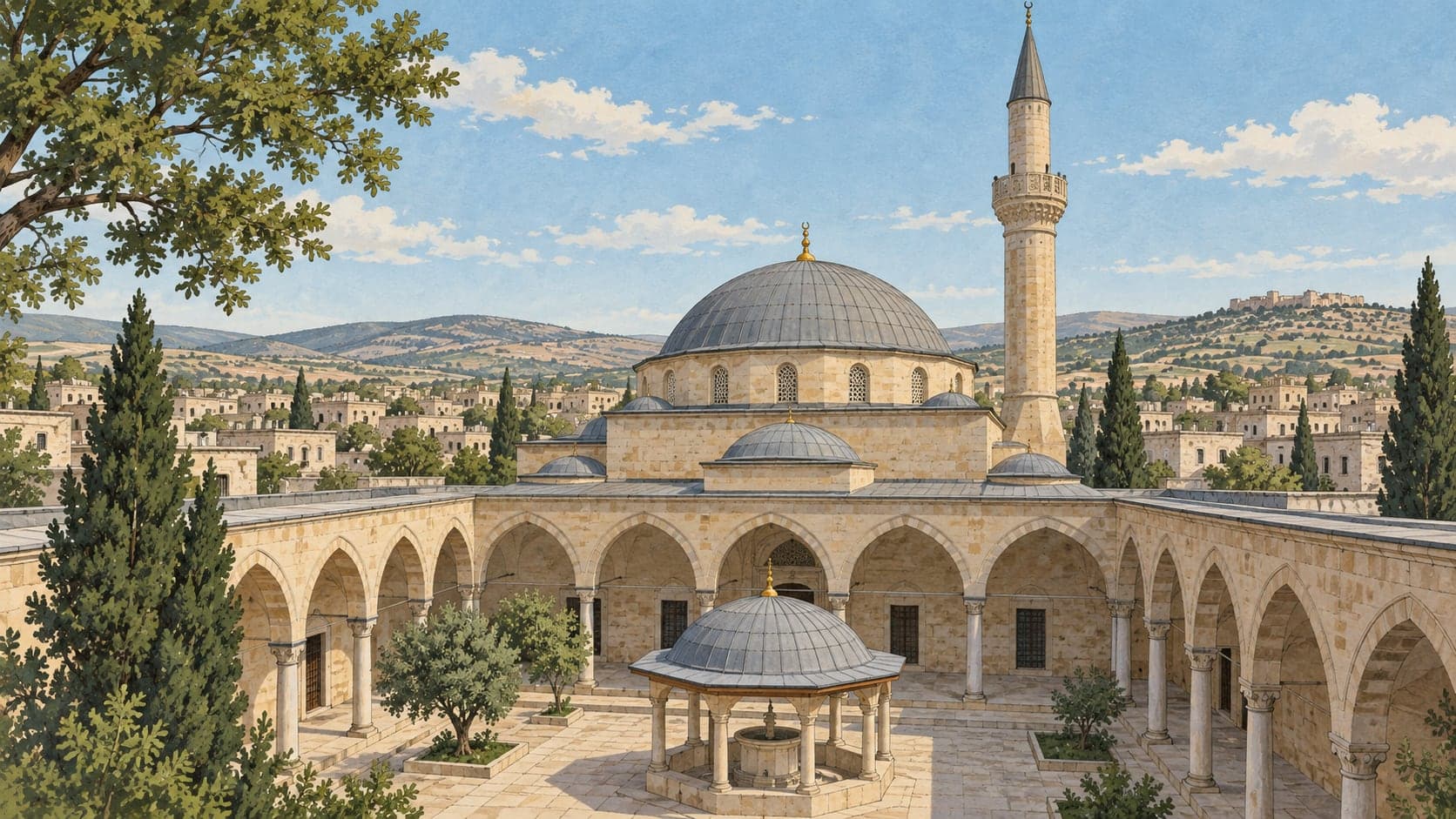
Çalık Mosque is in the Asit quarter of Kilis, once called Kızılca. The Hurufat registers name its founder, though not consistently: the Ministry's page gives it first as Hacı Ali bin Mehmet Ağa, called Çalık Hacı Ali, and then as Çalık Mehmet Ağa, son of Hacı Ali. The courtyard has three gates and holds the minaret, the cells of a medrese, a well with a carved stone rim, and graves said to belong to the founder and his wife.
The prayer hall runs parallel to the qibla as a single aisle with two domes: a rectangular, timber-covered space of six pointed arches resting on six free piers and one engaged pier. The porch has three arched bays on freestanding masonry piers, and a low arched door leads from it into the hall, with a rectangular window on each side under a flat lintel and a triangular pediment. The bay before the mihrab is domed, the transition made by pairs of large triangles, and the weight of the high dome on its round drum is carried through the arches of the vaults onto the engaged piers. Of the two mihrabs the original is on the axis of the door that opens into the hall from the older wing of the porch: a pointed-arched niche with a console in each upper corner, now used as a cupboard. When repairs widened the hall this original mihrab was abandoned, and the window between the two sections was blocked and shaped as a mihrab instead. The minaret adjoins the southwest corner of the hall on the right side of the courtyard, with a square base chamfered above, a polygonal shaft banded twice, a single balcony on muqarnas, star motifs cut through the openwork parapet, a cylindrical upper shaft and a conical stone cap. The most decorated parts of the mosque are that minaret, whose tiles beneath the balcony have largely fallen away, and the portal on the southwest, where courses of black and yellow stone alternate alongside octagonal and zigzag patterns.