Guide
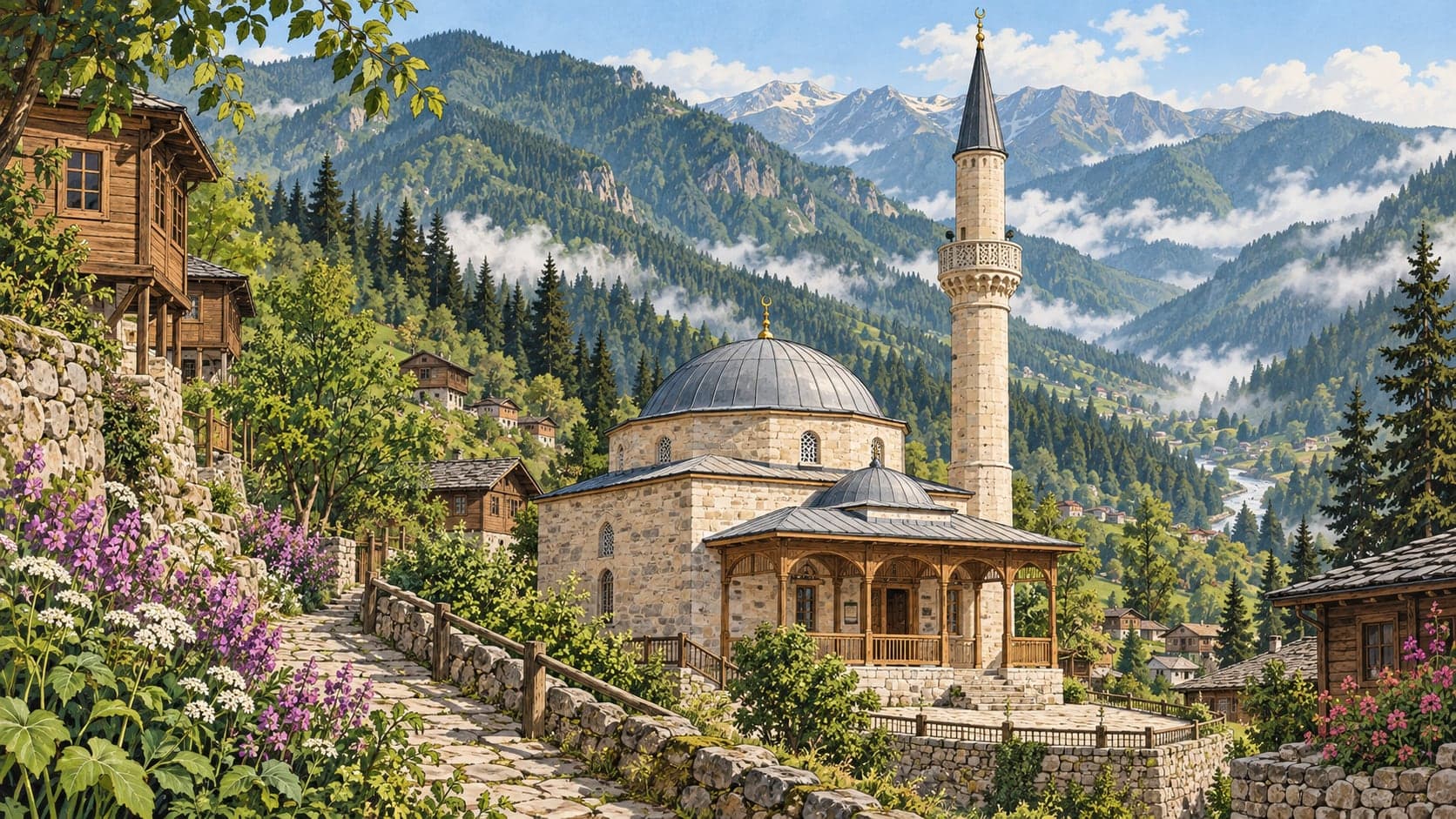
The mosque of Camili village, also called the Hertvisi Mosque, stands in the village of Camili — formerly Hertvisi — in the Borçka district of Artvin, in the historical region of Machakheli. It took the name Camili Mosque after the village name was changed. It is one of eight wooden mosques identified on the Turkish side of the Machakheli valley, and in design and manner, in its coloured interior and its distinctive motifs, it shares features both with the other wooden mosques of the Artvin region and with the mosques of Adjara in Georgia.
Its dating rests on more than one record. On the evidence of a warrant concerning the appointment of an imam, the Hertvisi Mosque is estimated to have been built before 1819. When that wooden mosque was destroyed by an avalanche, the present mosque was built in about 1855. The Georgian historian Zakaria Chichinadze, who travelled through the Machakheli valley in the early 1890s, records that the Hertvisi Mosque was built using the material of the old church in the village, pulled down for the purpose; and that in 1855 a rock called Kvirkvina broke away near the village of Dzneliti, destroyed this mosque and caused many deaths. On that evidence the present mosque can be said to have been built after 1855.
The building stands on a rubble-stone foundation and is made entirely of timber in the interlocking technique. Its minaret, with a single balcony, was built later. The plan is roughly square, with the main entrance on the north front, where a double-leaved door hangs and a porch was added over the entrance later; there is a second entrance on the east front with a single-leaved door. The wooden prayer niche is semicircular and set within a rectangular frame, and there are benches to the right and left of the main door.
The mosque was registered and taken under protection in 2005 by the Trabzon regional board for the protection of cultural and natural property. Even so, the source records, the wooden elements of the interior were varnished during a restoration in 2018 and the coloured interior decoration was entirely removed. The source holds that where non-original interventions are identified in such historic buildings it is possible, through proper restoration methods, to find the original layer and bring the original colours out across the whole surface — as was done in the restoration of the nineteenth-century mosque in the village of Bayat in the Çivril district of Denizli, where the original decoration was preserved as it stood.