Guide
The Parhali Monastery, known in Turkish as Barhal, stands in the village of Altıparmak in the Yusufeli district of Artvin. It is a Georgian Orthodox monastery built in the ninth and tenth centuries, and of the group of buildings the main church and two chapels survive.
According to the Parhali Gospel, copied by Ioane Beria at the Shatberdi monastery in 973, the monastery was built by the Georgian king David III between 961 and 973. It was founded in the name of John the Baptist and consisted of a main church and two smaller ones. The main church was turned into a mosque in 1677.
The oldest surviving manuscript of The Martyrdom of Shushanik — the earliest Georgian hagiographic work, of the fifth century, and counted by some writers the earliest novel in Georgian literature — was written out at this monastery. A man named Gabriel is known to have copied several gospels here at about the same date.
In the reign of the Georgian king Alexander the Great a porch open on three sides through arches was added in front of the southern entrance. An inscription written in red paint on the southern wall of the central nave records repairs in the time of Patriarch Ioane VIII, between 1495 and 1507, and in 1518 the atabeg Kvarkvare added a new space in front of the western entrance.
Giorgi Kazbegi wrote about the church at length in a book published in 1874. He found it unlike the other Georgian Orthodox churches in Türkiye, saying the outside put him in mind of a modern theatre building, and noted that this domeless church was then in better condition than the church at Tbeti. He remarked on the newer inscriptions alongside the old ones, observing that most of the new ones were in Armenian and that the long old Georgian inscription had largely been effaced and was hard to read.
The church was registered as immovable cultural property requiring protection by the Ministry of Culture and Tourism in 1987.
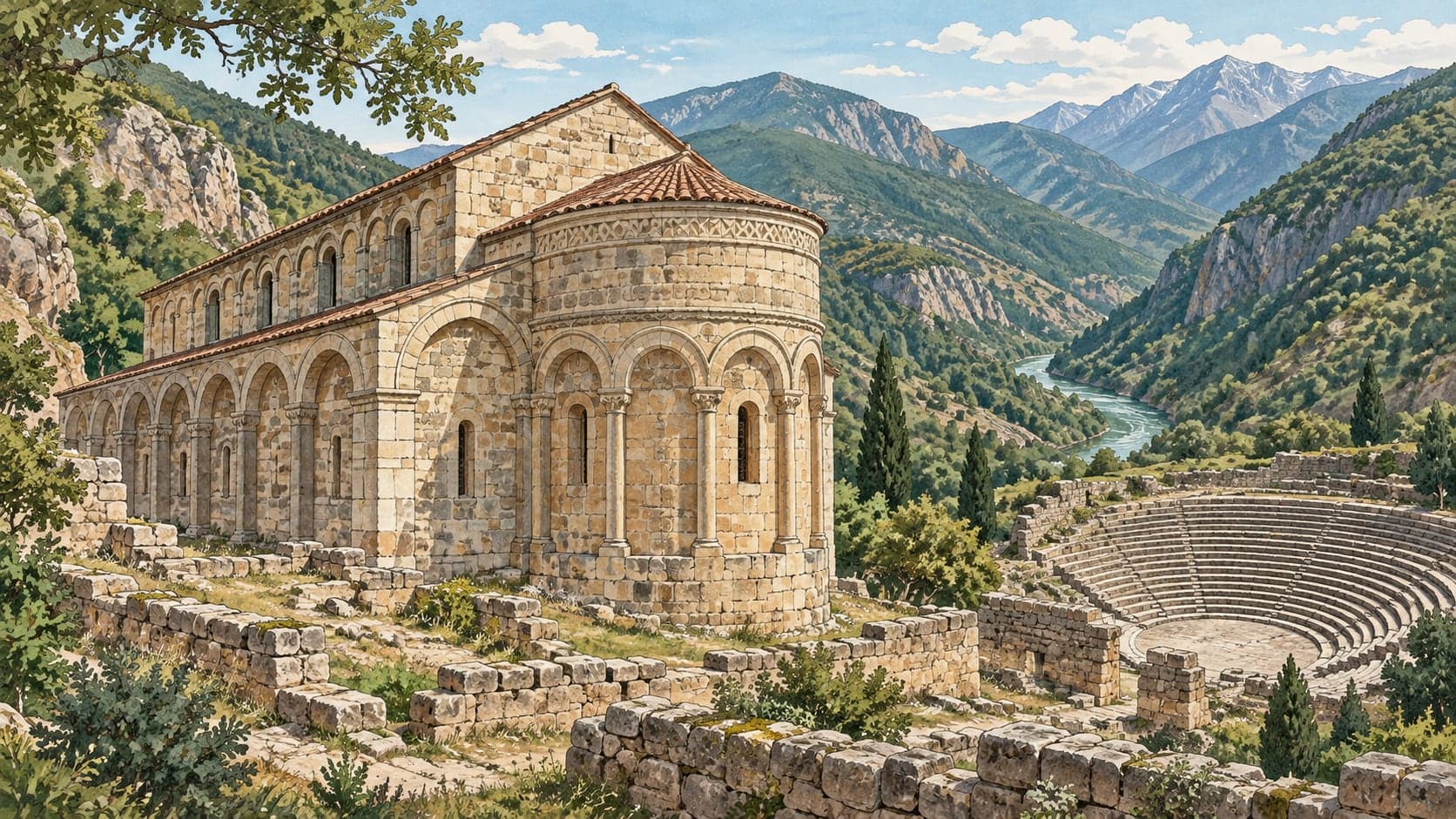
The main church is rectangular in plan, measuring 28.40 by 18.65 metres on the outside, and in plan type and size it closely resembles the church of Othta Eklesia. Built in the tenth century, it is a basilica of three naves. When it was turned into a mosque the northern of its three entrances was walled up from inside and the southern one was made into a mihrab niche. The faces of the building are laid in cut stone with careful workmanship, with blind arcading of the kind found at Othta Eklesia.