Guide
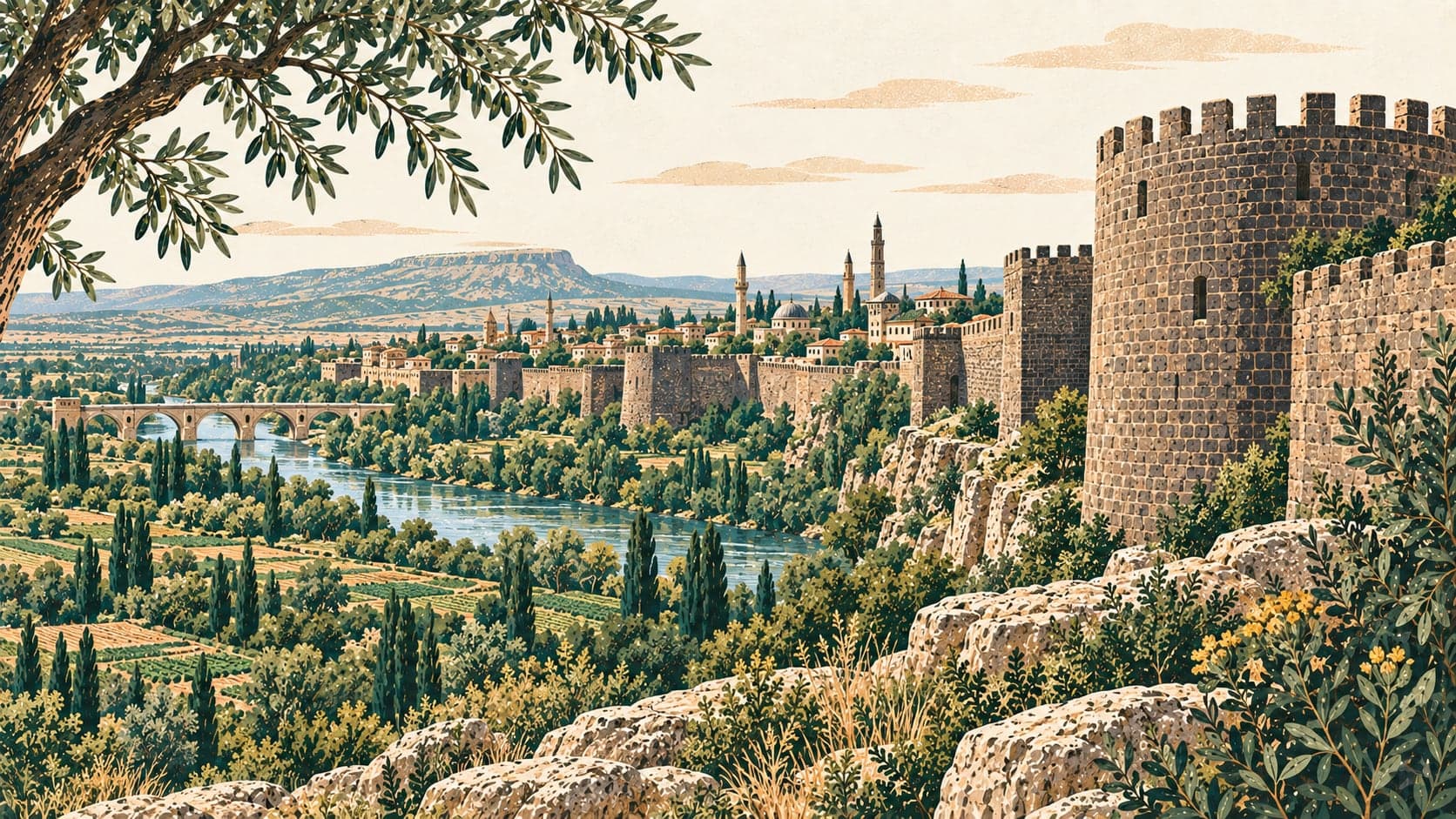
The walls of Diyarbakır enclose the old city in the Sur district, ringing it in an oval roughly five kilometres round. They are held to be, after the Great Wall of China, among the longest, widest and most solidly built defensive walls in the world. The circuit has two parts, the inner citadel and the outer wall. Four gates open through it: Dağ Kapı, also called the Harput Gate, to the north; Urfa Kapı, the Roman Gate, to the west; Mardin Kapı, the Tell Gate, to the south; and Yeni Kapı, the Tigris or Water Gate, to the east. UNESCO placed the site on its Tentative List in 2000 and inscribed it as World Heritage in 2015.
Who first raised the walls, and when, is not known. The inner citadel is thought to have been the city's original settlement. For the period before Rome the sources say little: that the Hurrians lived in the region around 2000 BC and that their city was walled, and that the old wall was repaired in the ninth century BC when the site was the capital of the Bit-Zamani. Three separate accounts place Roman work on the walls in the years AD 330–338 and 349. Later builders left their names where the Romans did not: much of what is most striking in the circuit is Seljuk and Artuqid work of the eleventh to thirteenth centuries.
The basic material is basalt, the black volcanic stone of the region, used with brick and mortar; the proportions differ from period to period. Built to follow the terrain, the walls stand 10 to 12 metres high and are 3 to 5 metres thick. The walled area measures about 1,040 metres north to south and 1,400 metres east to west. Eighty-two towers stand along the circuit, generally semicircular or polygonal, though those on the stretch facing the Tigris valley are mostly square. Inside each tower a stair beside the door climbs to the wall walk; the towers usually rise two, or three to four, storeys, roofed with domes, arches and vaults.
Several towers are worth singling out. The Evli Beden or Benusen tower, one of the most imposing on the circuit, carries rich Artuqid inscriptions and ornament; it was built in 1208 for the Artuqid ruler Melik Salih by the architect İbrahim son of Cafer, and its original stepped spur base bears inscriptions of its own. The Yedi Kardeş tower, cylindrical and built entirely of cut basalt, was completed the same year for the same ruler by the architect Yahya son of İbrahim, and is carved with the double-headed eagle of the Seljuks, with lions, and with inscriptions. Adjoining it, the Nur tower was raised in 1089 for the Seljuk ruler Melikşah, carved with running horses, lions, and figures of women and deer. The Selçuklu tower was built in 1088 at Melikşah's own expense by the master builder Muhammed of Urfa, son of Selame.
The Keçi tower is the largest and oldest on the walls and unlike the rest in plan: eleven arches, two storeys, and inside a hall of three aisles roofed with brick vaults carried on arches springing from columns. It is known to have served in the Byzantine period, in a different role, as a temple of Şemsi. Its date of construction is unknown; it was repaired by the Marwanids in 1223. The Dağ Kapı towers, restored in 1978, now house a tourism office and a state gallery of fine arts, their east and west faces carved with ornament and animal figures; the outer face of the gate has been closed off by a courtyard wall, so this is no longer a way into the city.
The walls carry visible damage. A condition report prepared by the site management authority for the Diyarbakır Fortress and Hevsel Gardens Cultural Landscape recorded harm done during the fighting in Sur in 2015–16: concrete poured on Yenikapı, on the Keçi tower and on tower 63 to anchor flagpoles, a portable toilet installed on the Marwanid Keçi tower with its waste line connected to a spout so that sewage ran down the tower wall, soot left on the stone by fires lit for warmth where the walls and gates were used as security posts, and concrete blocks set into the gaps between towers without the approval of the scientific board. The Dağ Kapı towers show damage of a slower kind: rising damp has left salt crystallisation, discolouration, surface loss and cracking in the lowest 60 to 70 centimetres where the outer faces meet the paved court, and while the east side has been repaired the west has serious structural problems.