Guide
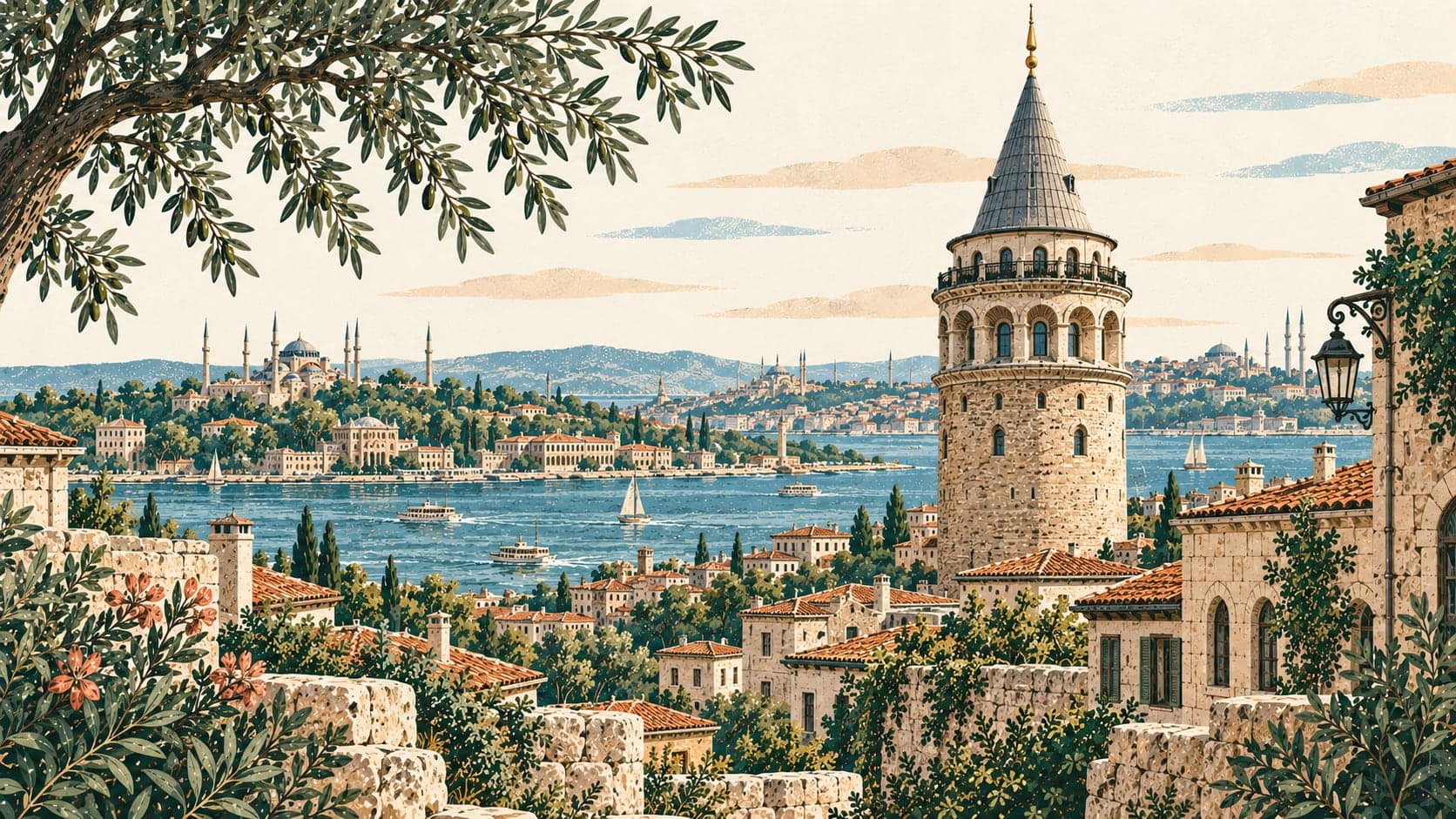
The Galata Tower stands in the Beyoğlu district of İstanbul and takes its name from the Galata quarter around it. It was built as a watchtower within the Galata walls, served many different purposes over the centuries, and since 2020 has worked as a museum and exhibition space. It is one of the emblems of Beyoğlu and of the city.
The Genoese, then allied with the Byzantine empire, founded a colony called Pera at Galata north of the Golden Horn in 1267, and enlarged the ground they held over time with Byzantine permission. Going beyond those permissions, they pushed north-east towards the hill and between 1335 and 1349 built walls and towers ringed with ditches on its slopes. The tower now known as the Galata Tower was raised in 1348 as the head tower of that circuit: a lookout, and a defence for the flat shoreline part of the colony against a siege from the land. A barbican stood in front of it, attached on both sides and bulging out in a half-circle from the straight line of the wall; this was where four lines of wall met and where the main entrance to Pera lay, and according to the plaque on it, its construction, completed on 1 April 1452, was the last fortification built before Pera passed to the Ottomans. In those years the tower was called Turris Sancte Crucis, the Tower of the Holy Cross, after the cross on its summit.
In August 1348 war broke out between the Byzantines and the Genoese over trade. It ended in 1349 in a Byzantine victory, and in the same year a decree of the emperor John VI handed control of the hill the tower stands on to the Genoese. After Constantinople came under Ottoman rule on 29 May 1453 the Genoese of Pera gave up the colony without resistance. Some damage was done to the fortifications at Galata, including the tower, but Sultan Mehmed II ordered it stopped by decree and the damaged parts rebuilt. The tower was harmed again in the earthquake of 1509 and repaired by 1510.
Its uses changed with the centuries. In the sixteenth and seventeenth it held prisoners of war and served as a supply store; from the eighteenth it belonged to the Mehterhâne corps and was used by fire watchers as a fire tower. After the fire of 1794 the design was altered in the repairs and the upper part turned into a coffee house; after the fire of 1831 it was altered again. When a storm blew the roof off in 1875, two wooden floors were added over the masonry top storey and that part was given over to watching for fires in the city and reporting them.
A restoration between 1965 and 1967 turned the tower into a visitor attraction with each floor serving a different purpose, and renewed the roof in a form close to its design of 1832–1876. It was leased from the İstanbul municipality and run by Ünal Kardeşler and later by a company belonging to their heirs. The outer face was restored in 1999–2000. In 2013 BELTUR, belonging to the İstanbul metropolitan municipality, took over the operation, and in that period a café and a restaurant occupied the top two floors; that same year the tower entered UNESCO's Tentative List. Ownership and operation passed to the General Directorate of Foundations in 2019, and work in 2020 turned the tower into a museum and exhibition space. The roof was restored again in 2023.
The tower is Romanesque, of masonry, 62.59 metres to the tip of its roof, with a cylindrical body of stone and a conical roof of reinforced concrete. It has eleven floors counting a basement, the ground floor and a mezzanine. A lift runs from the ground floor to the sixth; stone stairs climb from the ground floor to the fourth and steel ones from the sixth to the eighth. The ground floor holds ticket control and security, and the entrance to the lift. The first floor is the museum shop; the three above it are permanent museum and exhibition spaces — one a simulation area with a screen showing an animation of Hezârfen Ahmed Çelebi's glide from the tower, and works on the period when Takiyüddin used it; another with photographs from the War of Independence; another with material on the tower and the Galata walls, and on the tower and the city. The sixth floor is a passage; the seventh is a temporary exhibition space with a model of part of İstanbul and viewing telescopes set at the windows; the eighth is a viewing terrace. The outer face of the tower and the ground around it are used on certain days for remembrance, celebration or raising awareness.