Guide
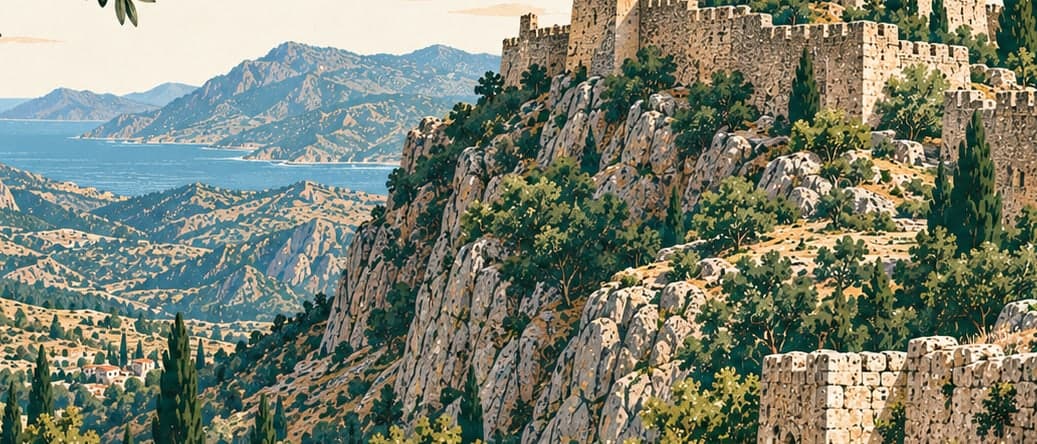
Gözne Castle stands on the southern slopes of the Taurus mountains, just south of the highland town of Gözne, a summer retreat for the people of Mersin, and within walking distance of it. Mersin itself is about thirty kilometres away. The ground around the castle has been laid out for visitors.
The remains consist of two buildings, both relatively little damaged. The rectangular building to the east has four towers, its entrance on the west, and is covered with pointed barrel vaults; it has five openings for air and light. The six-sided building to the west has three windows and two doors, its ceiling divided in two by an arch carrying the roof.
The building technique shows that the castle was put up in the time of the Armenian kingdom of Cilicia. It is thought to have been one of the small castles built to watch the roads, working under the larger castle of Çandır to the north.
Because the castle was built in two parts, it is also considered that it may have served some purpose other than that of a watchtower or guard post. Ornament on the keystones of the vault inside the six-sided space suggests that this part may have been used by men of high rank or by administrators.
Seven hundred and fifty metres south of the castle as the crow flies, an inscription of five lines in Aramaic, set within a frame on a natural rock face, was registered and taken under protection as immovable cultural property by the Ministry of Culture and Tourism on 4 August 2021. It was translated in 1907 by James A. Montgomery: it marks the boundary of Lampron, today Namrun, up to that point, and calls down the curse of Baalshamin, in the name of the moon and the sun, on anyone who would destroy it, and on his seed.