Guide
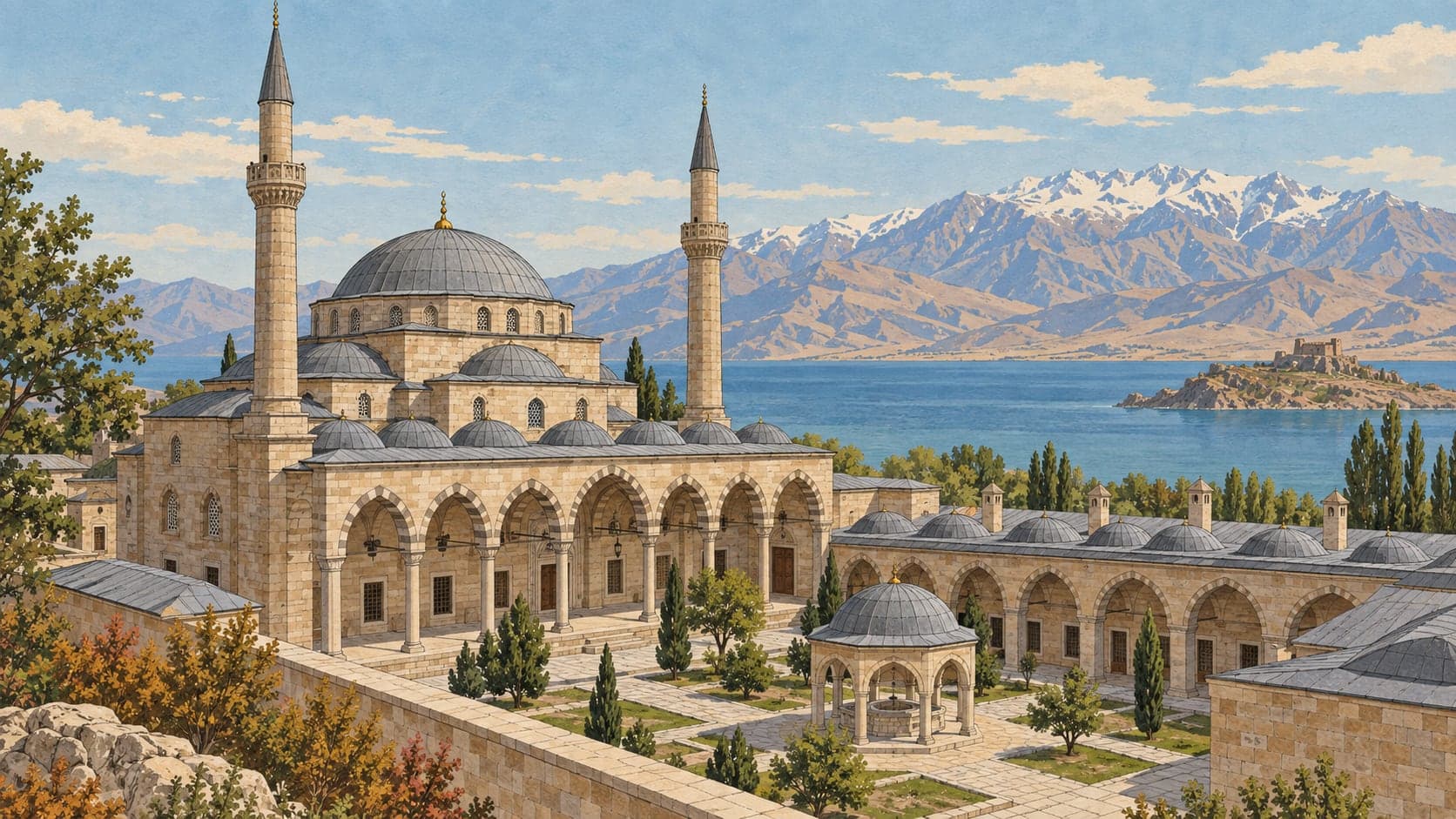
The Hüsrev Paşa complex stands in the old city of Van, built in 1567–68 by Köse Hüsrev Mehmet Paşa, governor-general of Van and one of the viziers of Süleyman the Lawgiver. It is counted among the works of Mimar Sinan. The complex takes in a mosque, a medrese, a tomb tower, a han, a double bath, a public kitchen, a primary school, a fountain, a guest house, a bakery and shops.
The mosque is square in plan under a dome. Cut stone was used in the walls, and brick in the squinches and the dome. On the north front the door opens within an arched recess, and that front, like the others, is given movement by its windows. Two-coloured cut stone appears on the minaret and the outer faces; the minaret rises at the north-west corner on a square base with a cylindrical shaft.
Inside, tiles cover the walls to a certain height. Painted decoration with baroque motifs appears on the tympanum of the arch above the entrance, on the squinches, on the mihrab, on the inner wall surfaces and on the arches.
The mihrab is set at the middle of the qibla wall. Rectangular in appearance and worked with a regular hand in limestone, it has a five-sided niche with a muqarnas hood crowned by a three-lobed arch, and various geometric ornaments across its surfaces.
Comprehensive repairs were carried out between 2007 and 2013 on the mosque, medrese, public kitchen, tomb tower, ablution fountain and courtyard at the centre of the complex, and those repaired parts are in active use today for religious, social and cultural purposes.