Guide
According to its endowment deed the mosque was begun in 1660 by Kaya Çelebizade Koçi Bey. When Koçi Bey was executed the work was left unfinished, and it was completed in 1663 by Cem Dedemoğlu Mehmet Bey. The mosque stands just behind the walls of Van castle, between the middle gate and the new gate.
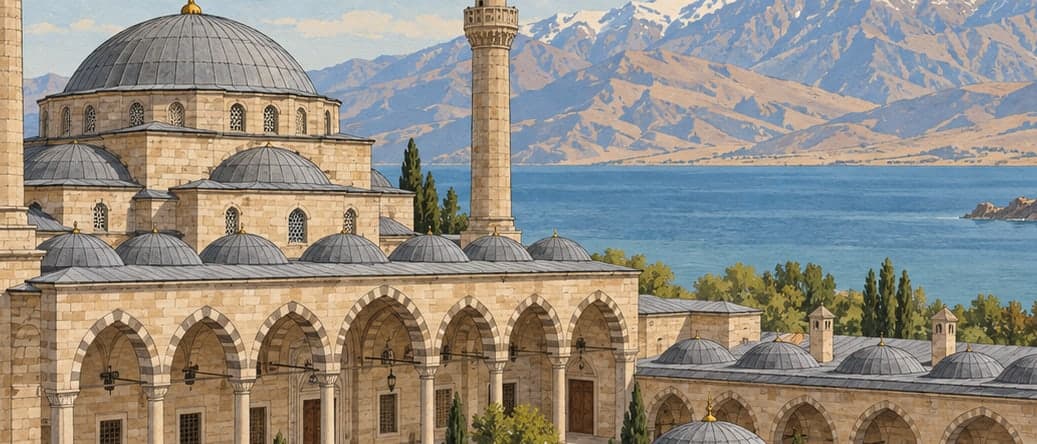
It consists of a square prayer hall under a single dome with a five-bayed porch on the north. The minaret at the north-west corner has a square base and a cylindrical shaft, and above the balcony ends in a short upper shaft and a cap.
The mosque is built of cut stone in two colours, and its fronts are enlivened by windows of various forms. The door is set at the middle of the north front, and the door and windows on that side carry plant and geometric ornament.
Inside, the mihrab set in the qibla wall is the notable feature. Built of even limestone blocks in a rectangle close to a square, it is framed by a muqarnas border. At the middle of a broad surface is a five-sided niche with a muqarnas hood, crowned by a three-lobed arch, and the whole is striking for its geometric and plant ornament.
One of the important buildings of the Ottoman period in the region, the Kaya Çelebi Mosque is open for worship today.