Guide
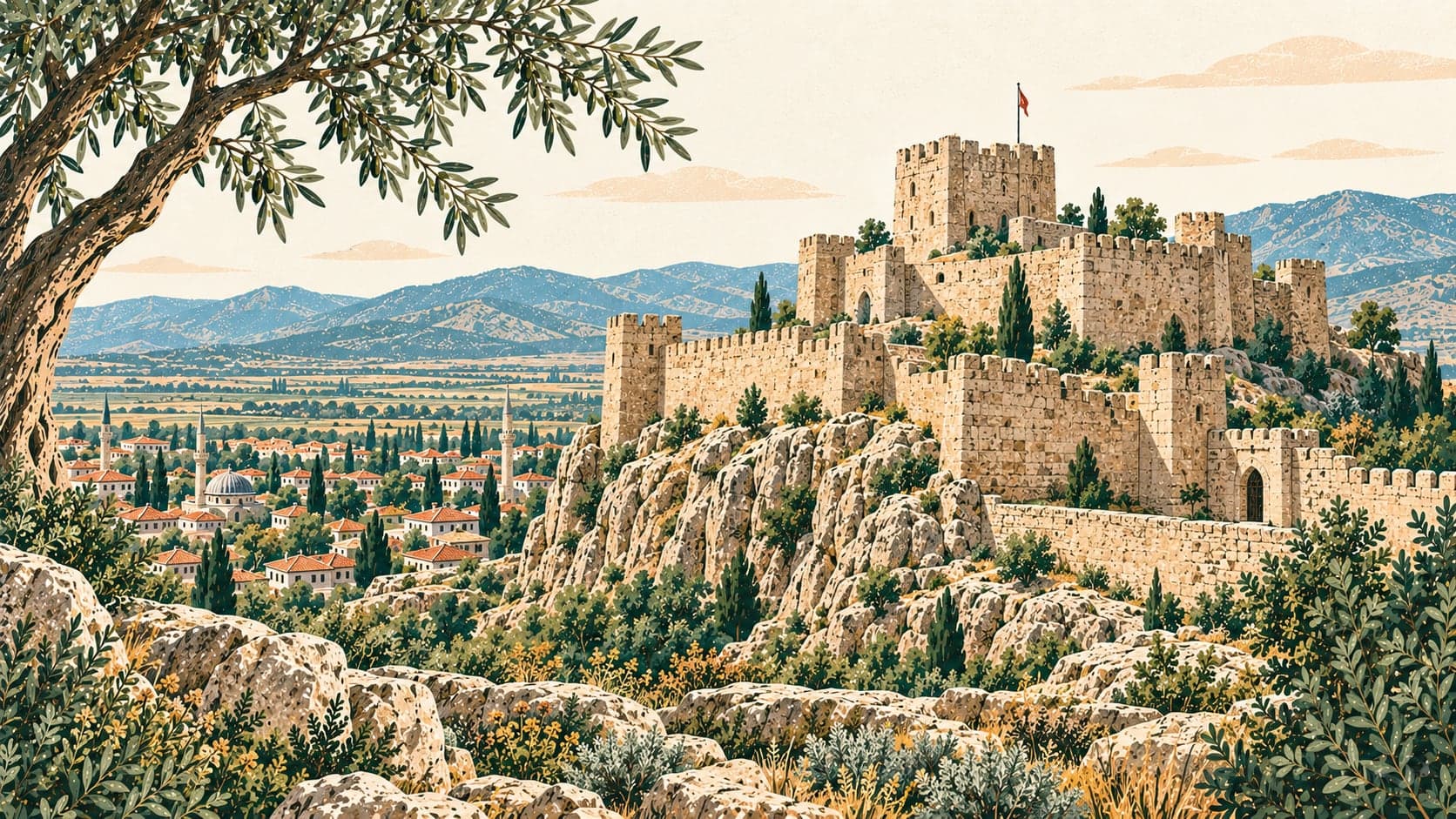
Karaman Castle once had three rings of wall enclosing one another — outer, middle and inner. Today the whole of the inner castle and part of the middle wall survive in ruin, and remains and fragments of the outer wall have been found in some places. Who built the castle and when is not known for certain; the earliest known date for the inner walls falls in the reign of the Anatolian Seljuk sultan Kılıç Arslan II, between 1156 and 1192, and for the outer walls in that of Sultan Gıyâseddin Keyhüsrev I, between 1192 and 1196.
In the Karamanid period the inner castle became the place where the beys lived. When the city passed to the Ottomans the castle was in ruins, and it was rebuilt with material recovered from the demolition of some buildings in the city; under the Ottomans the inner castle was used by the governors. Evliya Çelebi, who records that the city had three tiers of wall, writes that within the middle walls were a mosque and forty-six houses, that the middle walls had forty towers and two gates and the outer walls a hundred and forty towers and nine gates. The number of gates in the outer walls later rose to nineteen, and the ditch that had formerly run round the inner castle was filled in over time.
The castle was restored in 1961 and again in 1975. It was registered as a historic urban conservation site by decision A-2829 of the High Council for the Protection of Cultural Property on 13 November 1981 and taken under protection by decision A-3163 of the same date. Between 1988 and 1991 the municipality of Karaman cleared the housing that had grown up around the inner castle and turned the ground into green space; a stage and seating were built in the inner castle, which began to be used as a theatre and events venue. A decision to restore the inner castle, taken by the Konya board for the protection of cultural and natural property on the proposal of the Konya directorate of surveys and monuments dated 23 September 1992, was not carried out. Night lighting was added to the castle by the Ministry of Culture in 1993. The castle mound, registered on 5 April 1995, was made a first-degree urban archaeological conservation site by decision 2227 of the Konya board.
By decision 149521 of the General Directorate of Cultural Heritage and Museums, dated 5 July 2012, it was decided that the theatre in the inner castle should be removed so that the castle could be restored. Excavation work began under the municipality of Karaman on 5 January 2013 and reached wall remains.