Guide
The Midas Monument stands in the village of Yazılıkaya in the Han district of Eskişehir, on a rock mass jutting from the north-east foot of the plateau of the Phrygian religious centre known as the city of Midas. It is the most imposing of the Phrygian rock façades. The name comes from the word Midai in the Phrygian inscription cut into the levelled rock at its upper left; local people call it Yazılıkaya, the written rock, for the same inscriptions. Both names are in use. The monument is dated to the first half of the 6th century BC.
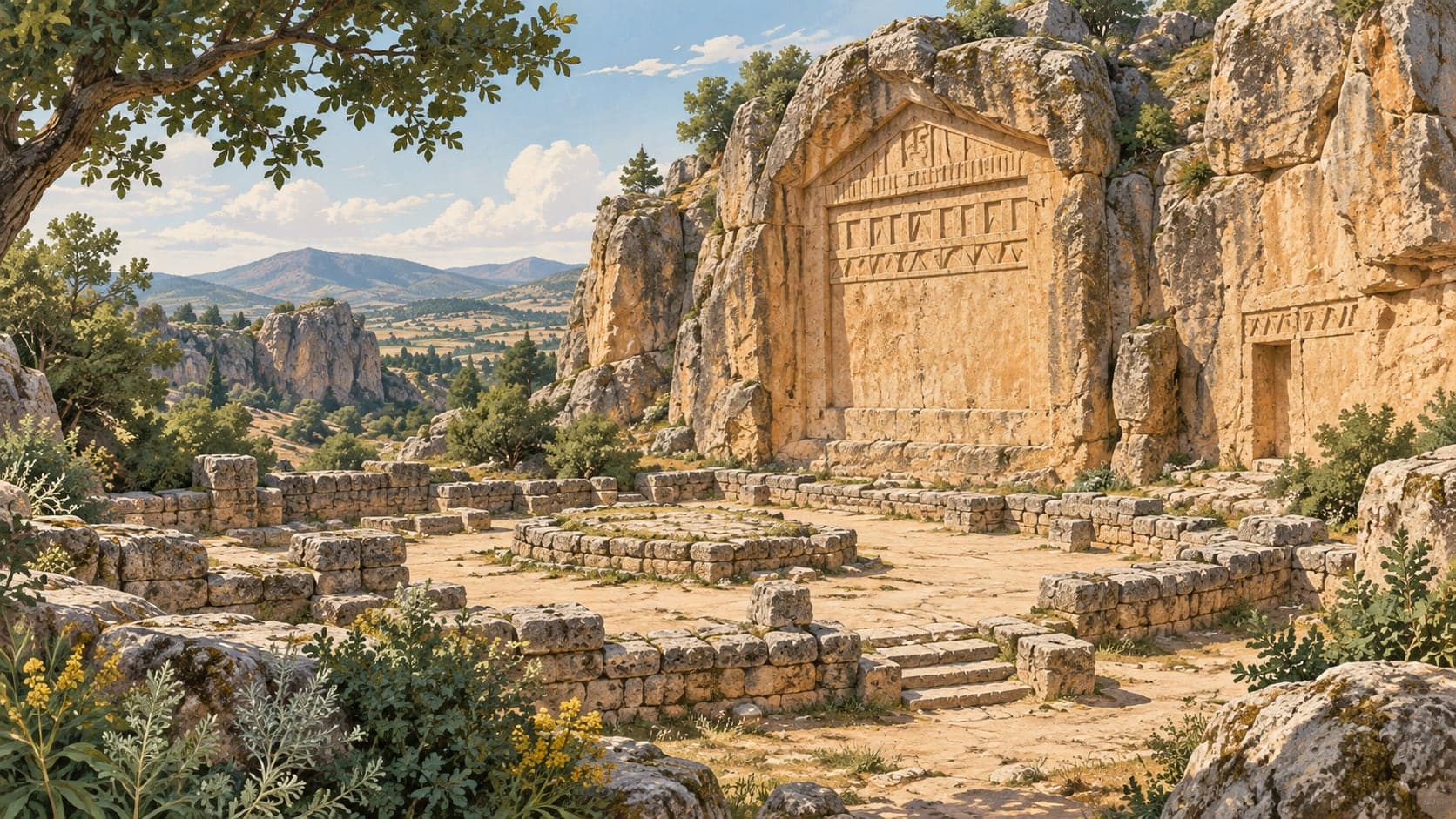
Facing east, it stands 17 metres high and 16.5 metres wide, its base between 1.2 and 1.8 metres above the ground, and it is worked into the shape of a temple front turned towards the sun. The crowning acroterion is formed of two opposed circle segments, and the pediment and façade wall carry dense geometric ornament. At the centre is a large niche representing a door: the sacred part, where during religious ceremonies the statue of the mother goddess Matar Kubileya — Cybele — was placed.
The monument was first examined and roughly drawn in 1800 by W. M. Leake and his companions. That drawing, by G. Koehler, is full of errors and omissions but holds a particular place as the first image to convey what a Phrygian façade looks like. In 1834 Charles Texier studied the monument and made an engraving of it, which remains the only rendering both faithful and equal to its scale. Excavation in front of the monument in 1936 and 1937 cut through fill reaching three metres thick in places and uncovered a courtyard 17 by 19 metres sloping to the north, and immediately to its south a level floor cut into the bedrock with four column bases belonging to a columned gallery. That gallery runs east–west and is closed at its west end by a large niche. Researchers agree that what stood here was a large open-air cult complex dedicated to the mother goddess Matar: a monumental façade, an open courtyard and a columned gallery.
Three Phrygian inscriptions are cut on the monument. All three can be read; what they mean has never been settled. The first relates to the monument as a whole and is incised on the levelled rock at the upper left, eleven metres long, running left to right in a curve from the left corner of the pediment towards the acroteria, with letters 0.45 by 0.40 metres. The name of King Midas can be read in it, the word for father stands out, and the words Ates and Midai also appear. The second, more particular, runs along the right frame of the monument, 4.75 metres long with letters of 0.25 metres; a few further Phrygian words, roughly and shallowly cut and barely visible to the naked eye, appear on both sides of the second frame around the niche and below the ornament to its right, and their importance is that the name of Matar occurs in them. The third inscription lies inside the niche to the left of the monument, beginning on the niche's left wall and continuing across its back and right walls, 4.45 metres long with letters of 0.40 to 0.45 metres. The village is 80 kilometres from Eskişehir.