Guide
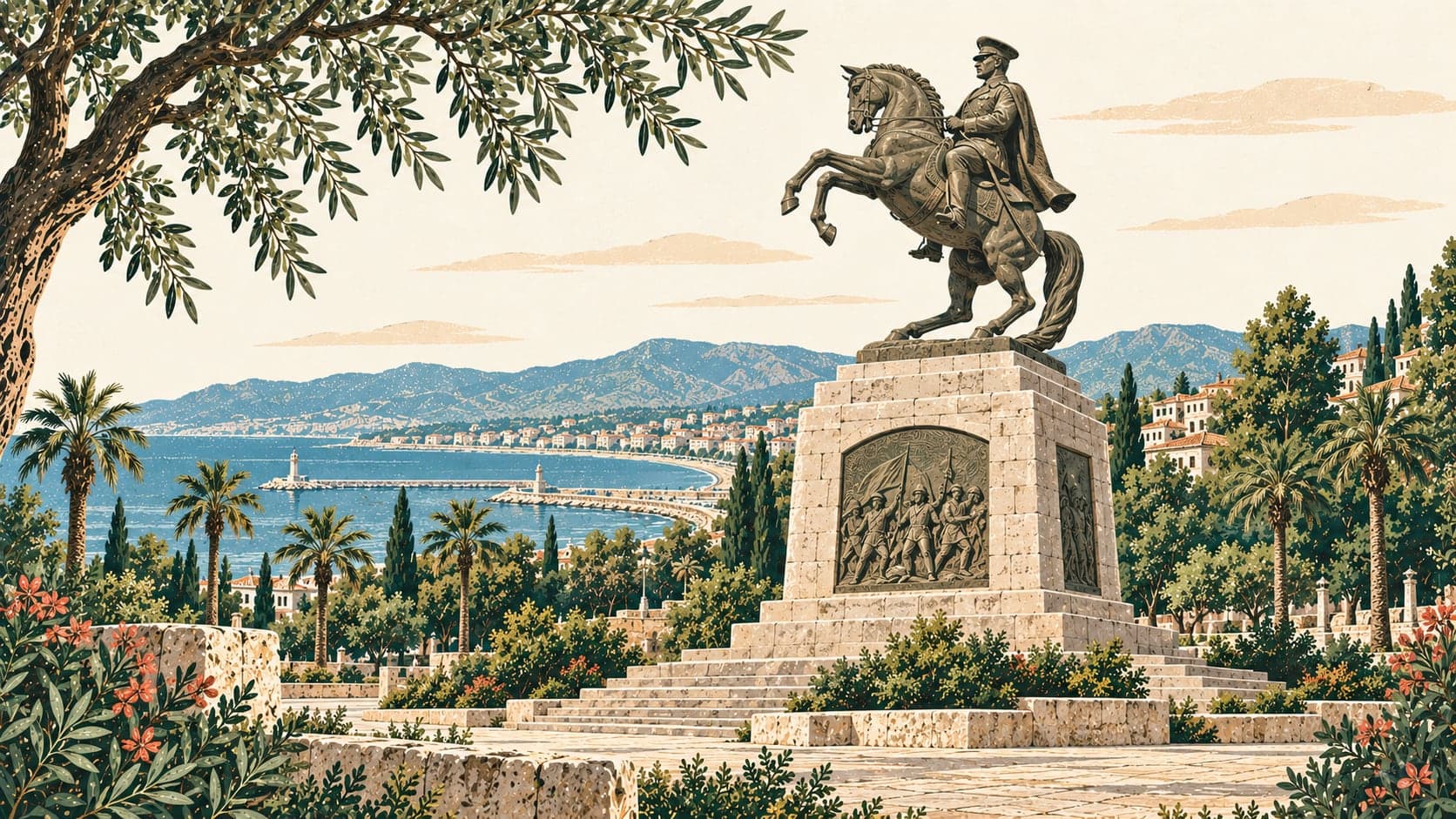
The Monument of Honour stands in Atatürk Park in the İlkadım district of Samsun and has become the emblem of the city. It was raised at the point where Mustafa Kemal came ashore at Samsun, and marks that moment, taken as the beginning of the War of Independence.
The bronze figure is 4.75 metres high, the stone block pedestal 4.10 metres, and the whole monument 8.85 metres. Mustafa Kemal is shown in a marshal's uniform on a rearing horse, commanding in battle. His upper body turns to the left and his face to the right; his left hand holds the reins while his right grips the hilt of his sword, about to draw it, and his clothing sits on him in a way that follows the movement of the body. The sword is far longer than the swords officers of the period carried. The face is worked in a way that recalls his younger years. The figure rests on the pedestal on the horse's two hind legs and its tail, and that balanced stance strengthens the sense of movement.
In the assessment of the sculptor Aylin Tekiner it is among the most dynamic and ambitious of all the statues of Atatürk, satisfying in rhythm and balance, with movement, tension and motion held in equilibrium. She reads the rearing of the horse as the desire to press forward, as defiance and heroism; Mustafa Kemal's effort to hold the reins as a call to composure addressed to a people impatient for independence; and his command of them as a sign of his strength and skill. In his speech at the opening, Krippel described the composition in terms of a gaze fixed proudly westward and into the distance, with eyes full of resolve, above a rearing horse.
The idea of raising a monument to Mustafa Kemal in Samsun came from Kâzım Paşa, then governor of the province, and building began formally with the laying of the pedestal's foundation stone on 19 May 1927, a ceremony he attended. The commission went to the Austrian sculptor Heinrich Krippel, who had won the earlier competition to build the Victory Monument, for $37,000 — about $587,661 at 2026 prices. For the proportions of the body and the composition of the face Krippel worked from measurements he had taken at Mustafa Kemal's residence in Ankara for his earlier works, and he made the statue in Türkiye. Casting in bronze began in 1928 at the Vereinigte Metallwerke foundry in Vienna and finished in 1931 in thirty-two pieces; after casting the parts were assembled at the foundry for cleaning and finishing, then taken apart again and crated separately.
The pieces were carried from Hamburg on the steamer Nicea of the Deutsche Levante-Linie and reached Samsun on 15 October 1931, where the statue was held at customs against a demand for ₺40,000 in duty. The provincial institutions could not pay it, so the Turkish government stepped in: foreseeing the bad impression it would make publicly if the statue could not be cleared, it created a central budget and met the duty from it. Once released, the statue was mounted on the pedestal on 29 October 1931 with the help of an Austrian engineer.
The opening was meant for 10 January 1932, the anniversary of the victory at the First Battle of İnönü, but was postponed because the preparations were not ready; some sources wrongly give 29 October 1931 or 29 October 1932, but it was in fact held at two in the afternoon on 15 January 1932. This was the thirteenth monument of the republican period and Krippel's fourth in Türkiye. A military band and detachment, the police of the city, associations and official bodies, politicians, and people from the city and the country around attended. After the band played the national anthem, a telegram from Mustafa Kemal was read, thanking the people of Samsun; the governor Mehmet Salim Bey then spoke and opened the monument, followed by speakers for the Samsun organisation of the People's Party, for the people of the city, for the general assembly, for the municipality and for the Ministry of Education. Krippel spoke last, in German, with Ekrem Rüştü Bey translating. The ceremony went on with a march-past of mounted troops and ended with a reception at the provincial assembly; a dinner was given that evening in honour of Krippel and the governor, and Krippel was paid a further $5,500, about $87,355 at 2026 prices.