Guide
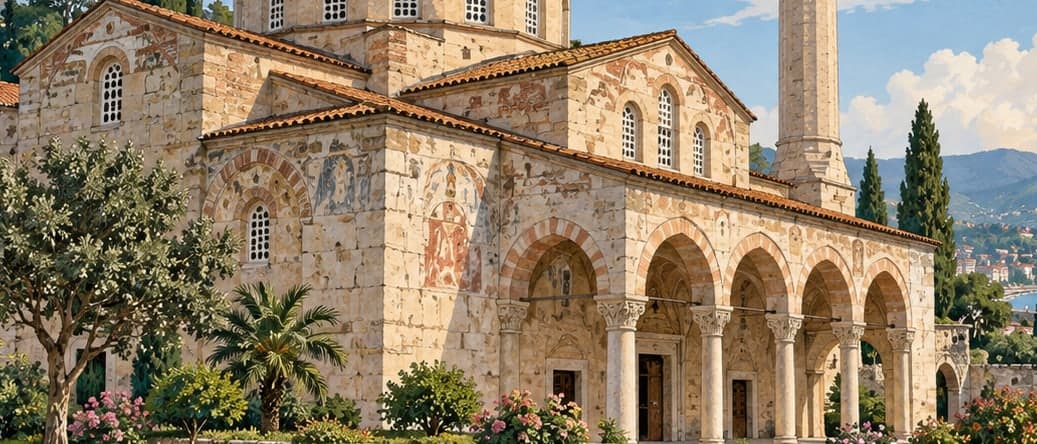
What survives in the upper part of Ortamahalle, the old quarter of Akçaabat, is the stone shell of a church and its tower. Its original name was Archangel, and it is also called Hagios Michael, or the Church of the Archangel. The building is cut stone, laid east to west, with a single apse; the main door is on the north side. Outside, the doors and windows are framed with rope-braid mouldings, and the drum of the dome is white stone worked in a Caucasian manner.
The floor is the thing worth going in for: a mosaic pavement of natural stone in black, white and red. Archaeologists put the mosaics in the eleventh or twelfth century. The date of the building itself is less settled, and the municipal account does not settle it. It says the church is thought to have been built at the end of the Byzantine period, in the twelfth or thirteenth century; elsewhere on the same page it calls the building seven centuries old. The traveller W. J. Hamilton, who came to Akçaabat in 1836, wrote that he had visited the church of Hagios Michael at Platona and that it had been built eight hundred years earlier in the old Byzantine style — a reading that would place it around the eleventh century, with the mosaics. A repair is recorded in May 1846.
The building has been restored for social and cultural use rather than reopened for worship, and is used for small gatherings — talks about the town and the quarter, painting, music — and as an art gallery, with its garden laid out alongside. Driving from the centre of Akçaabat, the municipality directs visitors along Milli Egemenlik Caddesi to the Harmancık locality and then, following the signs, about a kilometre past the Ortamahalle fork; the alternative is to turn left at the end of İnönü Caddesi and carry on for roughly a kilometre.