Guide
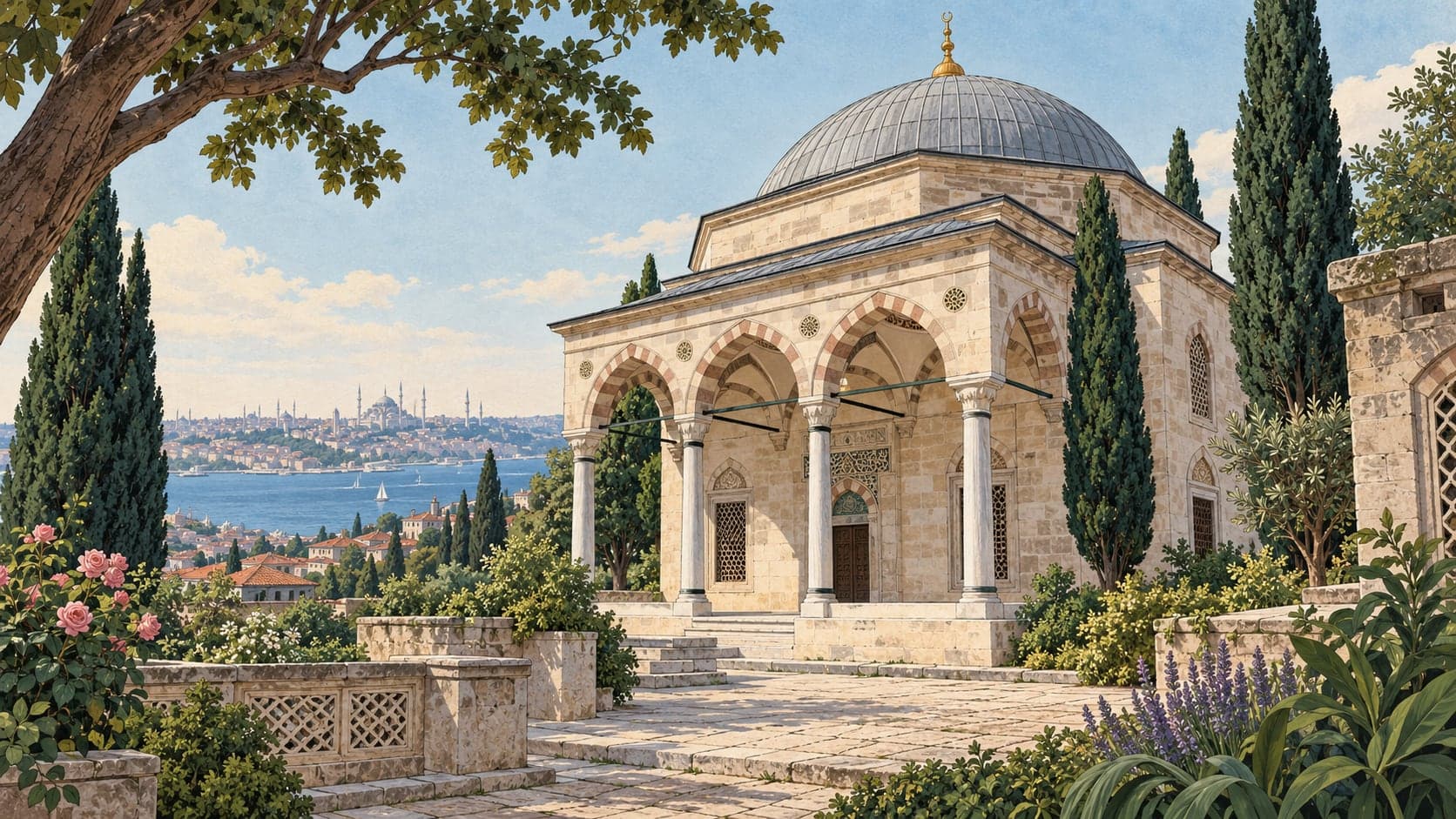
As it stands today Piyâle Paşa's tomb is a plain octagonal prism of well-cut küfeki stone under a shallow dome, with two windows one above the other on each face and no decoration inside or out. That plainness is not original. Remains and traces show that the building was once ringed by porticoes with flat lintels on octagonal columns under a wooden roof, in the manner of Süleyman the Magnificent's tomb, and the diamond capitals from that arrangement still lie scattered near the building. When the wooden-roofed portico collapsed in the eighteenth century a new one was put round it, in the taste of that time, on monolithic cylindrical columns with acanthus capitals; old photographs of it have been published, and those columns lie about the burial ground. The tomb has now been restored without a portico.
Inside are thirteen graves, three wooden cenotaphs and ten marble sarcophagi. By the sources the first row belongs to the pasha and one of his sons, the second to four sons and a daughter, and the third to two sons and a daughter. The sarcophagi are white marble and decorated not only with relief carving but with unusually interesting coloured painted work; most carry naturalistic plant motifs. None bears writing or a date, and they are placed at the end of the sixteenth century on the evidence of their form and their ornament.
The tomb was one building in a complex that Piyâle Paşa, grand admiral and a son-in-law of Selim II, had built in 1573: mosque, darülhadis, dervish lodge, tomb, graveyard, primary school, sebil, market and bath. It stands deep in the valley of the Pîripaşa stream north of the Golden Horn, at the foot of Okmeydanı — well outside Kasımpaşa and, until the middle of the twentieth century, outside the built-up city altogether.
Of all that, the mosque and the tomb survive. The market, the sebil, the school, the medrese and the lodge are gone; a powder works was built in the nineteenth century around the ruins of the double bath, whose remains can still be made out on the east side. Four gates once opened onto the site and only the western one is left, so that is the way in.