Guide
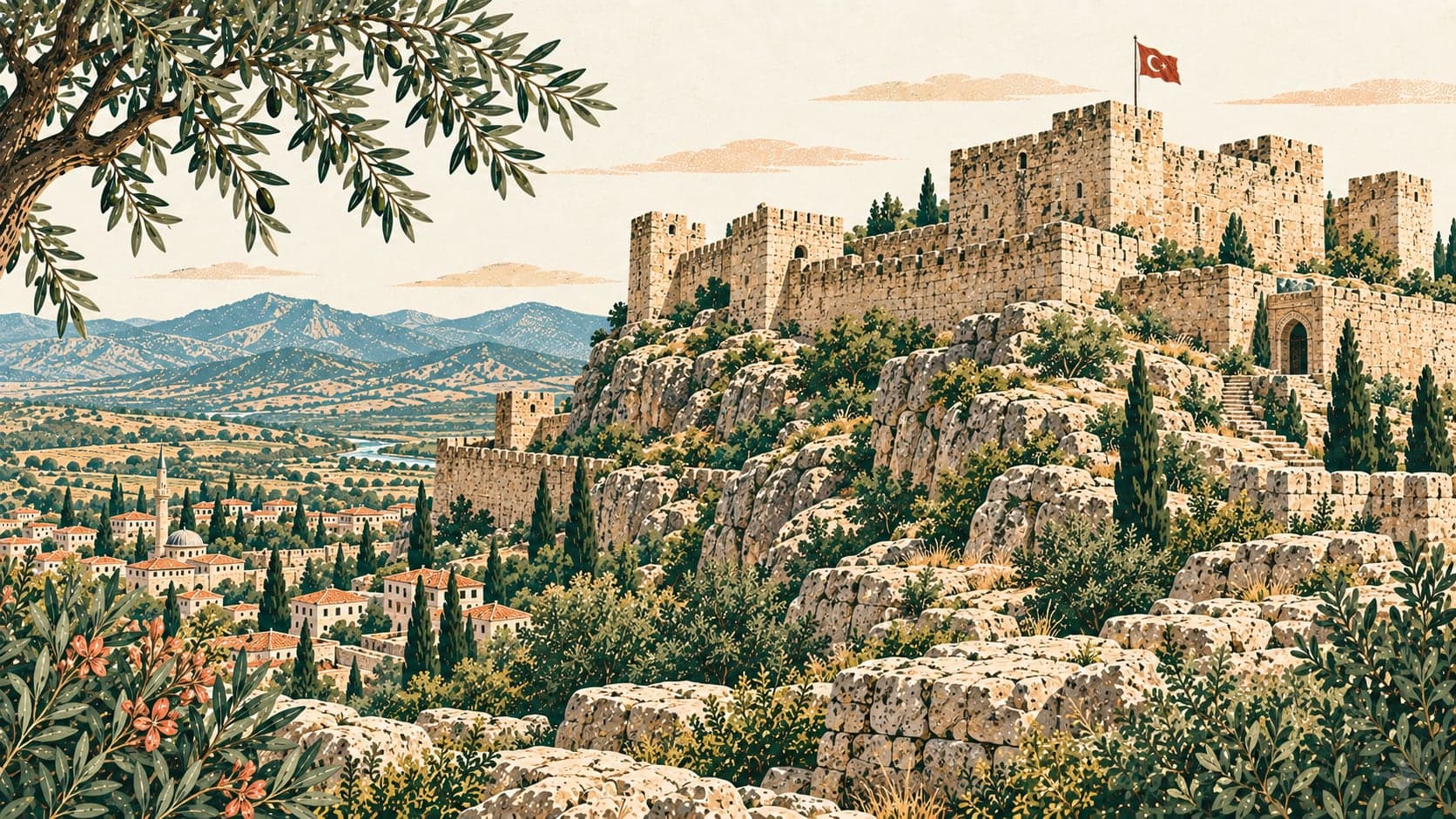
Ravanda Castle stands twenty-four kilometres north-west of Kilis, within the village of Belenözü — the old Ravandan — in the district of Polateli. Built on a high conical hill east of the Afrin stream, it commands a very wide view.
Its buildings occupy the level ground at the summit. Parts of the walls survive, along with some of the towers, angular and semicircular, set at varying distances from one another. What has come down to us is the inner castle; of the outer walls only foundations and rubble remain.
In the eastern part of the interior are two large cisterns with steps in front of them, and it is thought that a hidden passage led from these down to the Afrin stream. In the northern part are the remains of a building taken to have been a palace. The gateway of the inner castle, on the south, is 2.20 metres wide and 3.10 metres high; differences in technique and material show that it was repaired at various dates.
No archaeological excavation has been carried out at the castle or around it, so when the site was first settled is not known. It appears in the Islamic sources as er-Ravendan, in the crusader sources as Ravendel, Ravandal or Ravenel, and in the Armenian sources as Aréventan, and every state that held the region made use of it.
In the middle of the seventh century, during the fighting between Byzantium and the Islamic states, the Taurus mountains formed the frontier between the two. The lands east and south of those mountains were organised by the Muslims into the military zones called the Avasım and the Sügur, and many castles there were fortified. When the written sources list the castles of those zones, Ravanda is not among them — so at that date the castle did not yet exist.
One of the first notices of it comes from the records of Ibn al-Adim: at the time of the First Crusade, when the Christian forces were besieging Antioch in 1097, Ravanda was in the hands of Ridwan b. Tutush, the Seljuk ruler of Aleppo. The Latin documents record that in the same year the castle was taken from the Turks by Baldwin of Boulogne, who went on to take Urfa in 1098.