Guide
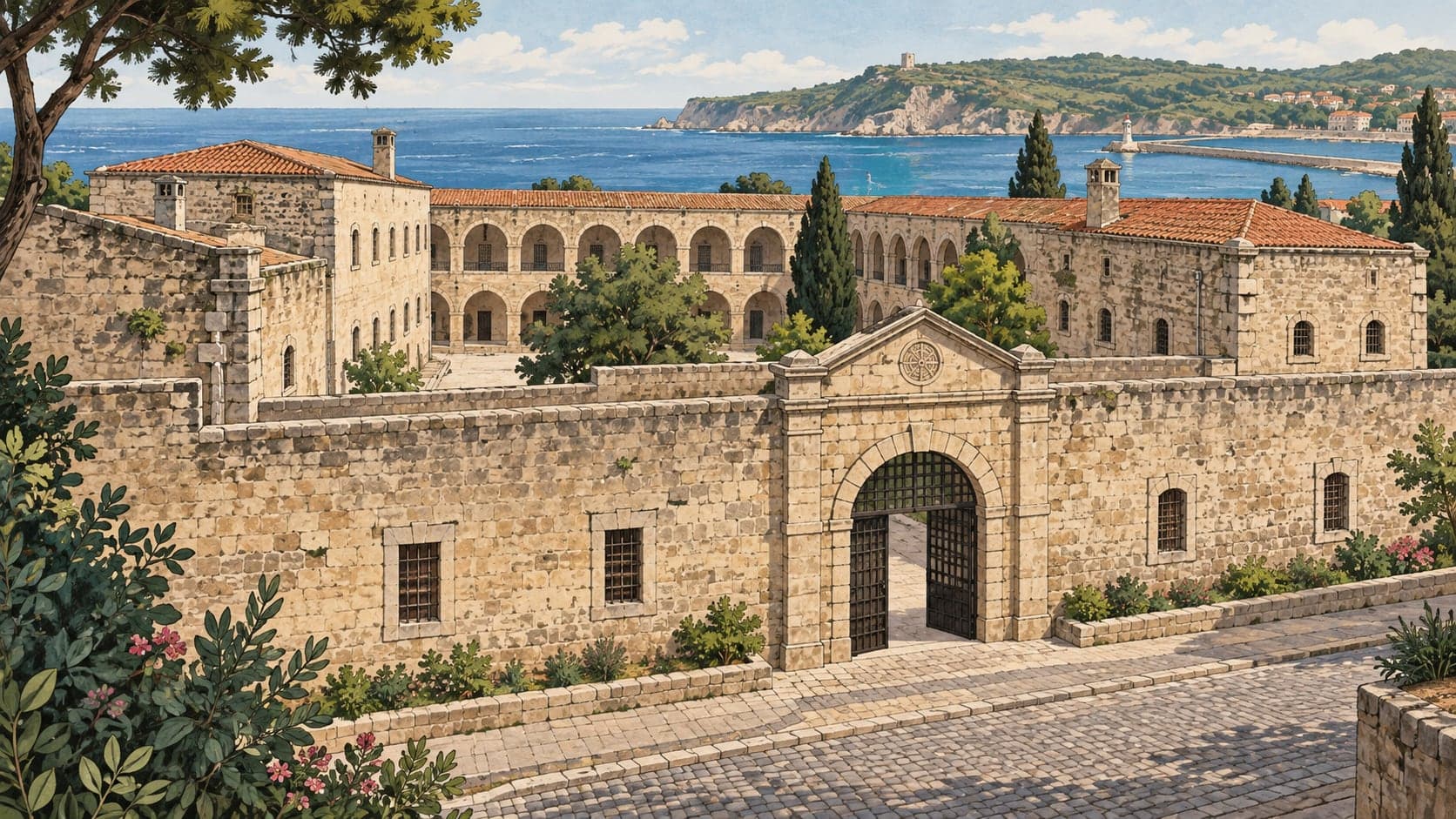
The prison sits inside the inner castle of Sinop, and the castle came first. After the Anatolian Seljuks took the town in 1214, Sultan İzzeddin Keykavus ordered an inner fortress built: a wall running north to south on the west side of Sinop Castle, parallel to the western defences, with eleven towers. A great deal of older material went into it — columns, capitals and inscriptions of the Hellenistic, Roman and Byzantine periods, reused as building stone. On the south side, facing the sea, the walls stand 18 metres high and the towers 22.
From the beginning the inner castle was also a shipyard, and two large arches belonging to it can still be made out in the south wall although they were later blocked. From 1560 the towers began to be used as a dungeon as well.
The prison building itself was put up in 1882, under the governor Veysel Paşa. It is a U-shaped block of cut stone running north to south, divided into three parts separated from one another by high courtyard walls: the northern and middle parts have two floors, the southern has a ground floor and two above. There are 28 wards. Inside the inner castle there is also a bath of the same date on the south-east side of the prison, a reformatory for children built in 1939 on the north side, and workshops built against the inside of the eastern wall.
Sinop prison, which the provincial inventory calls the Alcatraz of Anatolia, was emptied completely in 1996 and handed to the Ministry of Culture and Tourism. It reopened in 2000 as an open-air museum, and is at Kaleyazisi, Cumhuriyet Caddesi, within walking distance of the centre.