Guide
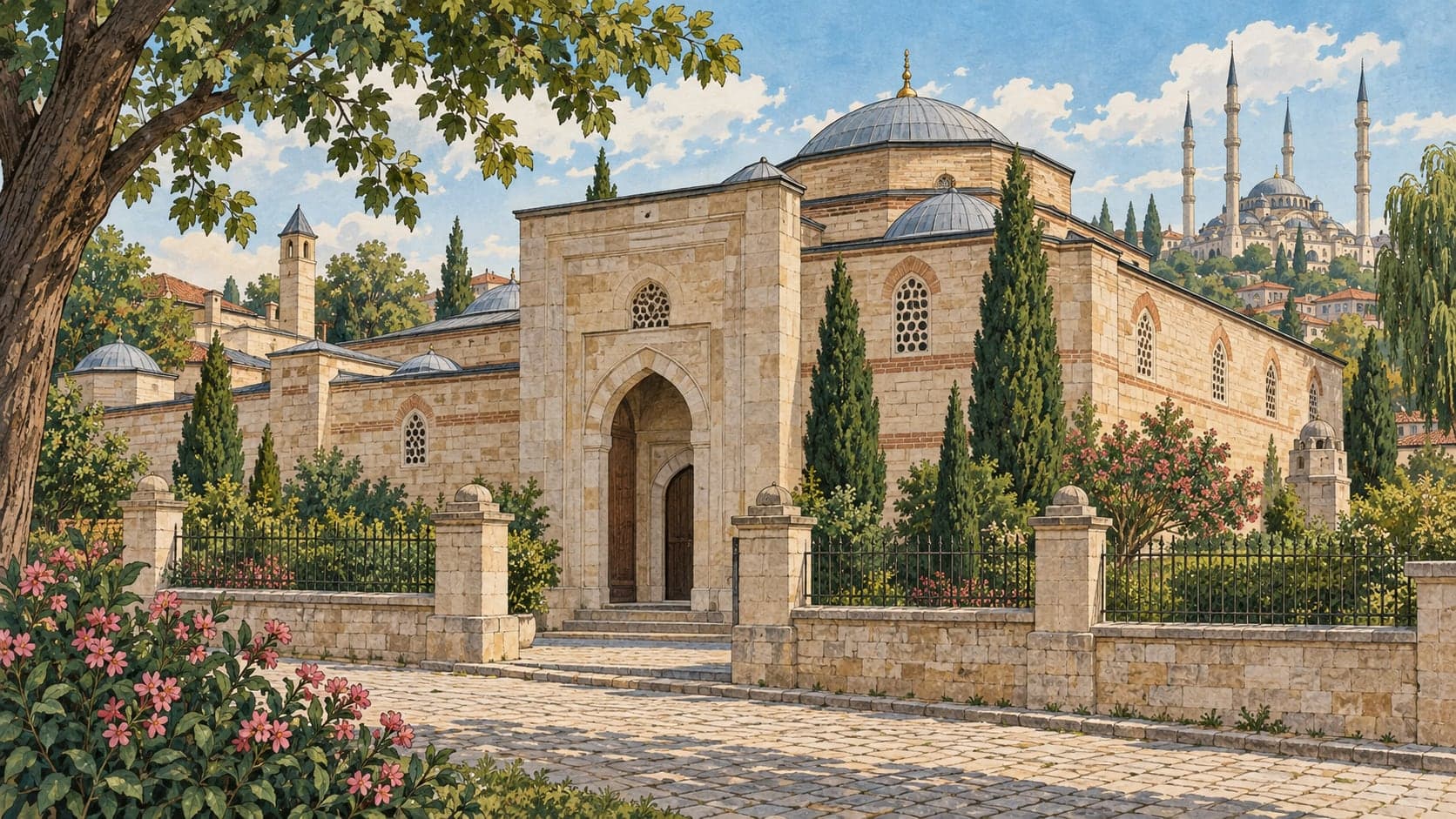
The health museum occupies part of a much larger complex on the bank of the Tunca, at Yeniimaret on the edge of Edirne. Bayezid II had the whole group built between 1484 and 1488 to the design of the architect Hayreddin: a mosque with a medical medrese, a public kitchen, a hospital, a bath, a kitchen and storerooms, spread over a wide site and roofed with something close to a hundred domes of varying size. Trakya University turned the hospital and the medical school into the museum, which the Council of Europe named European Museum of the Year in 2004.
What the hospital was for is the reason the place is remembered. The guiding principle in the darussifa, as the ministry's guide puts it, was to treat mental illness with music and the sound of water; the complex is also described as an important centre for the treatment of the eyes.
The plan can still be read on the ground. The darussifa has two parts: a rectangular main block and, attached to it, a hexagonal section for nervous and mental illness. Inside the entrance, the south-west side of the first courtyard has seven units behind a portico, six domed and the seventh vaulted, with the hospital kitchen in the north corner. A pointed-arched eyvan leads through to a second courtyard, and on its axis is the door to the hexagonal section — twelve units, each an eyvan or a room, ranged around a central space with a pool, under a dome with a lantern.
The medical medrese beside it is close to square, with eighteen domed rooms and a lecture hall around an arcaded courtyard. One detail there is worth looking for: a stair to the right of the entrance climbs to a gallery over the hall, put there so that students could watch medical procedures from above.