Guide
The sanctuary of Apollon Lairbenos sits on Asartepe, a small conical hill commanding the Menderes valley, on the south bank of the river about 35 kilometres from Hierapolis in what is now the Çal plain. At first sight it looks like one more of the local cult centres scattered across western Anatolia, and for a long time that is how it was read.
It has come to interest historians of religion for two reasons, and both rest on what is written on its stones. It is, according to the Culture Portal, the only place in Anatolia that has produced katagraphe inscriptions — texts assigning a person or a piece of property to the god. And it is one of only two areas that have yielded the confession inscriptions particular to western Anatolia, a practice that Christians later took up.
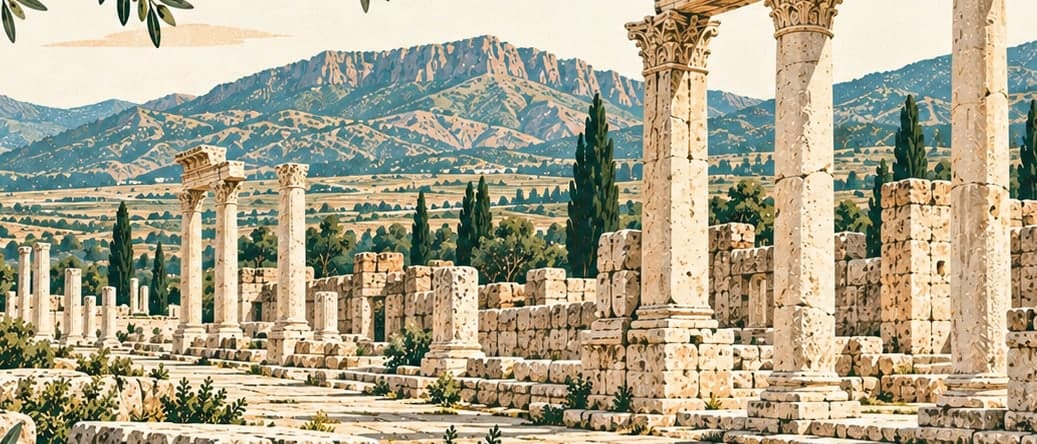
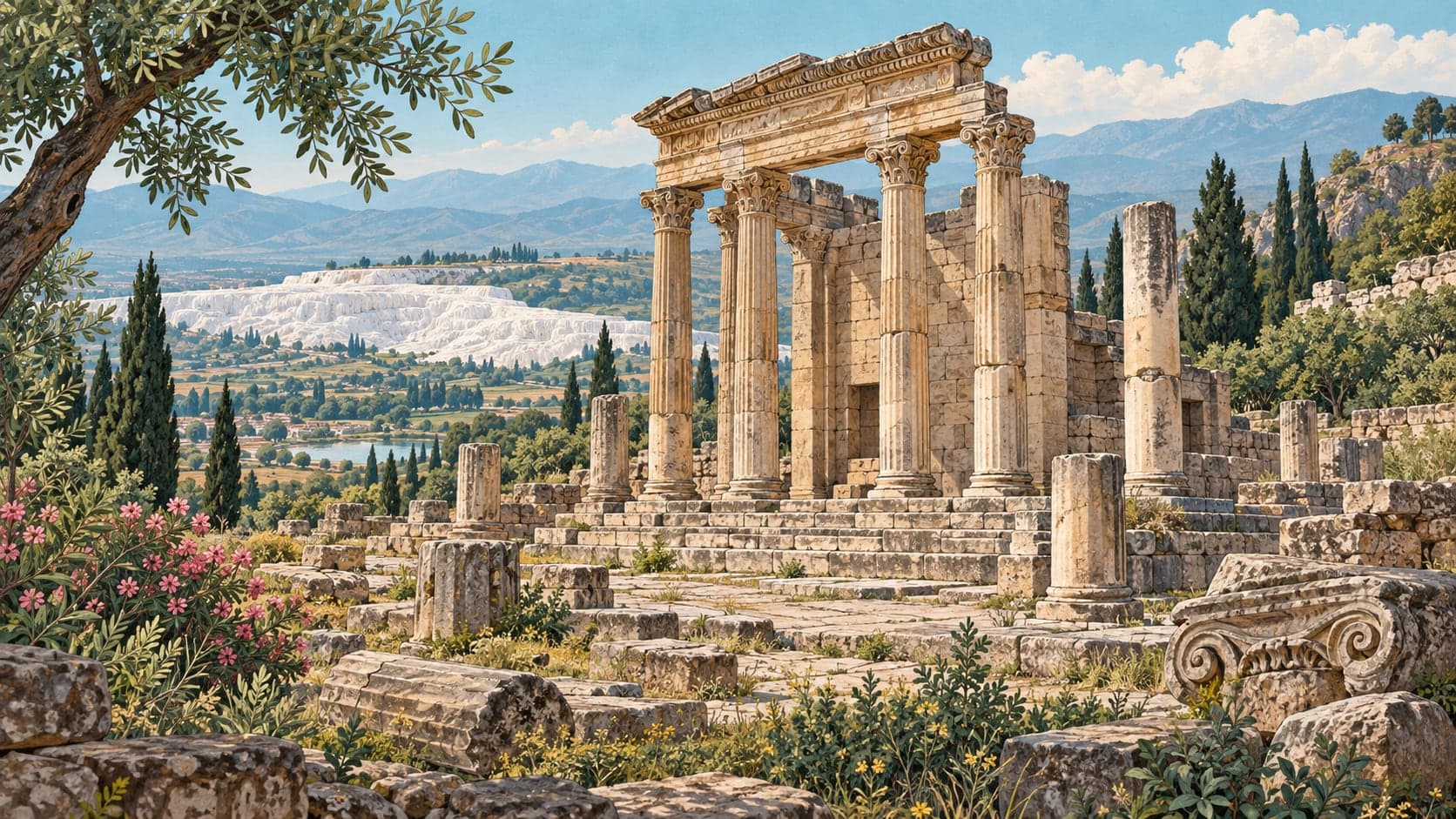
The site was identified in May 1887 by W. M. Ramsay, D. G. Hogarth and H. A. Brown. Judging by the other cult places in the region, the sanctuary was probably raised over an earlier centre of the goddess Kybele, in the second century of our era during the reign of Hadrian and shortly after. The temple itself stands at the western edge, on a high podium cut into the bedrock, aligned north-west to south-east, with four columns across its front and Corinthian capitals.
The god it was dedicated to is an Anatolian one. He is usually shown holding an ear of wheat, an oak branch or an offering bowl in one hand and a double axe in the other, and sometimes appears on horseback with a snake coiled around the axe on his shoulder. His name turns up in fourteen different spellings in the inscriptions found at the sanctuary and in the villages nearby, which suggests it was local and that Greek had no letter for one of its sounds; the coins of Hierapolis settle on the form Lairbenos.