Guide
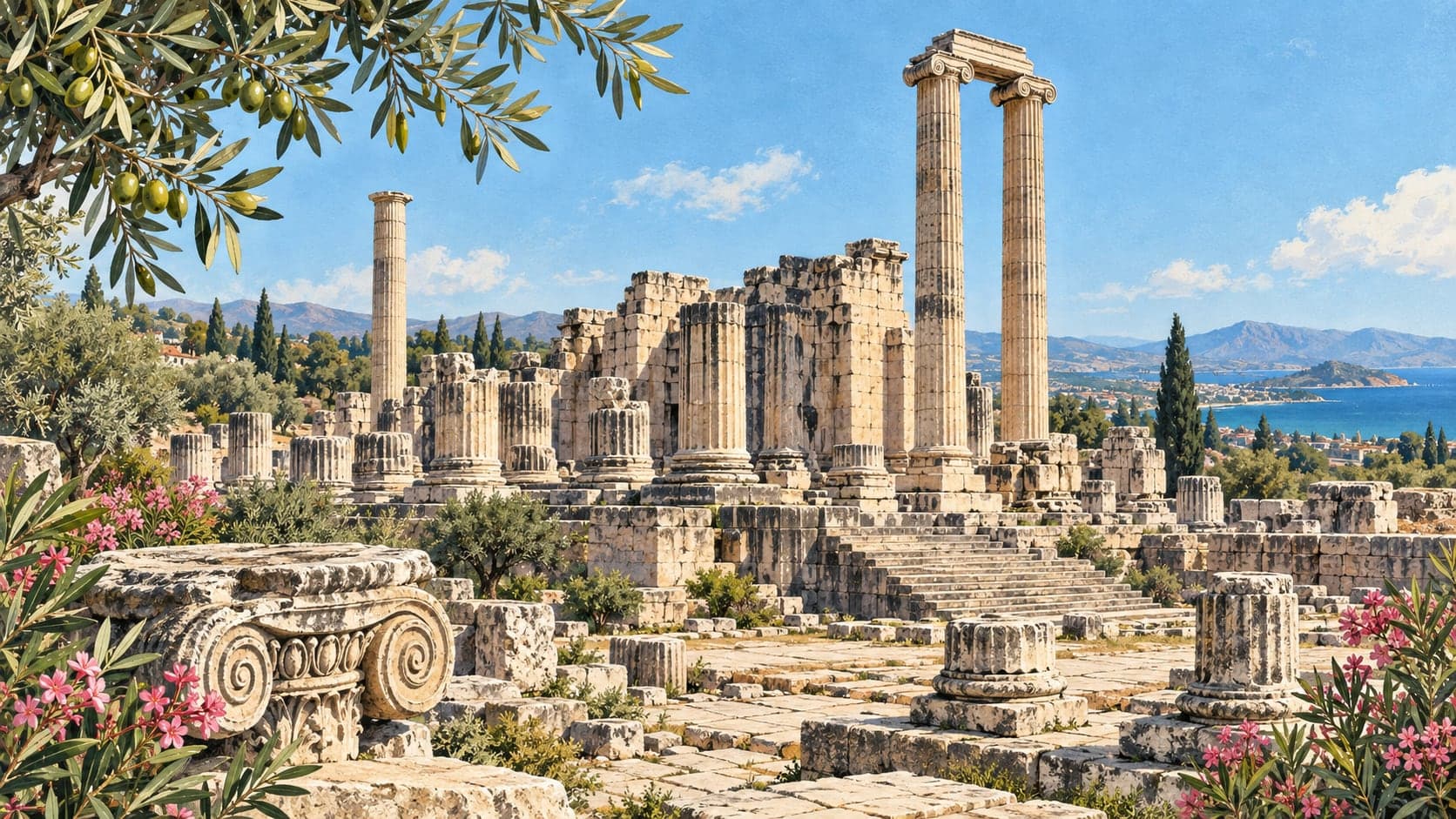
The ministry describes this as the third largest temple of the ancient world built in the Ionic order, and counts it among the best preserved. Scientific excavation between 1906 and 1913 brought it fully to light, and part of it was raised again; the protective wall that rings the site, built of architectural pieces too worn to place, dates from that same campaign.
A double row of columns wraps the building on the outside, making it dipteros in plan. The one element that breaks with convention lies further in: a courtyard open to the sky, with no stone paving on its floor. Inside that central court stood the sacred spring — whose exact position has still not been fixed — and a small temple, the naiskos.
The oddity of the plan follows from what the building was for. This was an oracle, and the shape served that function. An earlier temple of the sixth century BC had already won wide fame before the Persians destroyed it early in the fifth; the foundations still visible in the central court belong to it. The Hellenistic naiskos in that court was taken down in the fifth or sixth century AD and a Christian basilica built in its place, and the basilica, like the temple, was ruined by an earthquake.
Medusa guards the temple. She was the only mortal of the three sisters called the Gorgons, who in Greek myth had snakes for hair and faces so terrible that anyone who looked turned to stone.
Visit status for this record: open to visitors.