Guide
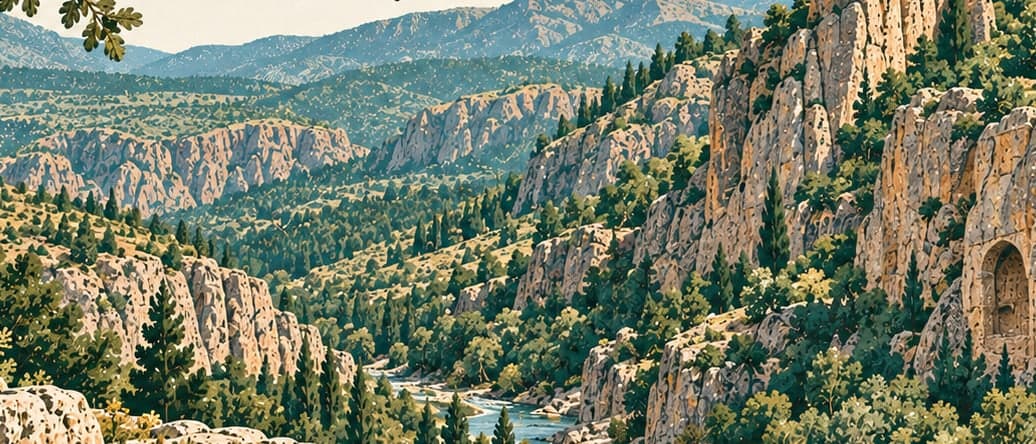
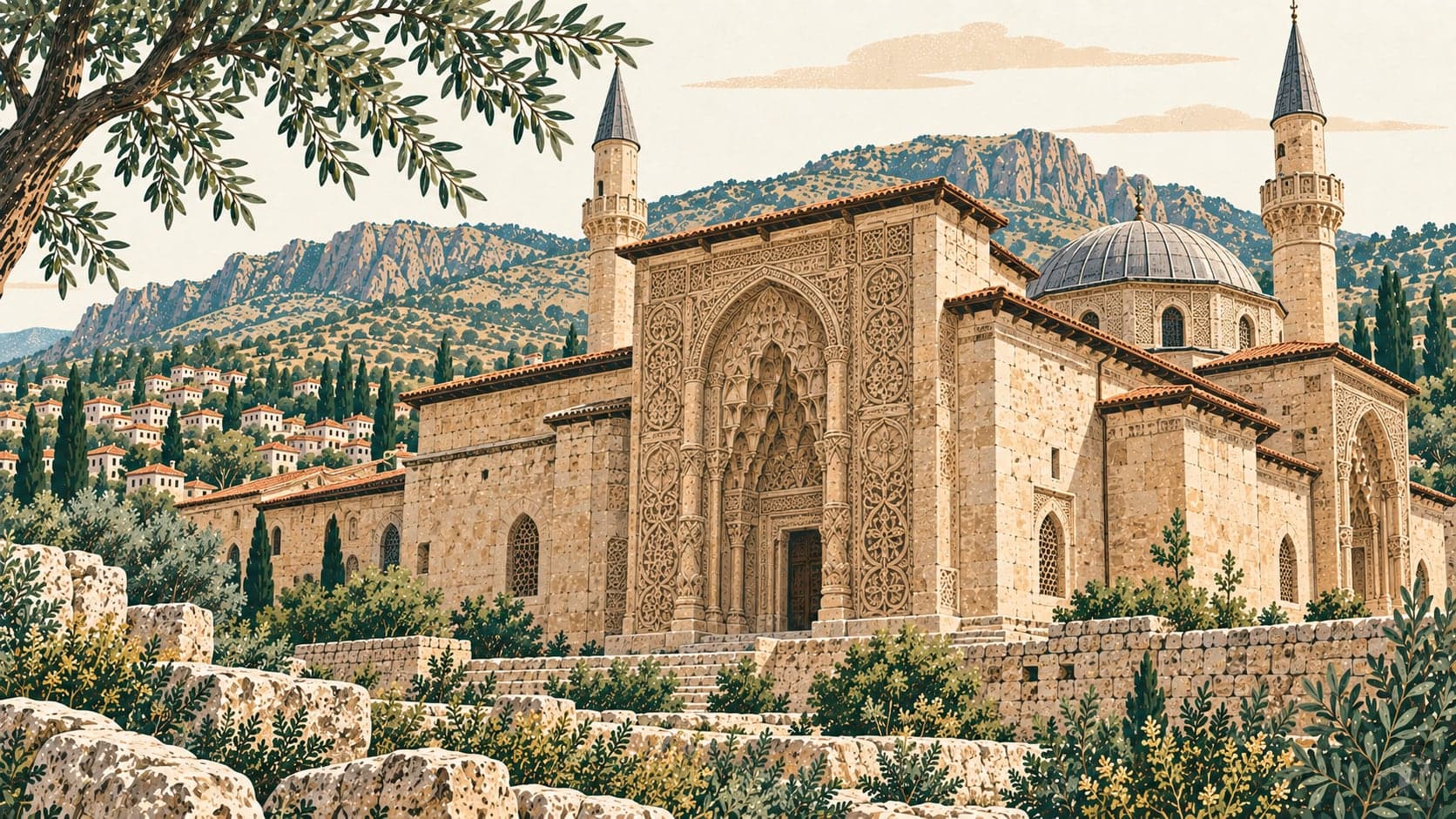
The Great Mosque and Hospital of Divriği stand in the Divriği district of Sivas: a mosque and a hospital built together. Both date from 1228-29. The mosque was commissioned by Ahmed Şah, the Mengujekid ruler; the hospital by his wife Turan Melek, daughter of Fahreddin Behramşah, the ruler of Erzincan. The architect was Hürrem Şah, son of Muğis, from Ahlat. The complex was inscribed on the World Heritage List in 1985, the first architectural work from Türkiye to enter it, and since 2024 it has lain within Divriği National Park, the fiftieth national park in the country.
The prayer hall is divided into five aisles running perpendicular to the mihrab, the central one wider than the rest. Over the bay before the mihrab rises a ribbed dome, covered outside by a pyramidal roof resembling a tomb and made to dominate the building from without. A lantern opens in the central aisle, and fan-shaped Turkish triangles carry the transition to its dome. Every aisle is vaulted differently, each with its own star vault. The building lets you see the Seljuk courtyard plan and the Umayyad plan side by side.
In plan and in ornament the complex has no equal. Its three portals share no common style and each is carved differently; the decoration is exuberant and baroque in character, and includes the double-headed eagle. The western portal bears the double-headed eagle that was the emblem of Alaeddin Keykubad together with the falcon that was the emblem of Ahmed Şah.
Inside, the wooden royal gallery survives only as the marks of its beams, yet it is among the earliest examples in Anatolia. The ebony pulpit was made with great care, with bands of raised thuluth script and star motifs, and the mihrab, exuberant and set with large palmettes, is another of the principal parts. Names are written into the building itself: the painter Ahmed of Ahlat above the window on the eastern front, which was originally the door of the ruler's gallery; Ahmed son of İbrahim of Tbilisi and the calligrapher Mehmed on the pulpit; Ahmed son of Mehmed on the band of verses along the southern wall. Though a modest complex by Seljuk standards, it is remarkable for carrying the names of six artists, evidence of teamwork in the Mengujekid orbit as well as the Seljuk.
The hospital leans against the southern wall of the mosque. Its central section is covered by a lantern dome and, counting the entrance, it opens into four iwans; a tomb occupies its northeastern corner. Water overflowing from the pool at its centre runs around the pool through a square channel and leaves the building in a circle.
Two things visitors are told to look for. When the afternoon sun falls on the mosque's entrance, the shadows form the standing figure of a man seen from the side, with another shape like a rectangle before him; these shadows are believed to be a man reading the Quran and praying. And the traveller Evliya Çelebi wrote of the building that the master had laboured so over its marble, and worked its door and walls into such shifting ornament, that tongues fall short in praising it and the pen breaks.
According to its inscriptions the complex was substantially restored many times between the fifteenth and nineteenth centuries. Further restoration work followed in the twentieth century to counter material decay and structural problems, and another major restoration was decided upon in 2010.
Visit status for this record: open to visitors.