Guide
A sixteen-sided tomb of cut stone on Câmiikebir Caddesi in Eyüp, begun by the Ottoman grand vizier Ferhad Paşa and finished some while after he was put to death. The date is on the building: above the slightly depressed two-coloured stone arch of the doorway, a sixteen-line inscription gives 1004 — 1595 — in the letter-reckoning and again in figures.
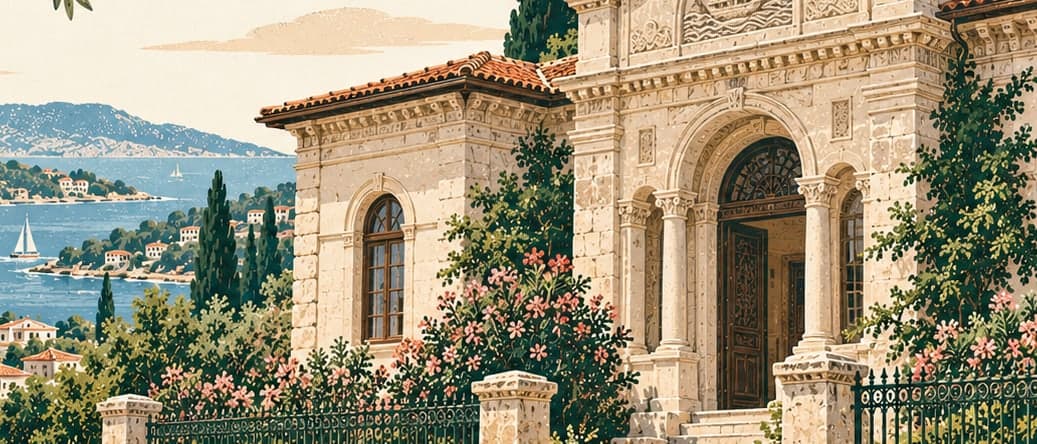
You enter through a flat-roofed portico on the north front carried on four square columns, open in three arches at the front and one to each side. The façades, with coloured stone used here and there, are divided by rounded piers that finish at the top like capitals; above them runs a projecting cornice of one row of muqarnas and one of palmettes, and a lead-covered dome closes the building. Every façade on the avenue side has windows, and the rear ones every other bay: rectangular below with marble openwork tympana, ogee-arched above.
Inside, the faces of the blind walls carry cupboard niches, their marble tympana bearing gilded Qur'anic inscriptions, and the lower tympana and the upper windows are closed with painted glass. The dome is painted with rumi scrollwork and palmettes in blue and white with brick red among them, and a medallion of the ninety-nine names at its centre. Eight marble sarcophagi, none of them inscribed, and four wooden cenotaphs stand on the floor.