Guide
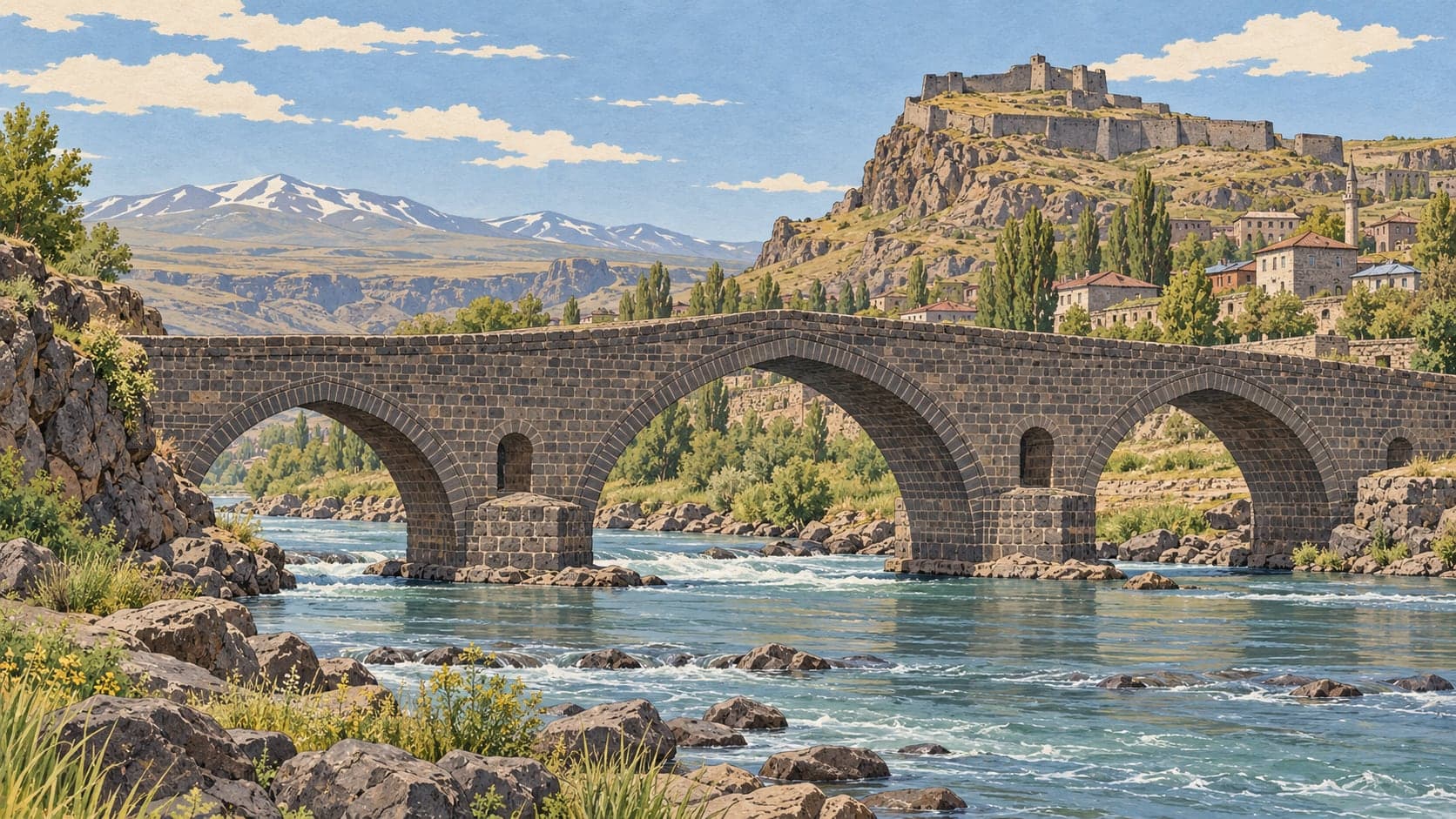
The Ani Bridge, also called the Silk Road Bridge, is a stone bridge over the Arpaçay river, which marks the border between Türkiye and Armenia. It stands at the point where the historic Silk Road first entered Anatolia. Its north-western pier lies in Türkiye and its south-western one in Armenia — today between the village of Ocaklı in Kars and the village of Haykadzor in the Armenian province of Shirak. In 2016 it was added to the UNESCO world heritage list as part of the archaeological site of Ani.
The bridge takes its name from Ani, the medieval Armenian capital. Because it stood where the Silk Road came into Anatolia, the name Silk Road Bridge is also widely used; from the argument that it was built under the Great Seljuks it is sometimes called the Seljuk Bridge; and local people call it the Arpaçay Bridge after the river.
The bridge as it stands is thought to have been built in about the ninth or tenth century, during the great building works at Ani under the Armenian Bagratuni kingdom. Yaşar Kop of Kafkas University in Kars has argued instead that it was built at the beginning of the twelfth century under the Great Seljuk empire and was heavily damaged by wars and earthquakes, adding that an inscription of 1119 records cotton and linen being carried across it. On the evidence of its architecture, the bridge is thought to have taken its final form in repairs during the thirteenth and fourteenth centuries, after the fighting of that period.
The bridge had two levels: the lower one for caravans to cross, the upper for people on foot and for soldiers. Its arch was pulled down entirely by Russian forces on 16 October 1807, during the war between the Ottoman and Russian empires, to stop passage across it. In the 1850s the French orientalist Marie-Félicité Brosset showed a military post beside the bridge in his engravings, but no such building is found at the site today.
The bridge runs about thirty to thirty-two metres in length and ten to eleven metres in width; the source gives the span of its single pointed arch as thirty-five metres. The core is of rubble stone and the outer faces of neatly worked ashlar.