Guide
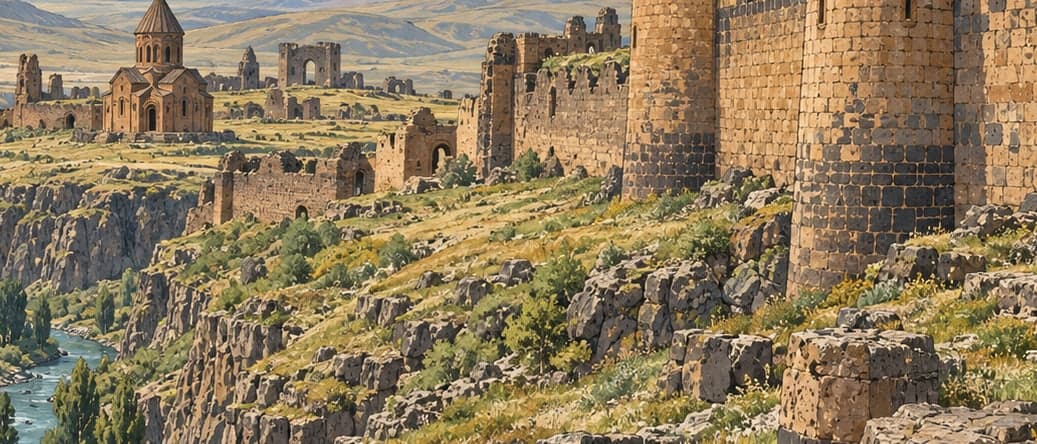
The citadel is one of the buildings registered as immovable cultural property at Ani. It is reached by a footpath on the south-west stretch of the road passing in front of the Ebu'l Menûçehr mosque, and it sits on a high hill. Because it was built on ground suited to defence, it is hard to get to.
It was built at the end of the fourth century AD by the Kamsarakans. Walls ring the top of the small hill in a circle, and within them are the remains of a church and a palace; the other buildings in the citadel are entirely buried. Everything here, standing or ruined, is built of the volcanic tuff of the region, and in architectural terms the citadel is the forerunner of the buildings in the city below.
The palace stands in the northern part of the citadel. Who built it and when is not known; it is thought to date from the period of the Kamsarakans. Palace buildings of this kind are rare enough that the complex is informative about how they were laid out and what they contained. It is ruined today, but it has been established that its buildings were set on both sides of a corridor running east to west, and that it held a large number of rooms, some of them on two floors, along with three ceremonial halls and a bath.
The church lies in the eastern part of the palace. According to an inscription formerly on its south wall it is said to have been built in 622 by a man named Absalon, which would make it the oldest dated church at Ani. The chapel built joined to its north side is two storeys, an arrangement rarely seen and the only example at Ani.