Guide
Kuyucu Murad Paşa, grand vizier under Ahmed I, died at Diyarbekir in 1611; his body was brought to İstanbul and buried in the tomb he had already built beside his medrese on Vezneciler Caddesi. Apart from a Qur'anic inscription over the door the building carries no inscription at all, and one source shows the medrese was finished in April 1610. Some researchers attribute the complex to Sedefkâr Mehmed Ağa, who was chief court architect in those years, but it is not certain that it is his work.
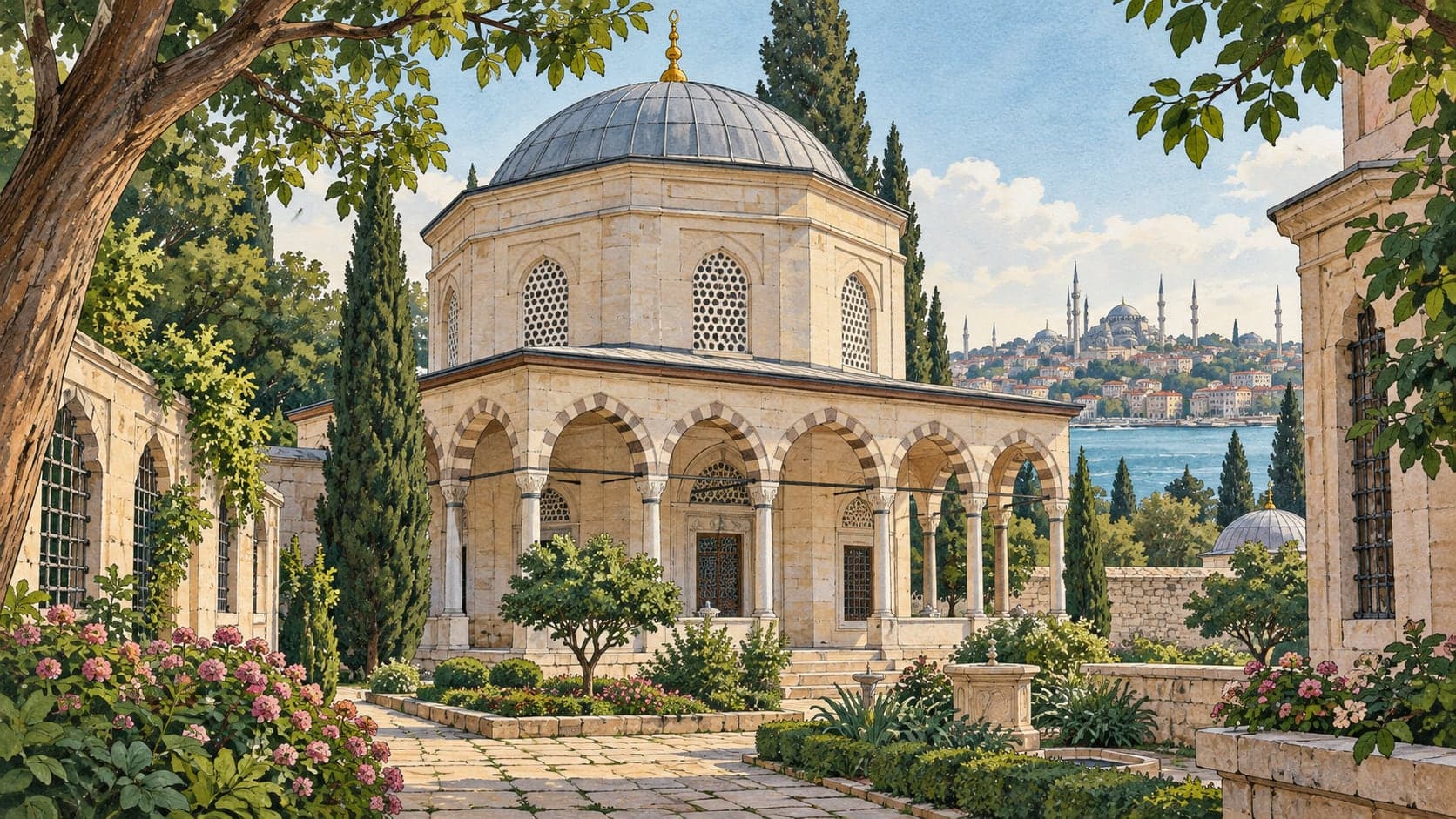
The tomb stands at the south-east of the medrese, built against the lecture hall and mosque. It is of cut küfeki stone on a square plan, roofed today with a four-pitched lead-covered roof over a wooden ceiling, though it is known to have had a dome. Before its bow-arched door, set off to the right on the south-east side, is a canopy of three pointed arches on marble columns with muqarnas capitals. Two rows of windows light it, rectangular below and arched above; one lower window on the door side opens into the sebil, and on the wall opposite two windows open into the lecture hall, while the two side fronts have two windows each to the outside and there are two cupboard niches within. Besides the grand vizier, Abaza Mehmed Paşa and Mehmed Paşa, son of Cigalazâde Sinan Paşa, are buried here. The building is in need of care.
Attached to the tomb at the south-east of the complex is a marble-faced sebil with five projecting faces, once a corner sebil, entered by a bow-arched door and covered by a lead-clad wooden dome; its pointed-arched fronts rest on marble columns with muqarnas capitals and are closed with metal grilles in geometric compositions. A rectangular opening looks from inside it into the tomb, and in the corner opposite the door are a marble cistern and a well; its water once came from the Süleymaniye conduit.
The complex has had a rough time of it. The tomb was damaged in the great fire of 1782, the primary school collapsed in the earthquake of 1894, and the Uzunçarşı fire of 23 July 1911 left the group partly ruined; a survey of January 1919 found the medrese occupied by people burnt out of their homes. The buildings were restored between 1943 and 1950, and the fine arts department of İstanbul University works in the medrese today.