Guide
The building known as the Ankara Palas Hotel stands on İstasyon Boulevard in the Nazilli district of Aydın and was built as a hotel between 1923 and 1930. It serves today as the private ethnography museum of the Nazilli municipality.
The film Anayurt Oteli, adapted from Yusuf Atılgan's novel, was shot here, and since then the building has been known by that name as well.
During the Turkish war of independence, before the regular army was formed, the building belonged to Demirci Mehmet Efe, who was active in the region, and for that reason local people also call it the Demirci Mehmet Efendi Hotel. It served for a time as a tax office, a police post and a dwelling, opened as the Ankara Palas Hotel in 1952, and after restoration became the private ethnography museum in 2010.
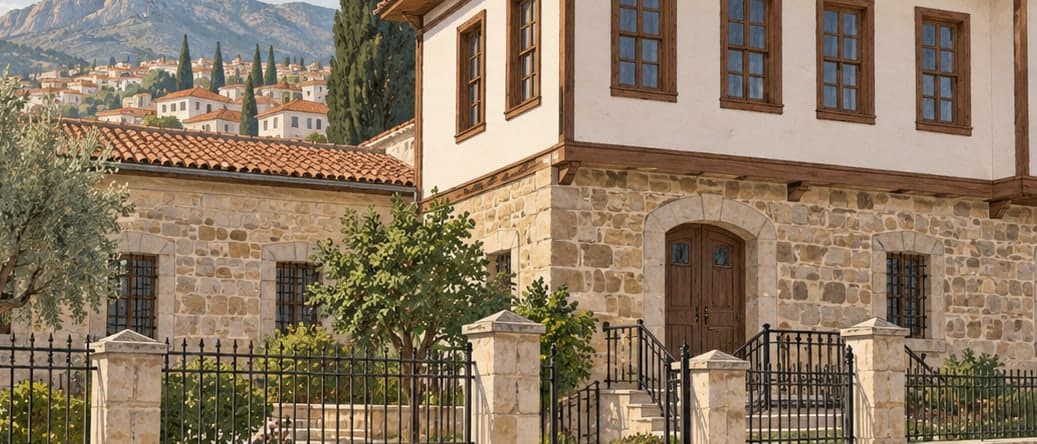
The building shows the architecture of the classic republican period. It has three floors — basement, ground and first — under a hipped wooden roof covered with local tiles, and many windows on its faces. Above the rectangular double-leaved main door is a small balcony.
The ground slopes from north to south, and the three floors are arranged across that slope. Stone and brick were used in the building, with the hipped roof covered outside in ridged tiles. The southern face, looking towards the railway station, was treated as the main front. At its centre is the rectangular double-leaved iron door of the ground floor, reached by steps, with a window opening above it in the pediment; the section between the door and that upper window is ornamented with a plaster crest of curling branches. The balcony door of the first floor was set directly above the ground-floor entrance, and the windows of the two floors line up with one another.
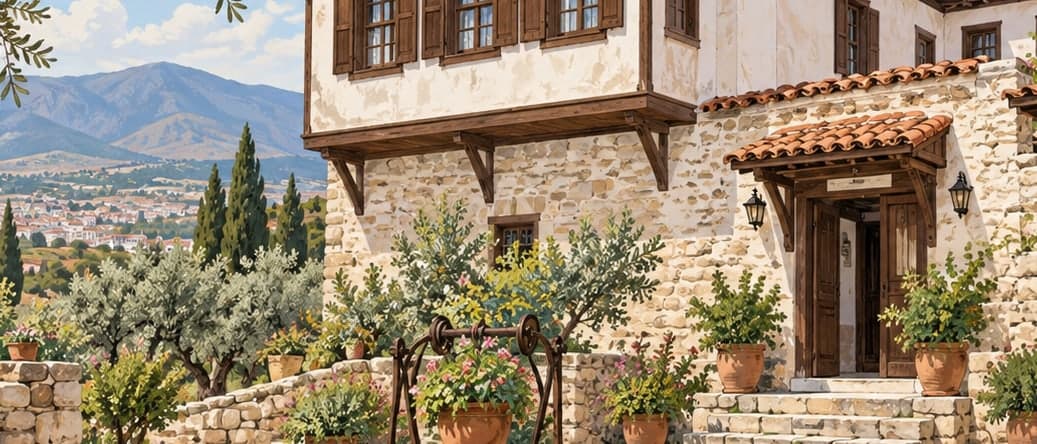
The garden on the north side was added later. On the northern face the rectangular entrance to the basement was made in the form of a recessed vaulted porch set into the middle of the two-flight staircase of the ground floor, and the openings here were arranged symmetrically with those on the southern face.
What the museum keeps and shows is the memory of the district. Material of the war of independence and of the Sümerbank printed-cloth factory takes up much of it: sewing machines, tools and equipment and pattern work from the factory are here, along with the first and the last lengths of printed cloth woven there.