Guide
The Nemrut archaeological site lies in the Kahta district of Adıyaman, on the summit of Mount Nemrut at an altitude of 2,150 metres. Here stand the tomb of the Commagene king Antiochos I and a group of colossal statues. The king declared himself a god and had this sacred precinct built while still alive, to make his name endure. The kingdom of Commagene held the region for roughly two centuries; the accession dates of its kings are not firmly known, but the sources indicate that Antiochos I reigned between about 70 and 32 BC.
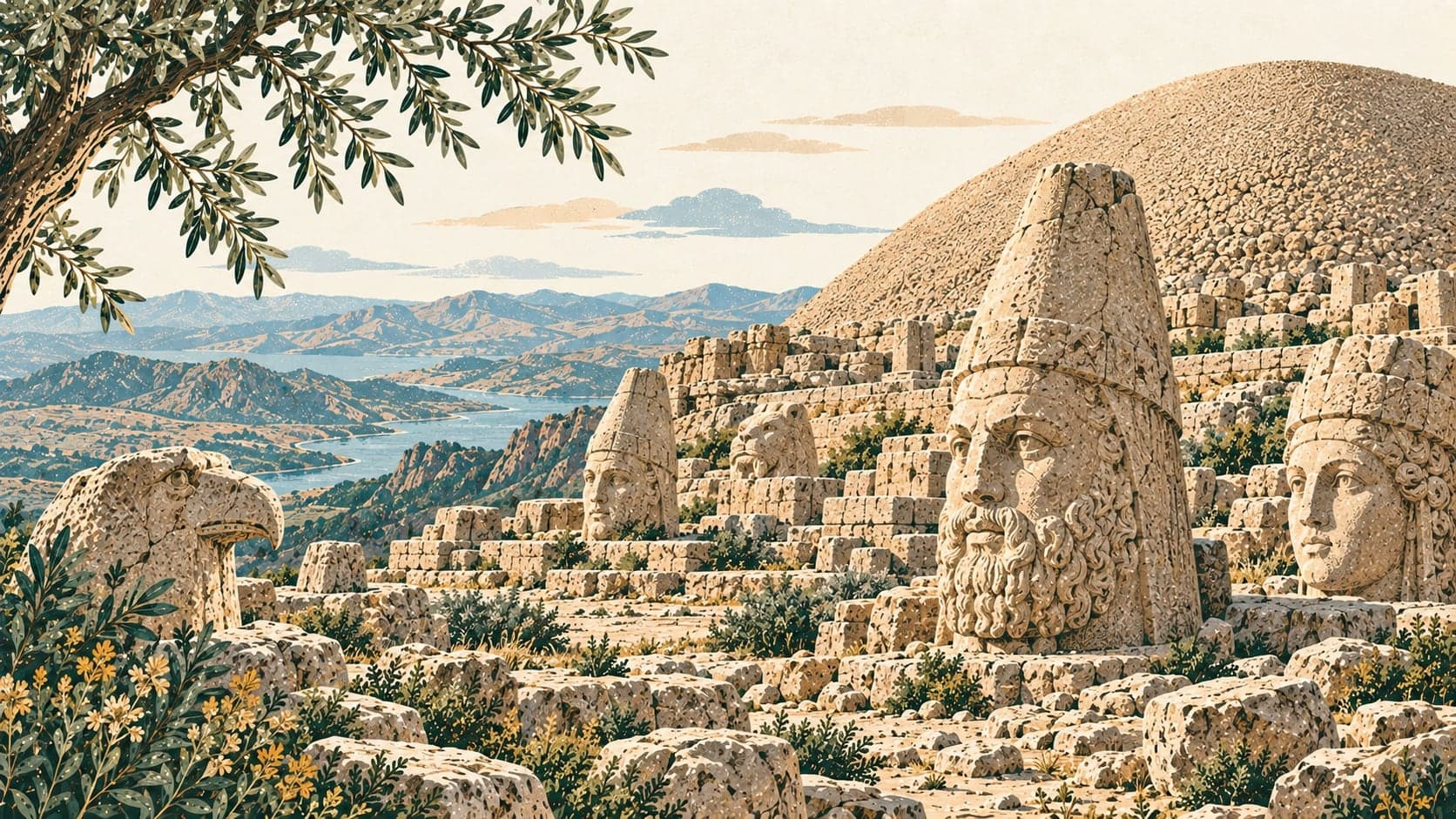
The precinct counts among the most imposing remains of the Hellenistic period. It consists of a tumulus enclosed on three sides by terraces, on which the giant statues and relief stelae were set. The tumulus, the king's funerary monument, was raised from broken rock and gravel; today it stands about fifty metres high and a hundred and fifty metres across. Although the inscriptions state that the king is buried here, no burial chamber has been found. The prevailing view is that his bones or ashes were placed in a chamber cut into the bedrock, then protected beneath the artificial mound.
The statues are spread over the eastern, western and northern terraces around the tumulus. Of the three, the eastern terrace has kept its coherence best. The eastern and western figures are all but identical apart from small details: Greco-Persian in manner, carved from limestone blocks. Reaching eight to ten metres, these enthroned deities have partly collapsed, their heads now lined up on the ground before them. From left to right they are the god-king Antiochos I, Commagene as the land's mother goddess, Zeus as chief god, Apollo and Heracles. A lion and an eagle flank them on either side: the lion stands for the kingdom's dominion over the earth, the eagle for its dominion over the sky. The figures were placed to face the horizon.
On the backs of the bases forming the thrones runs an inscription of 237 lines, the king's testament on religious and social matters. The eastern terrace also carries relief stelae of members of the Commagene royal family.