Guide
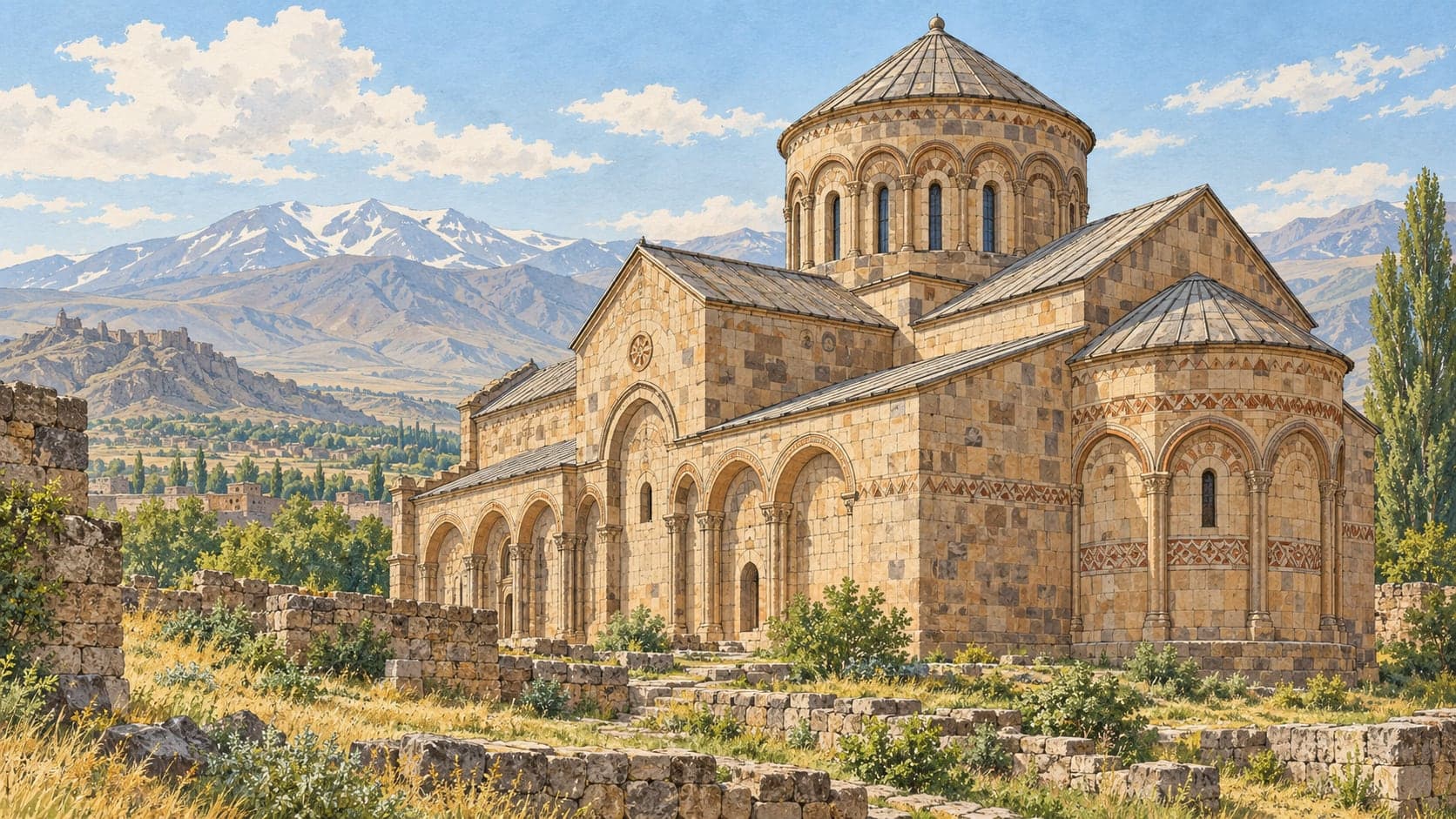
Öşvank stands in the village of Çamlıyamaç in the Uzundere district of Erzurum and is known for its coloured stone ornament and its figures in relief. According to the inscription on the entrance front of the south arm of the cross, it was built between 963 and 973 by Bagrat the magistros, son of Adarnase III, in the time of the Georgian Bagratid dynasty; the architect was Grigor of Öşk. The church is dedicated to John the Baptist, and its great dome was repaired between 1022 and 1028 by the Byzantine emperors Basil II and Constantine VII.
The frescoes, of which a great many can be seen inside, were painted in 1036 by Jojil Potrikios.
Twelve windows open in the drum of the dome, their outer faces bounded by mouldings in relief; pointed-arched, tall and narrow, they carry a gothic character. The plan is a cross, with crossed arms on the outside, while inside there is a three-lobed section formed by the apses and a long arm continuing from it. The bases of the columns within are decorated with plant motifs and religious pictures.
The covering of the apse has collapsed. On the front of the church one of the columns belonging to the added section has not survived, and a tree trunk stands in its place. The west arm of the cross is surrounded by added rooms on its west, north and south sides; the two-storey northern one belongs to the original building while those to the south and west were added later. Within the church are a bath, a dormitory, a baptistery, priests' houses, a kitchen and a library.