Guide
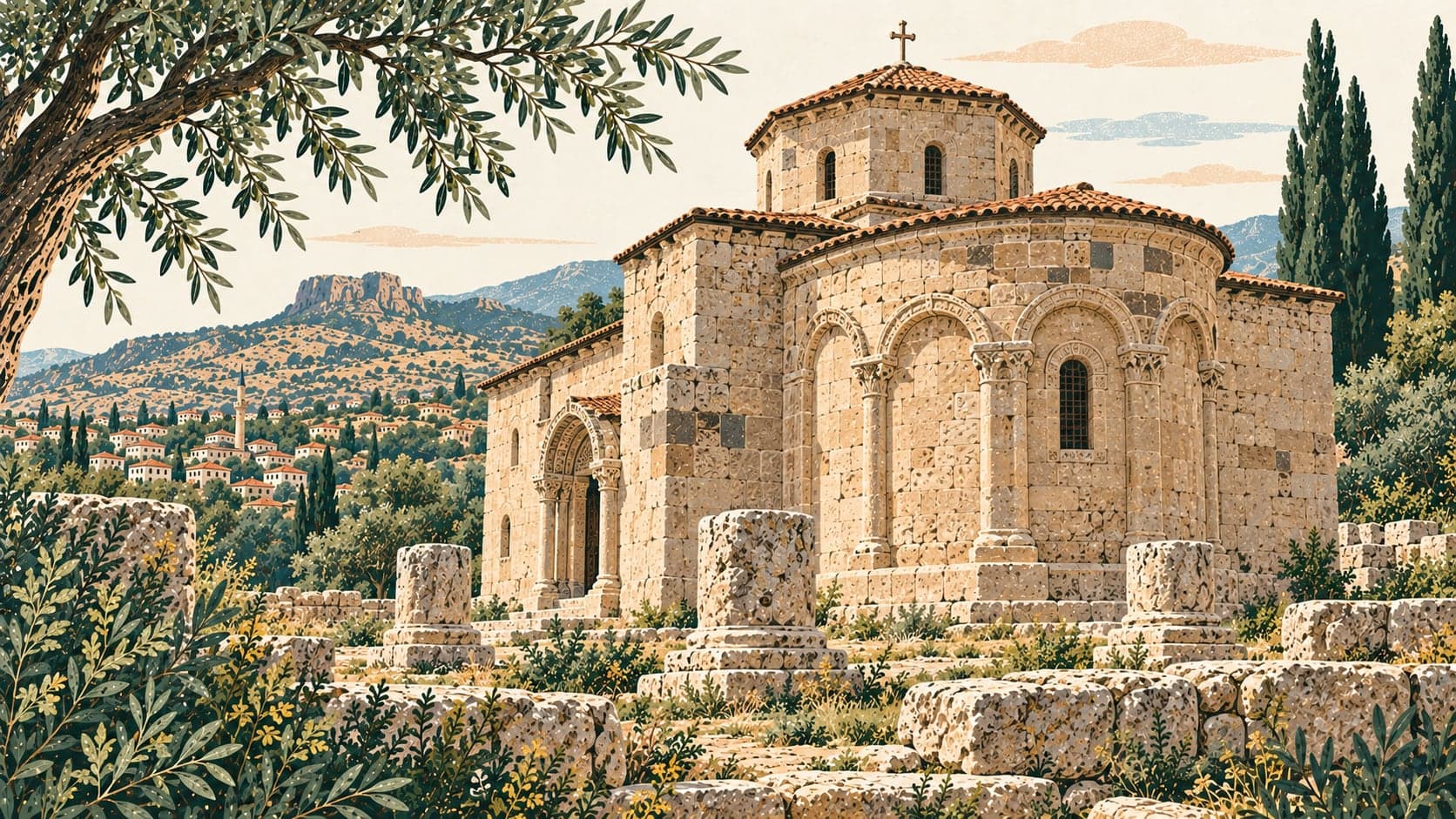
The Üçayak church stands thirty kilometres north of Kırşehir. Estimated to have been built in the tenth century, it is a Byzantine church with two domes, made entirely of brick. What makes it unusual is its isolation: it stands well away from the ancient settlements around it and holds no other historical remains. Everything but its columns has now fallen.
The church rose on six large columns, three at the front and three at the back. Seen from front or back these look like three legs each, which is why local people call it Üçayak, the three-footed. Its Byzantine name is not known, nor is the name of the settlement it stood in. There are no large settlements nearby. There is a spring close by, but the absence of any other human work in the area shows that the church was built in a wholly isolated and empty place.
The first account of it was given in 1842 by the English traveller W. F. Ainsworth, whose engravings gave further clues to the original form of the building. The English archaeologist J. W. Crowfoot, who visited the ruins in 1900, and the Austrian art historian J. Strzygowski in 1903 took the first photographs and gave fuller accounts. A detailed and wide-ranging study was made by the Turkish art historian Semavi Eyice and published in a French archaeological journal in 1968; in it he produced a restitution of the church and concluded that when whole it reached a striking height of seventeen metres including the dome. He also established that this is the first and only church within the boundaries of Türkiye built entirely of brick.
Eyice carried out an excavation in July 1970 with students from İstanbul University and young people from the villages nearby, which gave fuller information about the apse, narthex, dome, arches and interior.
The dome arches, pendentives and pieces of drum that had remained standing were thrown down in the Kırşehir earthquake of 1938. Ahi Evran University announced in January 2010 that it would restore the church, but the work has still not begun.
No old source has been found giving any information about the building of the church. No remains of the civil settlement that would normally stand around such a building have been found either, and the church did not serve as a monastery where monks withdrew.