Guide
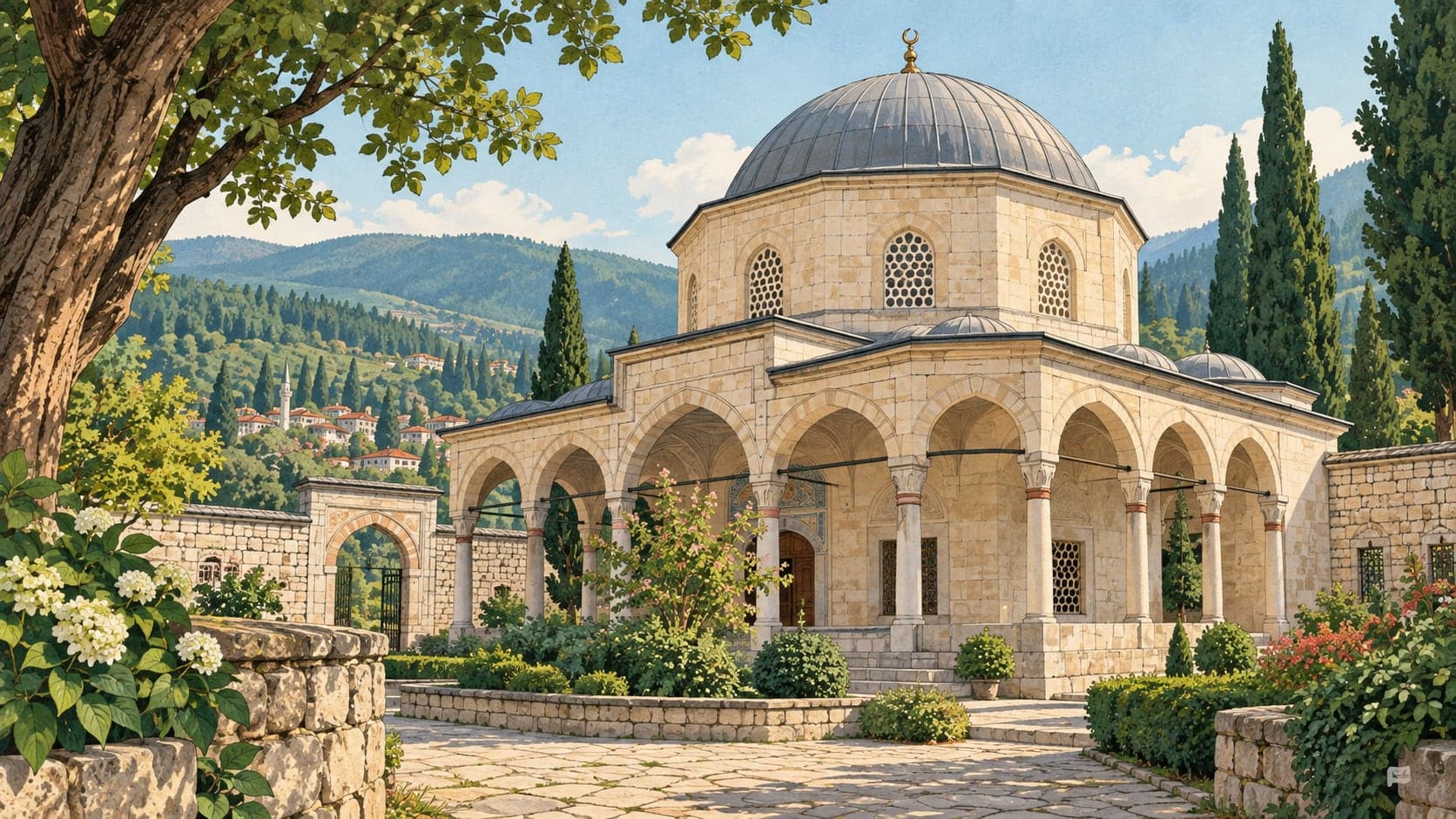
Akşemseddin was Mehmed II's teacher, and the sultan had this tomb built for him in Göynük after his death in 1459. It is cut stone, hexagonal in plan and domed. Each wall carries a rectangular window set in a pointed-arched niche, with a second row of pointed-arched windows filled with plaster grilles above. The doorway, in the northeast corner, sits in its own pointed-arched niche with the building inscription on its tympanum.
Inside are the cenotaphs of Akşemseddin and his sons. His own is walnut, carved in relief with inscriptions, and is a good piece of Ottoman woodwork in its own right.
The ministry's account of the man is worth knowing before you go, because the tomb is a place of pilgrimage as much as a monument. His full name was Muhammed Şemsettin bin Hamza, and he was known as Akseyh. He was born in Damascus in 1390, memorised the Qur'an young, and came to Anatolia with his father at seven, settling at Kavak near Samsun. After his father's death he completed a training in the religious sciences and in medicine, and became a professor at the Osmancık medrese. Those who saw how he lived advised him to go to Hacı Bayram Veli in Ankara, and he gave up his teaching post to do so.
The ministry describes him as a scholar, a skilled physician and a saint, and calls him the spiritual conqueror of İstanbul. Its page also repeats a tradition in which he is asked how he knew when the city would fall and answers that he and Hızır had worked the date out through a hidden knowledge, and that he saw Hızır enter the fortress with a company of saints on the day it was taken.