Guide
Hadrianapolis of Paphlagonia lies scattered over the land around a place called Viranşehir, three kilometres west of the centre of Eskipazar in Karabük. The ancient city takes in the villages of Budaklar, Büyükyaylalar, Çaylı and Beytarla, with the remains concentrated in the Hacı Ahmetler neighbourhood of Budaklar. North-west Anatolia's socio-economic structure, cultural history and archaeology in the classical period have not been much studied, and as a result the remains here are not widely known.
The city has more than one centre. Roman remains concentrate in one of them, a sanctuary with an aedicula worked into a rock face; beyond that the Roman architecture on the site is limited. Early Byzantine remains, by contrast, are dense. Three early Byzantine churches stand within the city, two of them opened by looters, and a cistern survives with its vaults still standing. Blocks from the Roman and Byzantine fabric of the city were reused as building material in various places around the district.
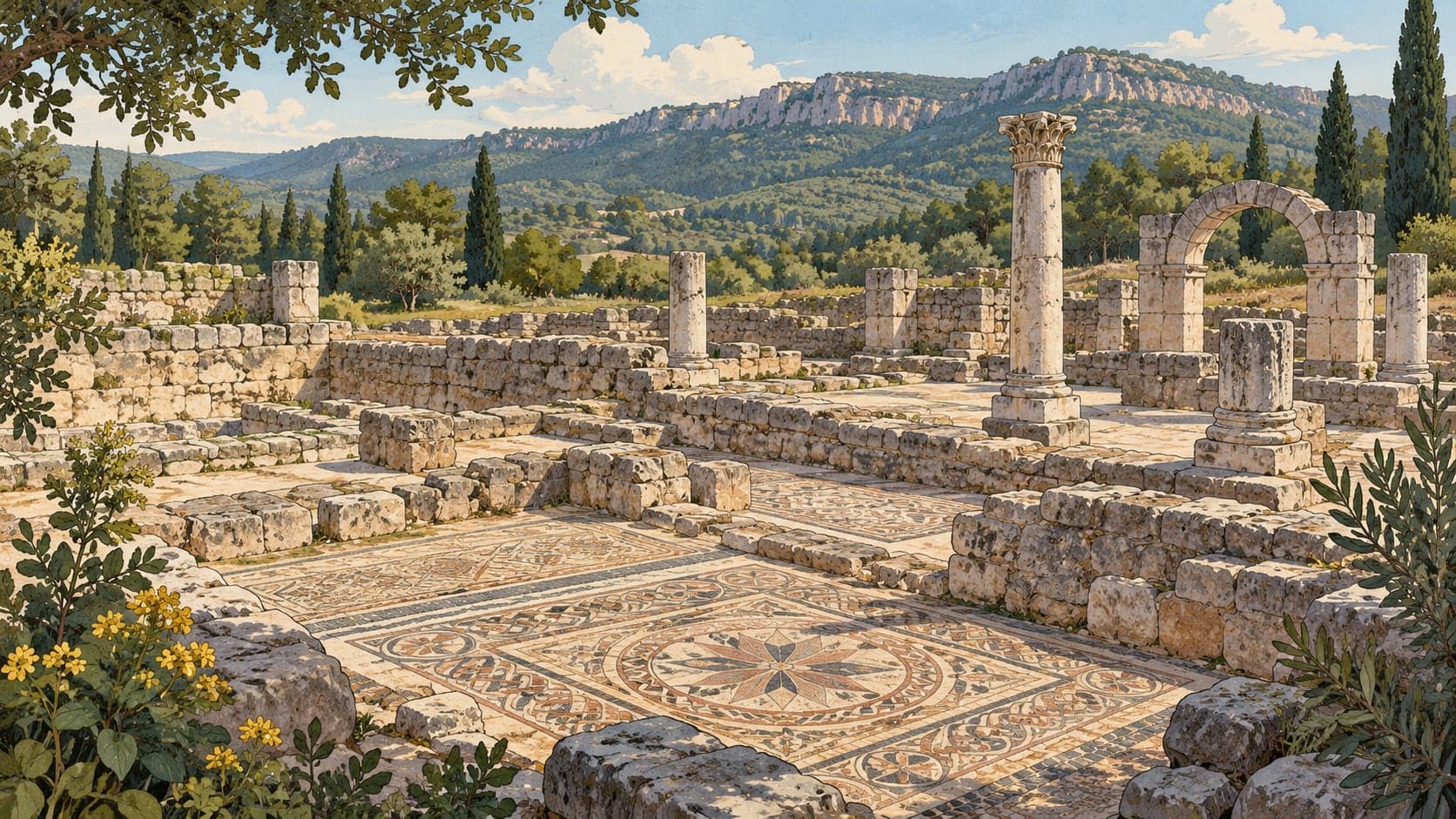
The ancient settlement concentrates above all around those three churches, all of which date from the 6th century AD. The earliest stands on a rise at the edge of the town, two kilometres west of Eskipazar. Work from 2003 onwards in this church, which measures 15 by 23.5 metres, uncovered four important mosaics with figures of women, men, animals and fruit. Their notable feature is that they carry the personifications of the four rivers of paradise in Christian belief — Phison, Geon, the Euphrates and the Tigris — together with their names, a composition the Ministry says has not yet been encountered anywhere else in Anatolia.
A votive inscription sits within the mosaic floor. It records the offering of Himerios, a loyal palace guard, and of Valentina, described in the highest terms of honour. Study of the name Himerios showed that he was a scholarios, an imperial guardsman, and that the name occurs philologically and prosopographically only in the 6th century AD; Himerios and Valentina are thought to have been married. The inscription has no verb, which suggests the rest of it survives somewhere. The mosaics were covered with a protective sheet in 2003 to shield them from the weather.
Closer examination of the church turned up two more texts. On the outer face of two stones in the lowest course of the atrium wall is a Greek inscription of at least ten lines; although it was struck out in a damnatio memoriae, the letters can still be made out. And set into the floor at the church door is a marble inscription in the form of a tabula ansata recording that Iordannes, whose memory is among the saints, lies here.