Guide
Where the museum is depends on which source you read. The provincial directorate states that since a rearrangement in 2019 the collection has been displayed inside Kayseri Castle. The Wikipedia article describes the building on Kışla Avenue in the Gültepe quarter of Melikgazi, begun in 1965 and opened on 26 June 1969. Both agree that the works are shown in order of date.
Museum work in Kayseri goes back a long way. Under a circular sent to the provinces by Osman Hamdi Bey, asking that the most important movable antiquities be sent to İstanbul and the rest gathered where they could be kept safe, a great many works collected around the city were put in a room of the Kayseri lycée.
During a visit in 1928 the minister of education, Esat Bey, saw those works and discussed founding a museum with the governor, Fuat Bey. Through the governor's efforts the Hunat Hatun medrese was repaired, and by a decision of the provincial standing committee it began to serve officially as a museum on 1 March 1930, with Nuh Mehmet Turancı as director. It worked as a storage museum until 1937; once the works had been classified by date and by scholarly criteria it opened to the public in 1938, for an entrance fee of five kuruş.
In 1948 Professor Tahsin Özgüç began systematic excavation at Kültepe, the site of Kanesh and its karum, twenty-two kilometres north-east of Kayseri. The finds from there, together with works bought and given from the surrounding country, grew more numerous by the day until room ran short in the halls and the stores — which is what led to the new museum building.
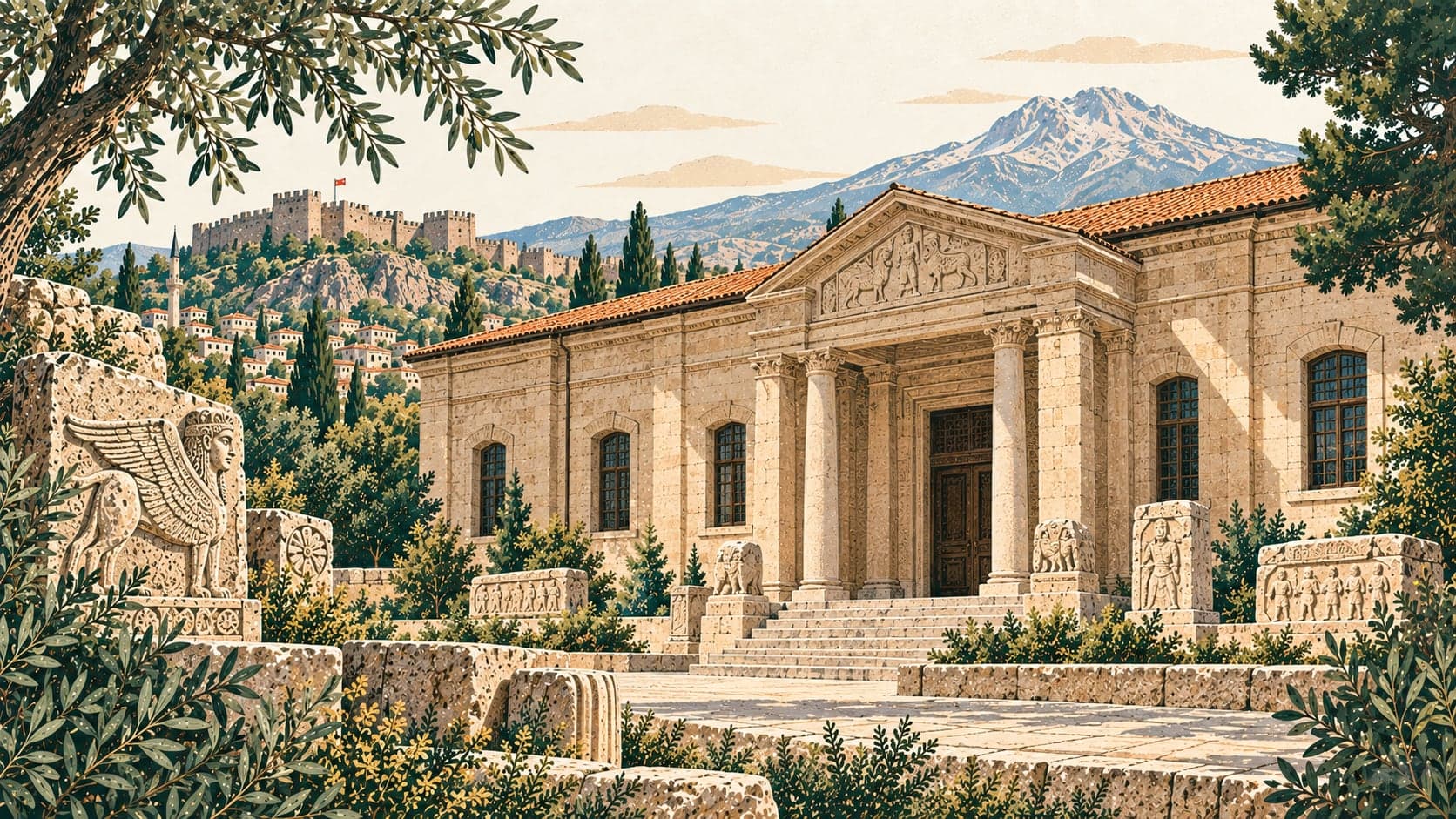
That building stands on a plot with a garden of 8,704 square metres and covers 580 square metres over two floors, with two halls, a corridor, workrooms and a store.
The first hall holds painted and plain ceramics and marble work of the Early Bronze Age along with material of the age of the Assyrian trading colonies, arranged by type: cuneiform tablets, round and trefoil-mouthed jugs, pots, vases, seals, drinking vessels and metal objects. The second holds work of the Phrygian, Hellenistic, Roman and Byzantine periods — pieces found in Kayseri, grave goods from the Beştepeler-Garipler tumulus, the Kayseri Herakles sarcophagus and funerary urns.
In the garden stand marble statues, grave stelae and sarcophagi of the Hellenistic, Roman and Byzantine periods, together with large terracotta storage jars. The collection also holds 107 anonymous Byzantine folles, three Anatolian Seljuk ceramic lamps and five Hittite cuneiform tablets.