Guide
The mosque stands in the Çöplü quarter of central Çorum. It is thought to have been built in the reign of the Seljuk sultan Alaaddin Keykubad III by Hayrettin, a freedman of his. What stands now is the result of major repairs.
Some of the complex is gone. The timber medreses on the north and east sides of the courtyard, and the masonry library built by Hacı Hasan Paşa, were demolished in the years after the Republic was declared and have not survived.
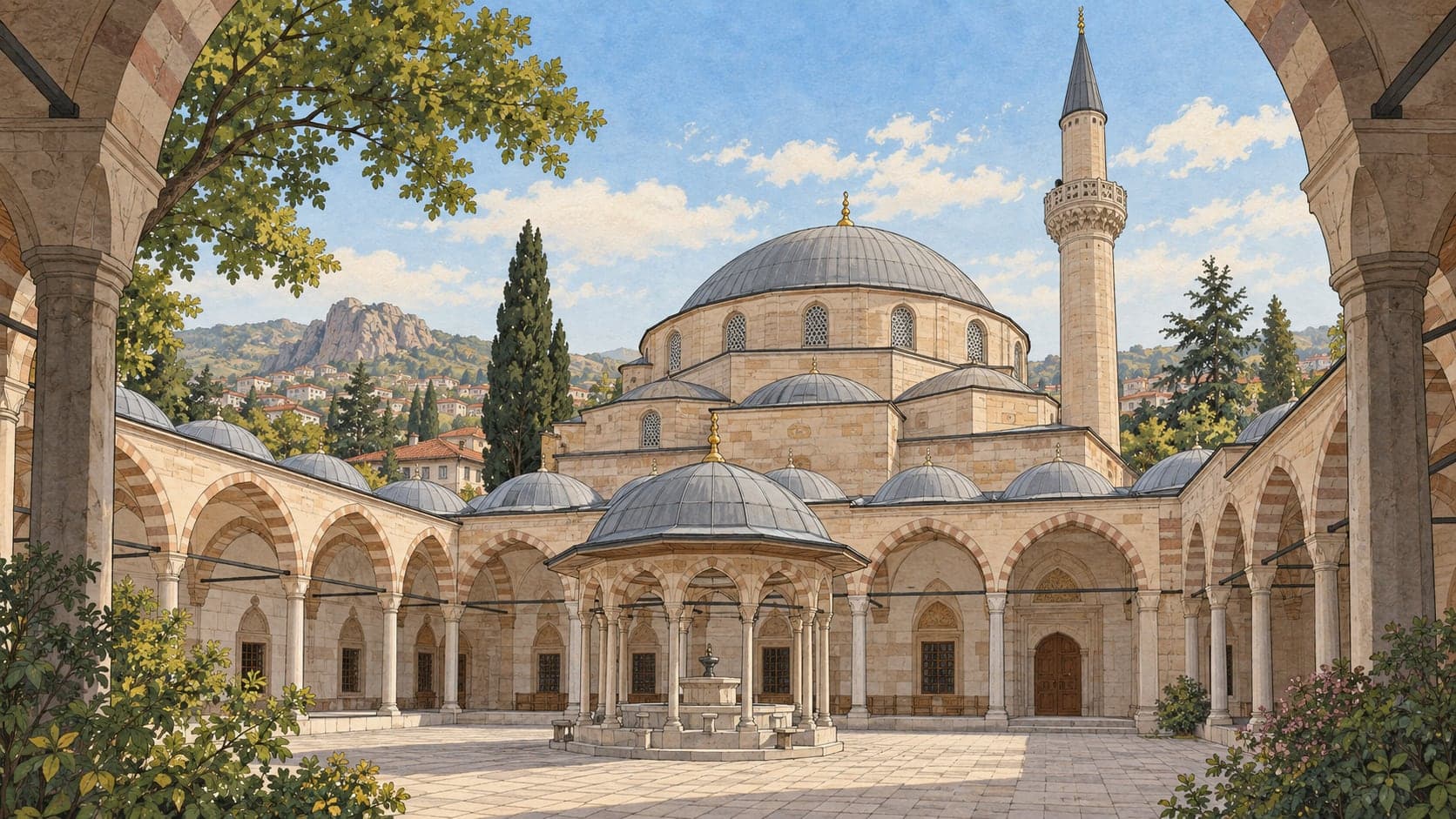
The courtyard is entered today from the east, west and north. In the part of it by the north entrance stands an octagonal ablution fountain: marble, with a fourteen-sided basin and wide eaves, covered by a dome within and a low cap without, resting on eight wooden columns. The inscription on its qibla side records that it was built in 1758 as the charitable work of a man named Abdurrahman. Its dome is painted, and it was repaired by the Directorate General of Foundations in 1990.
The mosque is a rectangular prayer hall under a large lath-and-plaster dome at the centre, with a porch closed on three sides. The east and west doors lead into the prayer hall and the north door into the porch, and all three have a canopy above — the northern one cross-vaulted, the others with wooden ceilings. The porch has two floors, the first flat-ceilinged and the second under five domes, and the wooden ceilings of both are decorated with lath-work lozenge motifs and an ornamental centrepiece.
A portal leads from the porch into the prayer hall. Its central section is domed and the rest has wooden ceilings; the dome is decorated with inscriptions and compositions of plant and geometric motifs and rests on twelve wooden columns tied to one another by depressed arches. The minbar matters a great deal in art-historical terms: made of ebony and painted in later years, it has been repaired over time but keeps its original character to a large degree.