Guide
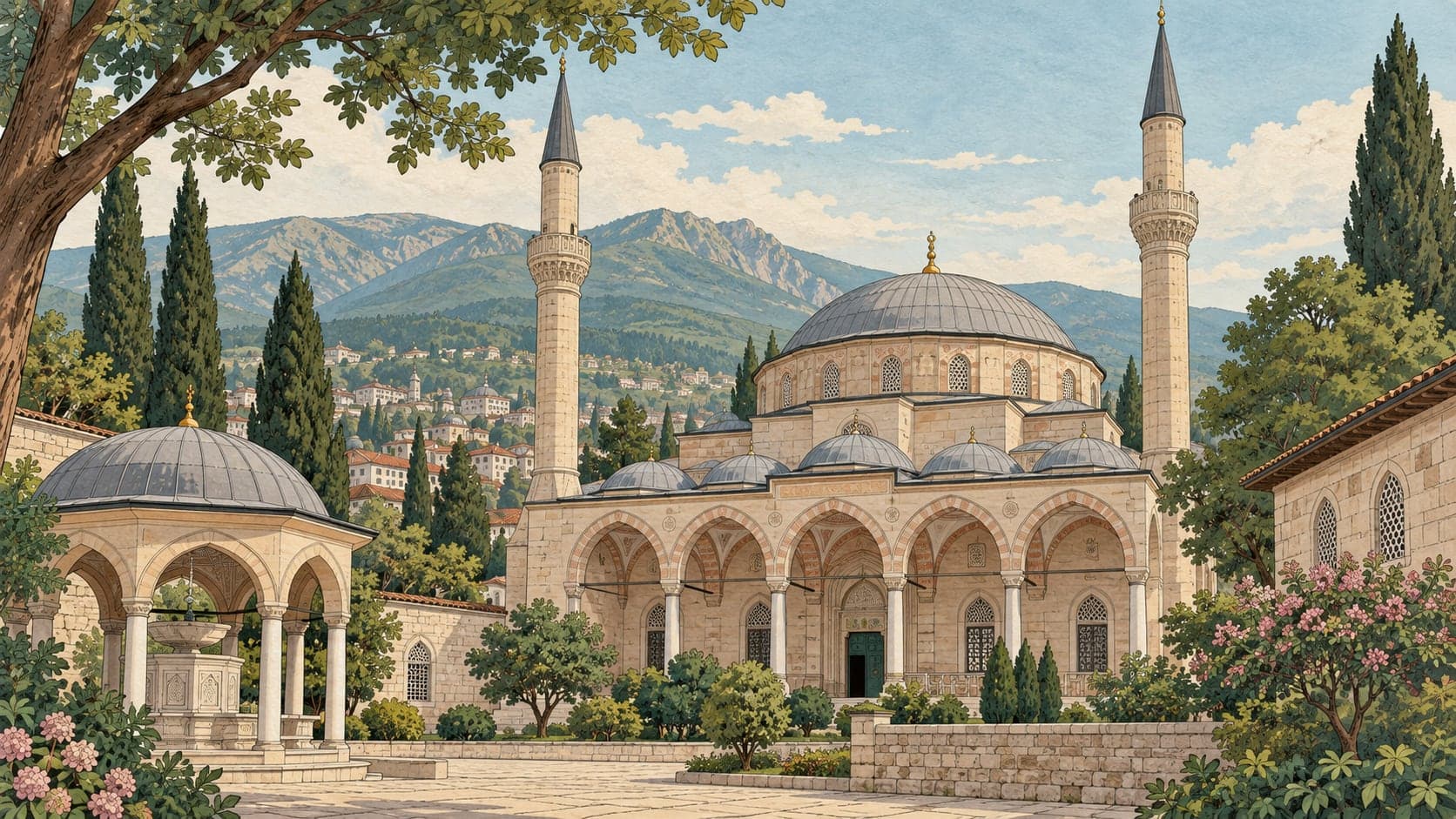
The Muradiye Mosque is the last of the mosques built in Bursa in the name of an Ottoman sultan. The stone and brick work of its outer face, its wooden door made in the kündekari manner, and the İznik tiles and painted ceiling decoration inside give it its place in the history of art.
It is the main building of the Muradiye complex, one of the six components of the world heritage site inscribed by UNESCO in 2014 as Bursa and Cumalıkızık: the Birth of the Ottoman Empire, the 998th site on the list. That inscription brought the mosque a good deal more attention.
According to the inscription over the main door, Sultan Murad II began the building in 828 of the Hijri calendar, 1425, and it was finished in 830, 1426. The inscription names the sultan as the son of Mehmed, son of Bayezid Han, and gives the months of Receb and Muharrem for the start and the completion. The architect is not known for certain.
The mihrab was damaged in a fire early in the eighteenth century and rebuilt in a rococo manner. The original minbar was also ruined by fire and replaced with one made in 1897. The western of the two minarets fell in the Bursa earthquake of 1855 and was rebuilt in 1904, and during repairs early in the twentieth century a window in each of the east and west wings was turned into a door.
The mosque was restored between 2013 and 2014 by the Bursa metropolitan municipality and the regional directorate of foundations. The damaged parts of the lead roof were renewed, cement was stripped from the inner and outer faces, cracks in the main and side domes were closed, some 160 square metres inside the mosque were rendered with horasan mortar, the porch was put in order and the entrance door was overhauled.
Built of brick and rubble stone, the Muradiye Mosque belongs to the type with side rooms flanking the prayer hall. In front of it is a porch of five bays, its arcade faced with geometric patterns laid in brick and with sky-blue star-shaped tiles. Two lightning marks in blue tile stand to the right of the entrance, taken to stand for Murad II as a sultan who struck his enemies like lightning. The wooden entrance door is made in the kündekari technique, fitted together without nails or glue.