Guide
Three buildings have stood on this ground. The first, raised by the emperor Constantius in 360, was called the Megale Ekklesia, the Great Church; the name Hagia Sophia, Holy Wisdom, came into use in the fifth century. That first church and the one Theodosius II put up in its place in 415 both came down in riots.
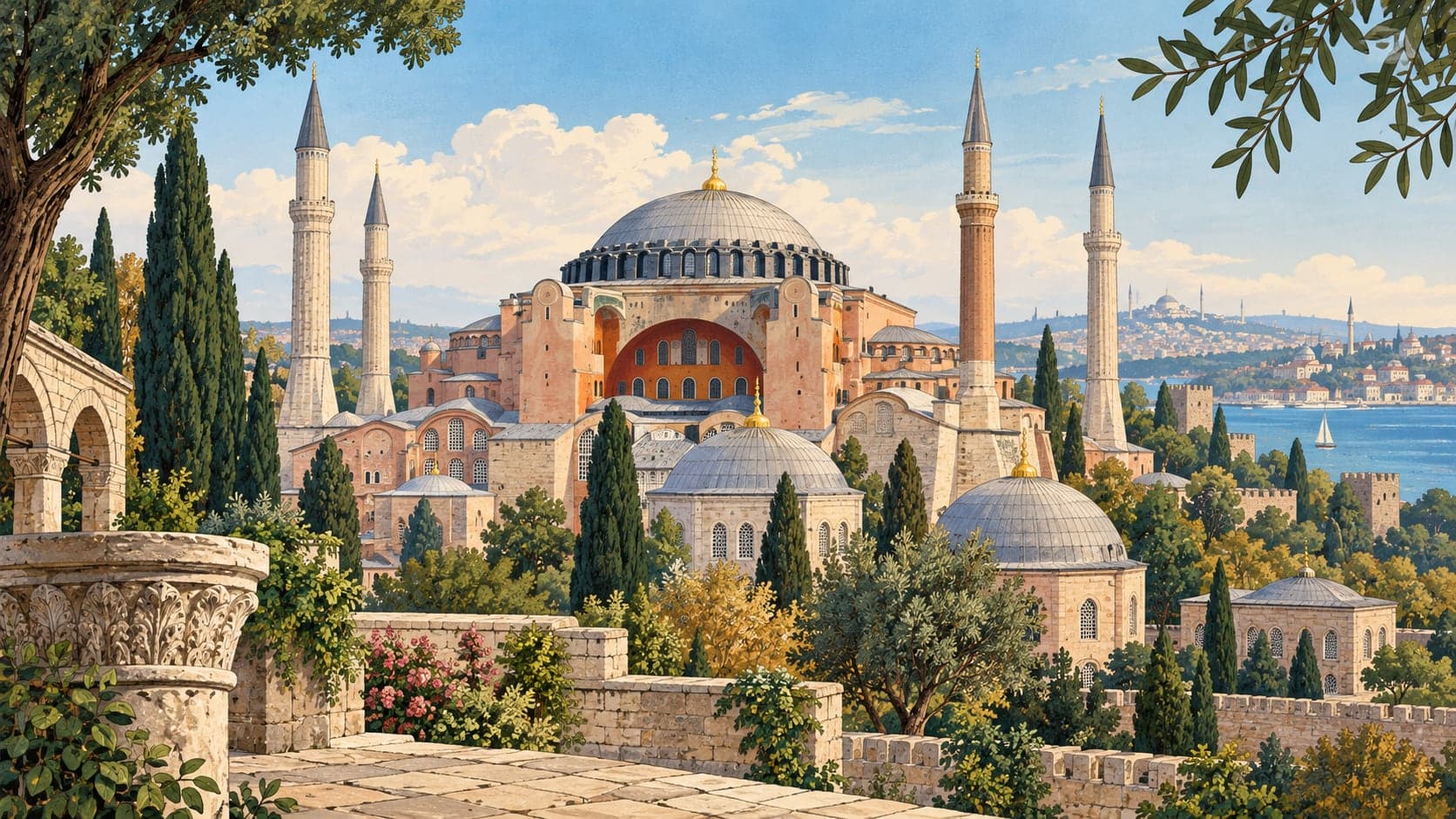
What stands now is Justinian's. He gave the work to two architects, Anthemios of Tralles and Isidoros of Miletos, and the records say that a hundred architects worked under them, each with a hundred workers, finishing in five years and ten months. It served as a church for 916 years. After Mehmed II took the city in 1453 it was made a mosque, strengthened and kept, and it went on as one through the Ottoman centuries.
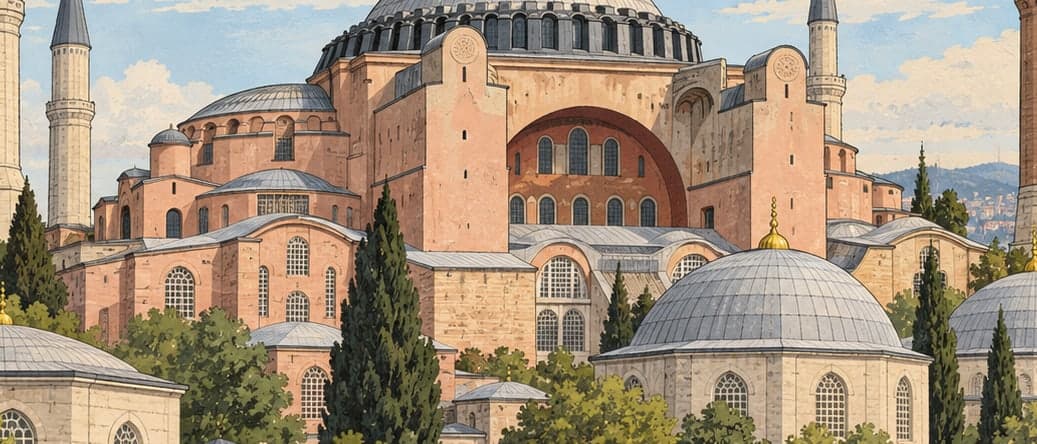
Those centuries left their own layers. Mihrabs, a minbar, galleries for the müezzins, a preaching pulpit and screened enclosures were added inside during the sixteenth and seventeenth. Outside, minarets went up at different dates, and a medrese, a primary school, a timekeeper's room, an ablution fountain, public fountains, sundials and a room for the board of trustees turned the building into a complex. It became a museum in 1934, remained one until 2020, and then returned to use as a mosque.
The dome is what the architecture turns on: larger than was usual and dominating the space beneath it. Marble, stone and brick were used throughout, and for the dome the builders had light, strong bricks made specially so that it would hold in earthquakes. During the repairs carried out between 1847 and 1849 by the Swiss Fossati brothers, on the order of Sultan Abdülmecid, the calligrapher Kazasker Mustafa İzzet Efendi wrote the thirty-fifth verse of the Surat an-Nur across the 11.3-metre circle at the centre of the main dome.
The mosaics belong to several periods, some figured and some not. The oldest to survive are the unfigured ones in the narthex; the figured ones are thought to have been taken down during the iconoclast period, and the apse mosaic is the first to have been made after that period ended in 843. Others survive in the gallery, on the tympanum wall, in the narthex, at the vestibule entrance and in the rooms off it.