Guide
The Basilica Cistern is an enclosed water cistern built in 526–27, in the reign of the emperor Justinian, to meet the water needs of İstanbul. It stands on Soğukçeşme Sokağı south-west of Hagia Sophia, beside the Milion, the stone taken in the Byzantine empire as the zero point of the world, in the same district as the Binbirdirek and Şerefiye cisterns and the baths of Achilles and Zeuxippus.
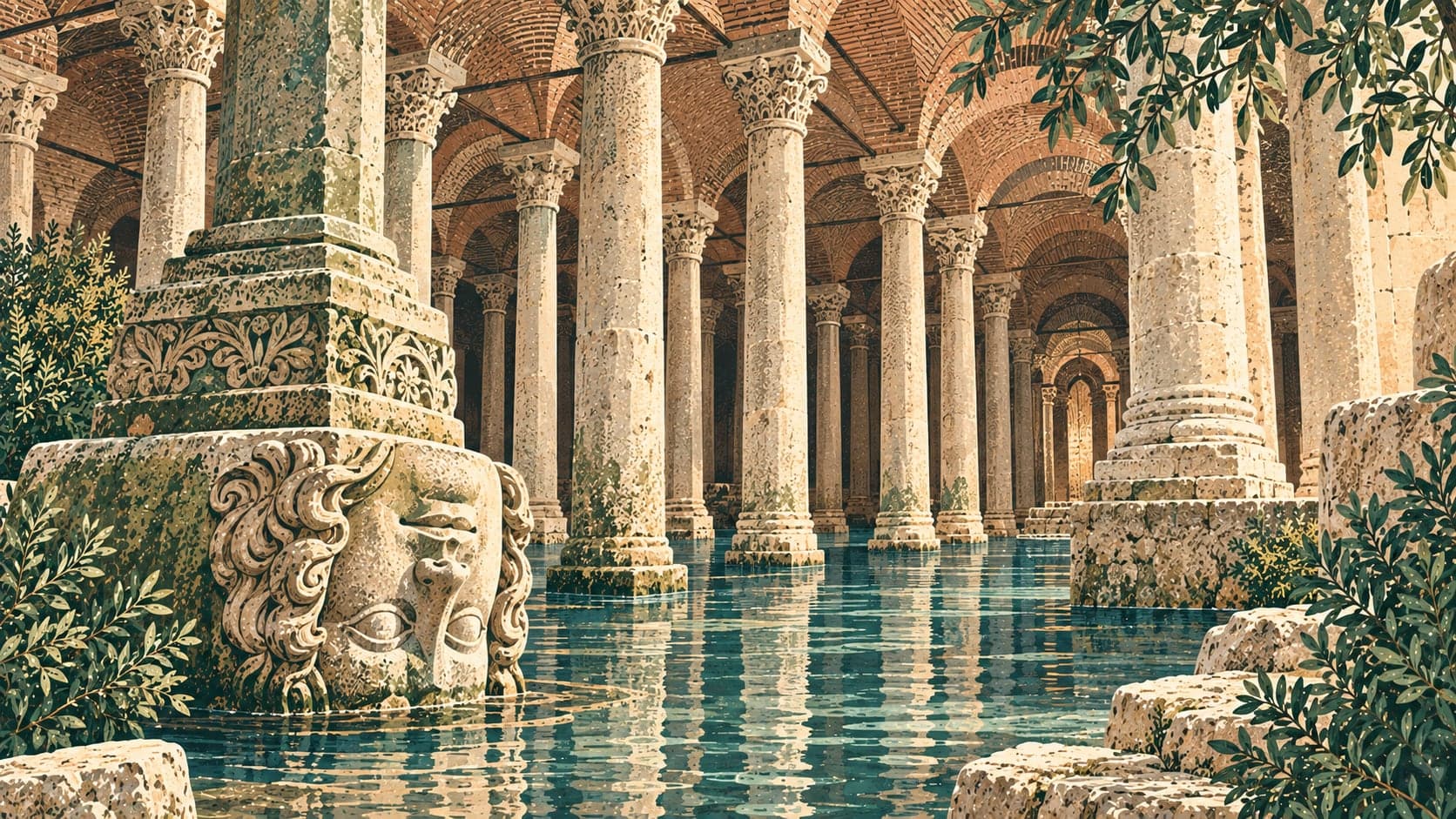
It is known by two names in Turkish: Yerebatan Sarayı, the sunken palace, for the many marble columns rising out of the water, and the Basilica Cistern, because a basilica once stood above it.
Built for Justinian I, the cistern was connected to the Hadrianic water lines that served the areas between the first and second hills of the city. After the Ottoman conquest it served as a water distribution centre for the area around Sarayburnu and Bahçe Kapısı; once the Ottomans built their own water works in the city and repaired the old Byzantine conduits, that function was partly changed. Its name passed to the palace, to the grand vizier's stables, to the street and to the quarter, and it kept its presence and its importance through the quarter that grew over it and through Yerebatan Caddesi, which joins Cağaloğlu to Divanyolu and the square of Hagia Sophia.
The cistern is a rectangular structure of brick resting on rock. Its dimensions were first taken during the First World War by the German archaeologist Eckhard Unger, who gave them as 138 by 64.6 metres.
It is thought to have been built to serve the monumental building called the Basilica Stoa, believed to have stood above it, and the water needs of the district. Excavation in the courtyard of the imperial stoa was carried down to bedrock to form the storage part of a cistern; the spaces between the rows of columns forming that storage were joined to one another by arches and roofed with vaults. The cistern holds about 100,000 tons of water.
Three hundred and thirty-six columns carry the brick vaulting above: twenty-eight rows east to west and twelve north to south. Forty-one columns are no longer visible, lying within the area closed off in the reign of Abdülhamid II on the north-west side. The building holds decorated columns, Corinthian capitals and the inverted Medusa heads.