Guide
İdebessos is a Lycian settlement north of the centre of Kumluca, near the Kozağacı locality in the Karacaören neighbourhood — seven kilometres north of Akalissos and north-west of Kormos. The "ss" ending of the name suggests an older settlement here than the visible ruins imply, but the earliest actual historical information dates only from the period of the Lycian League. Ancient writers say little about the place; what is known is that it formed a sympoliteia, a political union, with Akalissos and Kormos, and that Akalissos led it. After the Roman period the city took the name Edebessos, and in Christian times it appears within the metropolitanate of Myra as a bishopric called Lebissos or Lemissos.
The settlement is small, built on a narrow ridge running north to south parallel to Bey Dağı and commanding the Alakır stream. Part of the remains lie on the flat ground facing west and part on both slopes of a steep hill descending to the east, protected by a wall. Roman and Byzantine work can both be read in the wall itself.
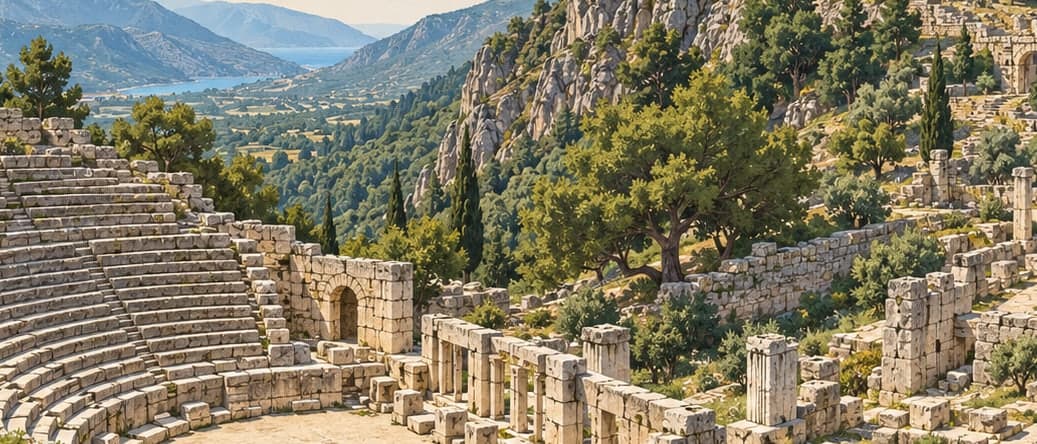
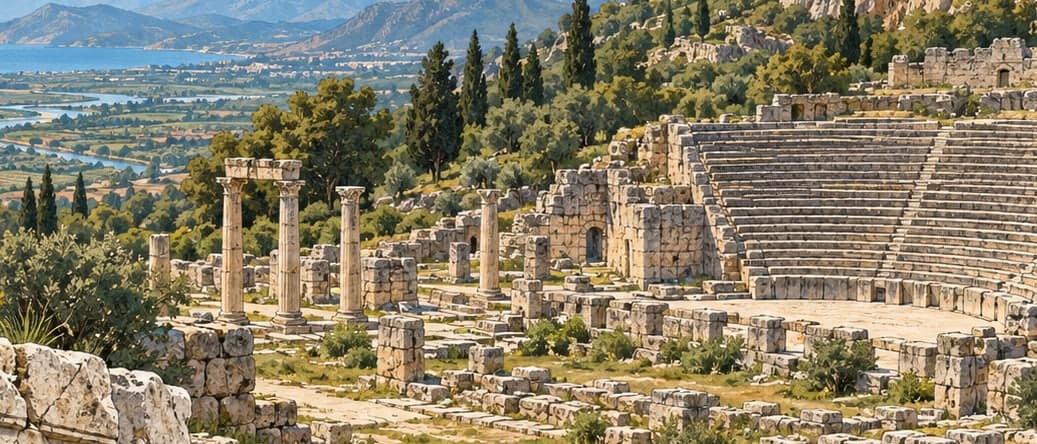
West of the wall is a small theatre facing toward the mountain. About thirty metres across and thought to have held 600 to 700 people, it keeps five rows of seating in the cavea and no trace at all of a stage building; its plan dates it to the Hellenistic period. Roughly seventy metres north of it stands a small bath in the Lycian tradition, and further north again a small basilica of the Middle Ages, now badly damaged. The walls can still be followed around the acropolis to the south-east, where they enclose the houses, public buildings and monumental tombs behind the theatre in a defensible quarter.
The tombs are what a visitor counts. Sarcophagi stand both inside and outside the walls — at least fifty of them, all Roman. The most striking are the groups of three set on U-shaped exedrae. Most are plain, some carrying a tabula ansata, and the decoration on their sides runs to Pisidian motifs with and without spears.