Guide
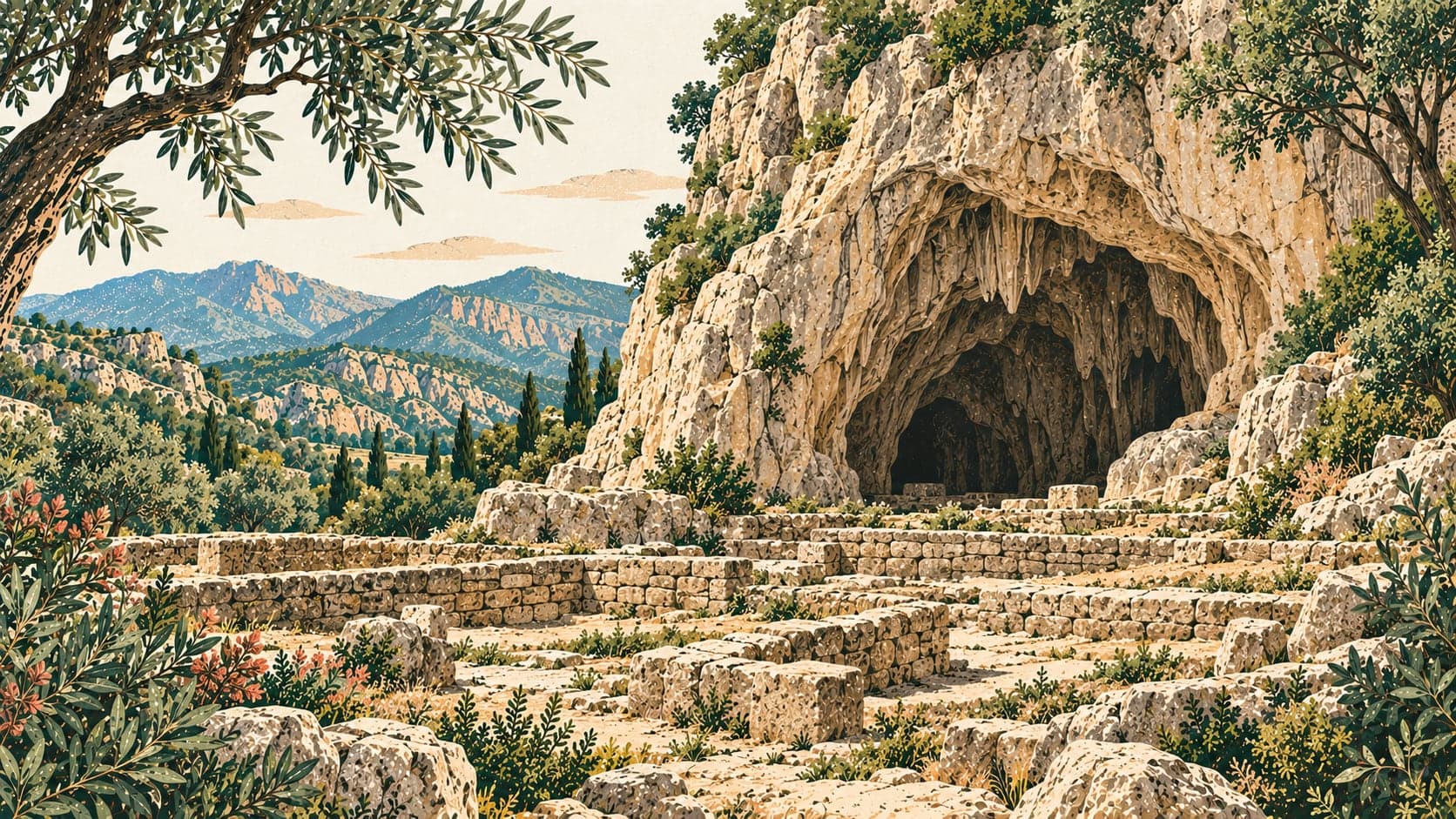
Karain is one of the largest natural caves in Türkiye and the largest in which people have lived. It stands 430 to 450 metres above sea level within the Yağca quarter, thirty kilometres north-west of Antalya and five or six kilometres off the old Antalya–Burdur road; the turning is at the Karain sign at the thirteenth kilometre, and the cave is twenty-seven kilometres from the city. There is a charge to enter.
The cave is karstic, worn naturally into Çadır Tepesi on the steep limestone slopes of Çam Dağı, within Cretaceous limestones of two periods. Kılıç Kökten found it in 1946, and his work on its formation showed it to have come about where three rocks join, connected by narrow passages.
Excavation has gone on since 1946 and still continues. It has established that the area was lived in as much as 150,000 to 200,000 years ago. The cave was occupied continuously from the Lower Palaeolithic through the Middle and Upper Palaeolithic, the Neolithic, the Chalcolithic, the Early Bronze Age, the second millennium BC and the classical period, and as a result it holds a thick cultural deposit reaching about eleven metres. The longest and most important occupation is the Palaeolithic one. Use in classical times was largely as a votive cave, a shrine: there are Greek inscriptions and niches on the brow of the cave and on its outer walls. In the excavations directed by I. Yalçınkaya a small quantity of Early Bronze Age pottery was also found, and the cave is said to have been occupied seasonally in that period.
Karain matters beyond its own region. Most known Palaeolithic caves in the world represent a single period, while Karain shows unbroken stratification through the Lower, Middle and Upper Palaeolithic, and the evidence from those layers bears in particular on the connections and migration routes between Europe and the Near East. The oldest human remains known in Anatolia have come from here, and the portable art found in the cave is among the earliest work of Anatolian art. The plant and animal remains it has yielded also do much to reconstruct the ancient environment of the western Mediterranean, and together with the caves around it Karain is proposed for the World Heritage List as a mixed site for both its natural and its cultural qualities. It was declared a first-degree archaeological and natural conservation site in 1997. There are traces of bats living in it.
One find stands out. A bone tool recovered from the E chamber in the 2011 season was made from the leg bone of a large animal, a hippopotamus or an elephant. It came from geological unit VI, which is dated older than 400,000 years and is known to hold a fauna including hippopotamus and elephant. Described as a denticulate tool, it is dated within the Lower Palaeolithic to between 500,000 and 600,000 years ago and has been characterised as the first and therefore the oldest known tool of that period. It carries no burning or breakage, and measures 14.2 centimetres long, 7 wide and 2.2 thick, weighing 209.34 grams.
Bone tools have come out of the cave in quantity. By the end of the 2013 season 395 had been recovered from the B chamber, and typological study of those that could be identified set them in seven groups: bark extractors, awls, needles, worked bone and antler, spoons, spatulas and points. Awls dominate, with 222 pieces counting fragments, or 56 per cent, followed by worked bone and antler at 122 pieces, spatulas at 18, needles at 12, points at 11, bark extractors at 8 and spoons at 2. Of the bone itself, 156 pieces could be identified to species and 239 could not; among those identified were 29 limb bones of the even-toed Artiodactyla — sheep, goat, deer, cattle and pig.
The finds from the excavations are displayed in the Karain Museum immediately beside the cave and in the prehistoric section of the Antalya Museum.