Guide
Karkamis is one of the key sites of Near Eastern archaeology, on the west bank of the Euphrates near the district town of the same name in Gaziantep, directly on the Türkiye-Syria border. In the second millennium BC it stood at a junction of the routes running from Anatolia down to Mesopotamia and Egypt, and that position explains its long history. The first documents mentioning kings of Karkamis appear around 1700 BC. Around 1650 the Hittite king Hattusili I took the city and the towns around it to secure the road into northern Syria; it later came under Mitanni control and was returned to the Hittites under Suppiluliuma I, after which it was governed by vassal kings, most of them of the Hittite royal line, who held the empire's Syrian territories. When the Hittite empire fell at the start of the twelfth century BC the city became the centre of one of the many new Late Hittite kingdoms. It was made tributary during the Syrian campaign of the Assyrian king Ashurnasirpal II, and in 717 BC Sargon II burned and destroyed it and annexed it to Assyria.
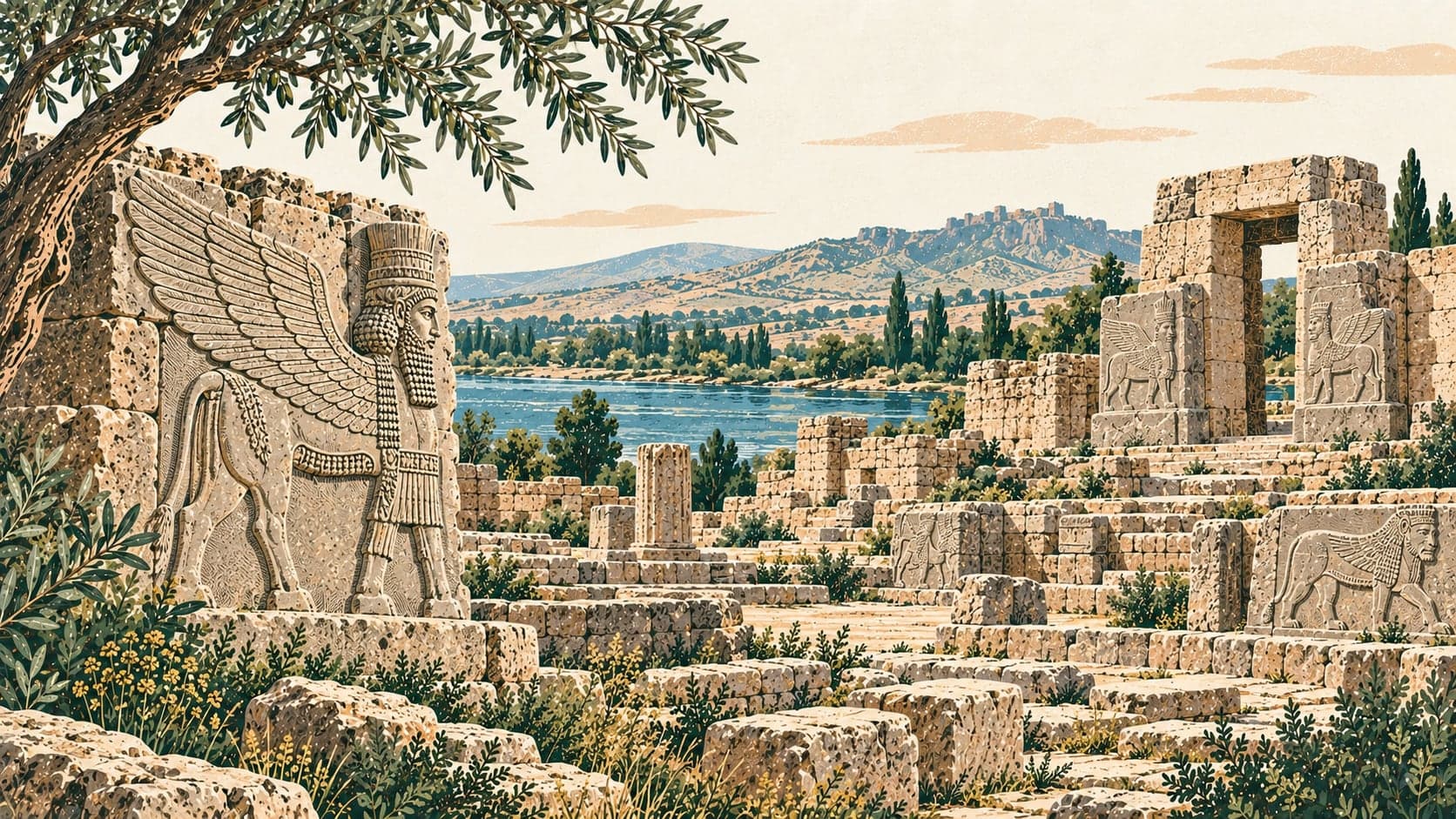
George Smith identified the ruins near Jerablus as Karkamis in 1876, and the British Museum excavated here in 1878-81, 1911-14 and 1919-20, with Hogarth, Lawrence, Campbell-Thompson and Woolley among those who worked on it. On the citadel mound, alongside prehistoric material, two main settlement phases were identified, Early and Late Hittite. The city is rectangular and falls into three parts — outer town, inner town and citadel — with the administrative and religious buildings at its core. Those buildings were faced with orthostats of black basalt and white limestone carved in the Hittite-Assyrian manner, and most of the reliefs found belong to the Late Hittite period. They show the goddess Kubaba and the procession held in her honour: soldiers, priests, figures carrying animals, princes armed with long straight swords, chariots, composite creatures and guardian animals — which together tell us a good deal about the dress, culture and daily life of the early first millennium BC.