Guide
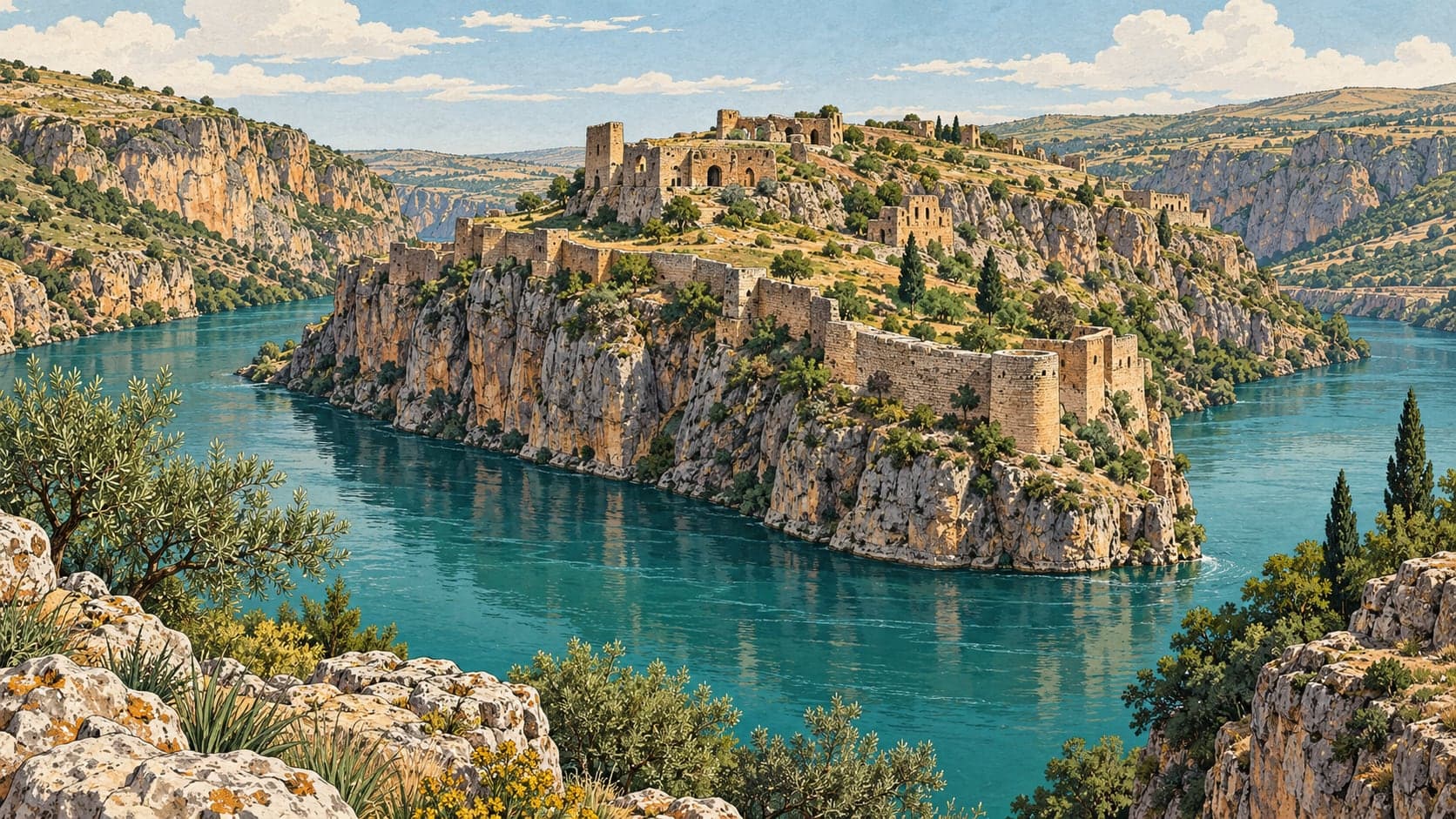
Rumkale stands on sheer rock at the point where the Merzimen stream meets the Euphrates, in the Yavuzeli district of Gaziantep. Since the reservoir filled, water surrounds it on three sides and it reads as a peninsula. Reaching it means taking a boat, either from Kasaba village, 25 kilometres from Yavuzeli, or from Halfeti on the Şanlıurfa side — there is no road approach, because the rock spur that once joined the castle to the land was cut into a ditch in the 12th century.
Its defences work in two layers. The first is natural: the rock on the east, north and west was cut vertically to make a cliff that functions as a wall. The second is built on top of it, a curtain of hard limestone ashlar. Seven rectangular towers stand along the north and east walls, and the north wall carries a run of arrow slits. The fortress itself has gone under a long list of names over the centuries: Kale-i Zerrin, the golden castle; Kal-at el Müslimin; Kal-at el Rum; Ranculat; Hromklay; Kal-a Rhomayta; and Şitamrat.
Inside the walls, besides the towers and curtains, a visitor can make out the church of St Nerses, the monastery of Barşavma, a scatter of other building remains, water cisterns, a well and the ditch. The structures above ground are known to belong to the 12th to 14th centuries. Tradition holds that in the Roman period John, one of the apostles, came and settled at Rumkale and copied out the Gospel in a room cut from the rock. The castle passed to the Ottomans in 1516.