Guide
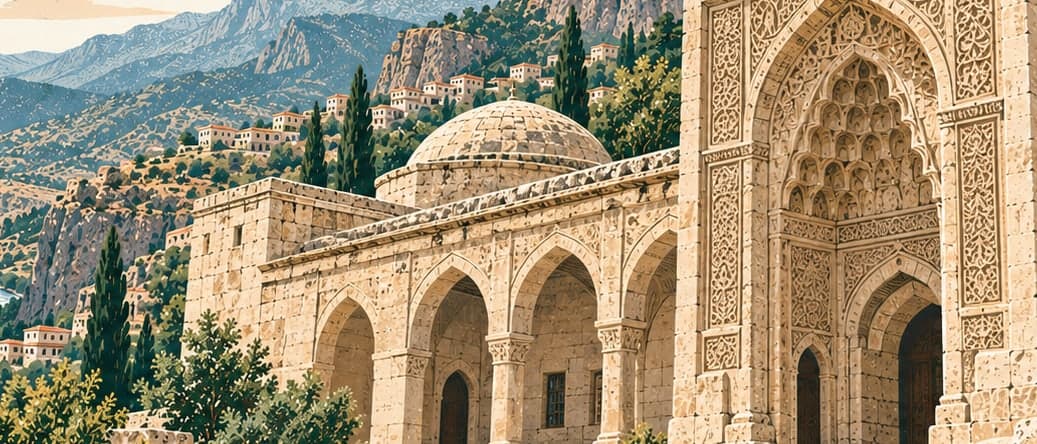
The Red Medrese stands in the Dağkapı quarter in the middle of the Cizre district of Şırnak, on the remains of the city wall to the west of the town. Most of it is laid in square red bricks, and it takes its name from that material. It was built together with the mosque and tomb on its southern side.
Though it has come down to us in a ruined state, the building has become bound up with the identity of Cizre. In 2007 the Directorate General of Foundations repaired and renewed it, and it was opened for use as a mosque and a Quran school.
It stands in an area holding other important buildings of various dates, among them the tomb of Noah, believed to have been built after the flood, and the tomb of al-Jazari, the medieval physicist and craftsman.
The medrese was built in the fourteenth century by Han Şeref Bey II in the time of the emirate of Cizre. It is thought to have been part of a complex he had built as a votive offering for the taking of the city, after he put an end to Akkoyunlu rule there.
The building is a complex bringing together a medrese, a mosque and a tomb in relation to one another. It is of the open-courtyard medrese type, rectangular in plan running north to south, with two iwans. The courtyard is ringed on all four sides by arcades; the southern side holds the mosque, the rooms of the head teacher and the tomb, and the other sides the rooms of the teachers and the students. The Kurdish scholar Molla Ahmed-i Cezirî is thought to have taught in this medrese.
From the triple arcade on the south of the courtyard a low-arched door leads into the mosque, and from a door in the southern wall of the mosque, reached by two steps, one passes into the tomb. Known as the tomb of Molla Ahmed Cezirî, it has two floors: the lower is the burial chamber, and the upper is said to have been used as a room for debate, where important meetings were held and religious questions argued out. Seven gravestones stand in the burial chamber. Among those whose inscriptions can be read, the name of Melayê Cizîrî does not appear, though the gravestone of Mîr İmadeddin bin Şeref el-Bohti is known among the people as his grave.