Guide
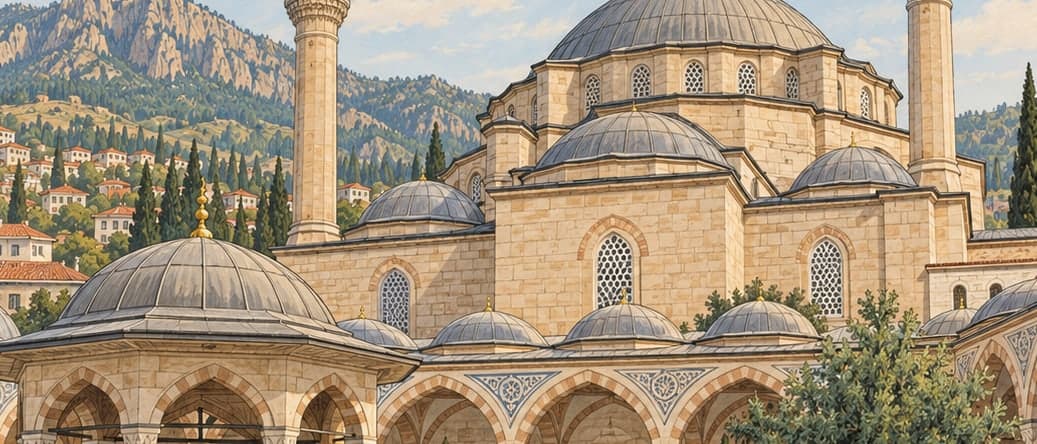
The Great Mosque of Manisa sits on the northern skirts of Spil Dağı, commanding the city, and the complex takes in the mosque, a medrese, a tomb and, to the northeast, a bath. It was built in 1366 by İshak Çelebi, grandson of Saruhan Bey, who had it made by the architect Emet bin Osman, using roughly dressed stone, brick and some ancient architectural elements.
The mosque is a transverse rectangle covered by a single large dome resting on an octagonal pier system, with one minaret. Its minbar, made in the true kundekari technique, is one of the masterpieces of Turkish woodcarving of the beylik period — but note that the minbar door is not here; it is kept at the Manisa Museum. The medrese, also known as the Fethiye Medrese, adjoins the mosque on the west, has a single iwan and two storeys, and was built about ten years after the mosque by the same architect; it is the oldest medrese in the city, and a fountain stands on each side of its north-facing portal. The tomb is entered by a door opening in the south wall of the passage between the mosque and the medrese, and the four cenotaphs in it are thought to belong to İshak Çelebi and his family. The bath of the complex, known as the Çukur Hamam, is now in poor condition; the endowment deed shows that it was built to produce income for the complex.