Guide
The medrese stands in the centre of Merzifon, in the Camicedit quarter, beside the mosque that carries the same name, some forty-nine kilometres from the city of Amasya. It is also known as the Sultaniye Medrese.
It was built in 1414 — the inscription over the entrance, in a single line of three parts, was read by the scholar Gabriel in 1930 as the Hijri year 817, which falls in 1414 and 1415 — by order of the Ottoman sultan Mehmed I, and the work was carried out by Ebu Bekr b. Muhammed el-Müşeymeş. The Ministry's culture portal records that the sultan had it raised for Ebubekir Mehmet bin Hamza. Its first teacher was Ferîdüddîn-i Dîvânî, and it was repaired between 1418 and 1419 by Emin Onuroğlu Ali Bey.
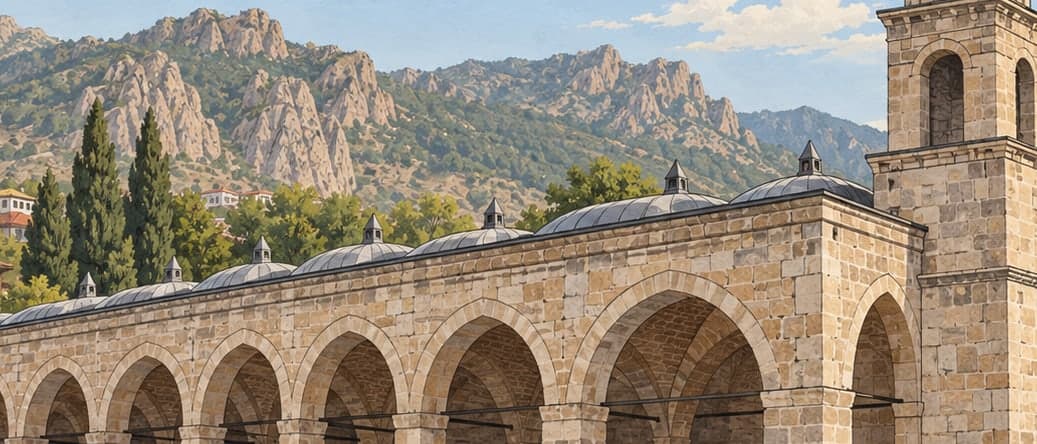
The plan follows the Seljuk model: a square building around an open courtyard with four iwans, built of cut stone, holding twenty cells.
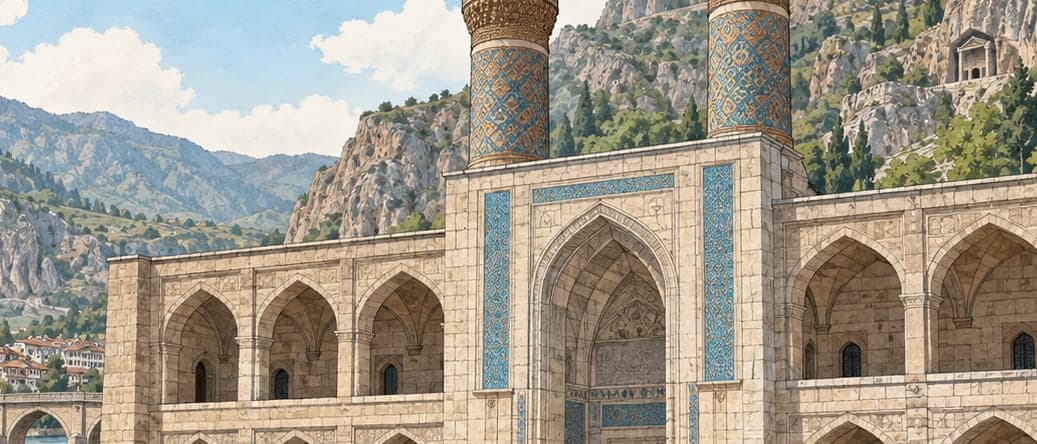
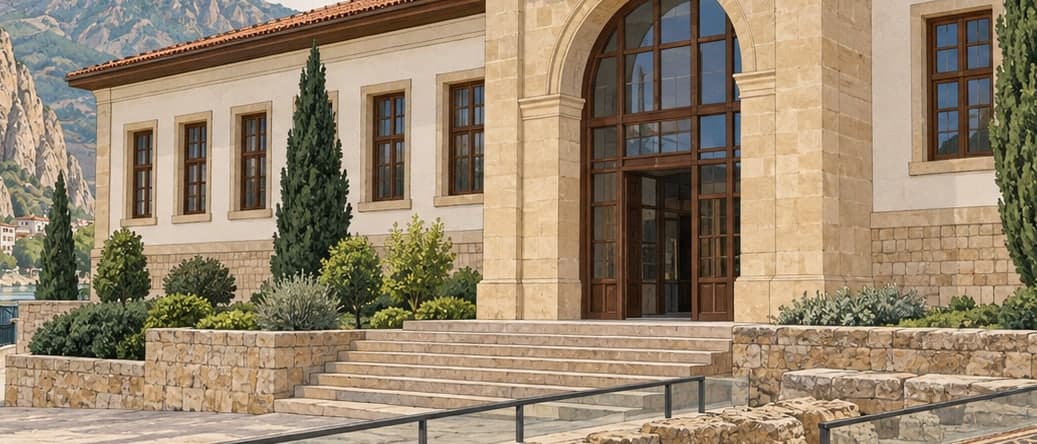
The portal is the show piece. It takes the form of an iwan and is ornamented with coloured cut stone and marble, the red and white laid in bands. The original leaves of the door are now in the Ankara Ethnography Museum; those in place today were made later by the municipality of Merzifon and do not resemble them.
Above the entrance rises a clock tower with a cylindrical brick shaft, carrying dials that face in four directions. It was added by Ziya Paşa, governor of Amasya; the culture portal gives the year as 1865 and the Wikipedia article as 1866.
The building has been put to many uses. In the 1950s it served as a children's and public library, as a municipal store and as a music school, and in later years as a wedding hall and a Quran school. Today it is a place for social and artistic activity.