Guide
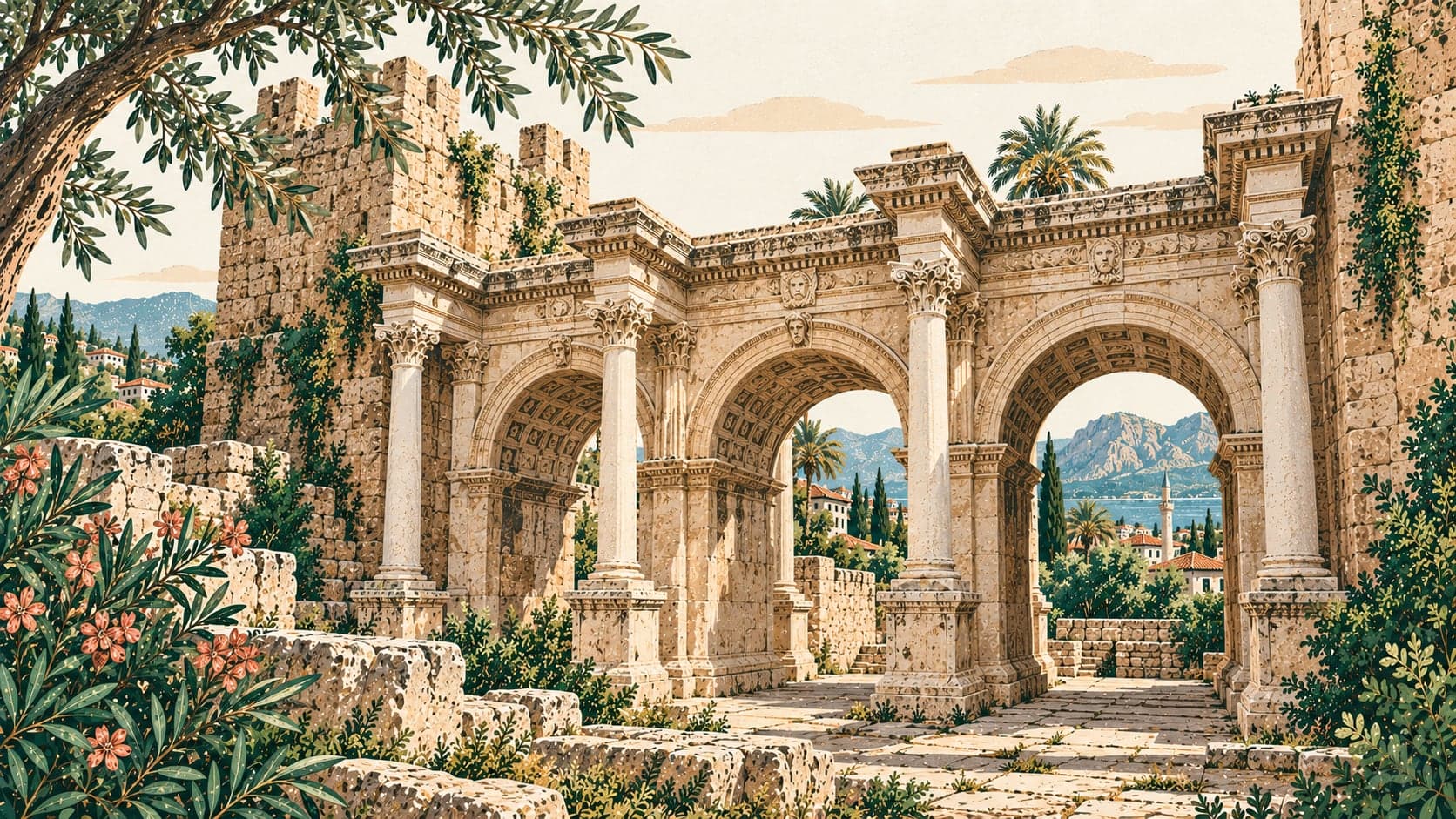
Hadrian's Gate, known locally as Üçkapılar, the Three Gates, is a monumental triumphal arch built into the wall ringing Antalya in the year 130, in honour of a visit by the Roman emperor Hadrian. It has three arched openings with four marble columns on each of its two faces, and a tower to either side. The upper storey has not survived.
The arch is made of two architectural parts, the gate and the towers, and both are symmetrical front and back. The gate is richly ornamented and patterned, worked in materials as difficult as marble; the towers, continuing the line of the walls, are of plain stone. In the reign of Alâeddin Keykubad I the existing tower was found too low, and six metres of small coursed stone were added on top of the western tower, bringing it to fifteen metres; with the addition the parapets of the original tower became two windows each, and an Ottoman inscription stands beneath them.
Today the wall runs on fifteen metres from the western tower and about fifty metres from the eastern one. The rest was pulled down in 1937 by the mayor Hüsnü Karakaş, on the grounds that Kaleiçi got no wind and was too hot.
The gate went unremarked for a long time. Travellers who visited Antalya in the modern period — Evliya Çelebi, or Corneille Le Bruyn — wrote about the city without mentioning it at all. The first account of it came from Francis Beaufort, commanding the British frigate HMS Frederickssteen, who called at the city in 1812. The fullest early description was by Lanckoroński, who visited in 1882 and gathered his detailed drawings and sketches in his work on the cities of Pamphylia and Pisidia. The traveller E. J. Davis records that the authorities tried in 1872 to reopen the closed passage, and that the attempt came to nothing because the owner of a house standing just inside the walls behind the entrance would not agree to have it demolished.
Excavation began in 1882 at the instance of the governor Turhan Paşa: the walls around the gate were pulled down and half of it was brought to light. The columns fell while the rest, still buried, was being dug out, and pyramid-shaped stone buttresses of coursed masonry were put in their place. Those buttresses were removed in the great restoration of 1959, which returned the lower storey to its original form with columns of white marble.
The setting has been reworked twice in recent years. In 2016 the municipality decided to lay out a green space in front of the north-east face for visitors to rest in, planned on the form of a sun, with planting beds in that shape, benches, narrow paths and ground lighting. In 2021 the south-west face, towards Kaleiçi, was paved in stone to match the old city, with balustrades of Alanya marble set along the kerbs, so that the surroundings were brought into keeping with the monument and foot passage opened on both sides of the gate.